| Previous day | 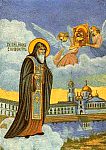
|
Next day |
| Old Style
May 27
|
Tuesday |
New Style
June 9
|
|
2nd Week after Pentecost.
Tone 8.
Fast of the Holy Apostles. |
 Fish, wine and oil allowed.
|
 Hieromartyr Therapontus, priest, of Sardis (3rd c.).
  Translation of the relics of St. Nilus of Stolobny (1667).
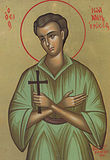
  St. John the Russian, confessor, whose relics are on the island of Euboea (1730).
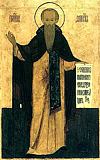
Virgin-martyr Theodora and Martyr Didymus the Soldier, of Alexandria (304). St. Therapont, abbot, of Belozersk and Mozhaisk (1426). Translation of the relics (1472) of Sts. Cyprian, Photius, and Jonah, metropolitans of Kiev (1472). St. Therapontus, monk of Monza Monastery (Galich) (1597). St. Lazarus the Clarivoyant, hieroschemamonk of Pskov Caves Monastery (1824).
Viliya Icon of the Most Holy Theotokos.
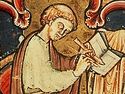
Martyr Julius the Veteran, at Dorostolum in Moesia (ca. 302). St. Bede the Venerable, hieromonk and chronicler, of Wearmouth and Jarrow (735). St. Michael of Parekhi, Georgia (8th c.-9th c.). St. Basil of Khakhuli, son of King Bagrat III of Georgia (11th c.). St. Melangell, virgin hermitess, of Pennant, Wales (ca. 590). Hieromartyr Helladius, bishop (6th c.-7th c.). New Hieromartyr Therapontus, priest, of Sofia (Bulgaria) (1555). Synaxis of the Saints of Carpatho-Russia.
Repose of Blessed Zina of Vetluga (1960).
Thoughts for Each Day of the Year
According to the Daily Church Readings from the Word of God
By St. Theophan the Recluse

Tuesday. [Rom. 4:4–12; Matt. 7:15–21]
Beware of false prophets (Matt. 7:15). From the beginning of Christianity and to this day there has not been a time when this warning was not applicable. The Lord did not indicate exactly which false prophets to beware of, for how could they be pinpointed? They change like fashions and are continually generating more like them. They always appear in sheep’s clothing, with a likeness of good will in their deeds and a mirage of truth in their speech. In our time their clothing is sewn of progress, civilization, education, freedom of thought and deed, a personal conviction which does not allow for faith, and such like. All of this is a deceptive cloak. Therefore, if you come across this show of clothing, do not be hasty to open your ears to the words of “prophets” dressed in such clothes. Examine closely whether there is a wolf concealed under this sheep’s clothing. Know that the Lord is the only motivator toward true perfection, the sole softener of hearts and customs, the sole educator, the sole giver of freedom and filler of the heart with a feeling of the truth which forms a conviction so strong that nothing in the world has the power to shake it. Therefore, as soon as you perceive in these new “prophets’s” talk some shadow of contradiction to the teaching of the Lord, know that they are predatory wolves, and turn away from them.
Articles
 Hieromartyr Therapon the Bishop of SardisThe Hieromartyr Therapon, Bishop of Sardis suffered for Christ during the third century (the city of Sardis was in Lydia, Asia Minor). |


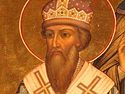 St Photius the Metropolitan of KievSaint Photius, Metropolitan of Kiev and All Russia, was by birth a Greek from the Peloponnesian city of Monembasia (Malbasia). |
 St Jonah the Metropolitan of MoscowSaint Jonah, Metropolitan of Moscow and Wonderworker of All Russia, was born in the city of Galich into a pious Christian family. |
 Venerable Bede, the Church HistorianSaint Bede was a church historian who recorded the history of Christianity in England up to his own time. |