Khabarovsk, Khabarovsk Krai, Russia, November 13, 2023
 Photo: pravkhabarovsk.ru
The canonization of two New Martyrs was festively celebrated in the Holy Transfiguration Cathedral in Khabarovsk, Russia, this weekend.
On August 24, the Holy Synod of the Russian Orthodox Church resolved to add Priest Leonid Serebrennikov, Priest Philip Raspopov, and Priest Vasily Nosov to the Synaxis of New Martyrs and Confessors of the Russian Church, and yesterday, the rite of glorification of Sts. Leonid and Philip was celebrated in far eastern Russia.
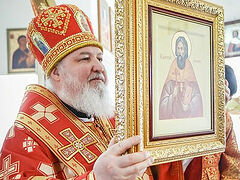
The service was led by His Eminence Metropolitan Artemy of Khabarovsk, concelebrated by four other hierarchs and local clergy, reports the Orthodox Khabarovsk.
 Photo: pravkhabarovsk.ru
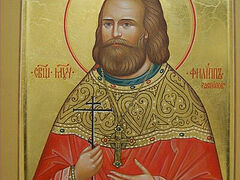
During the Small Entrance, the Synodal decree on the canonization of Sts. Leonid and Philip was read out. Icons of the New Martyrs, painted at the local Sts. Peter and Paul Convent were brought out of the altar, and during the singing of the troparion and magnification, the faithful were blessed with the holy images.
After the service, Vladyka Artemy addressed the faithful:
The clergy whom we glorify today as saints, like Christ, fell on the ground like a seed, sprouted, bore fruit, and attracted many people to the Orthodox faith. They tried to persuade the New Martyrs to renounce the faith, but they stood firm in their confession. And they were granted the highest Christian death—martyrdom for Christ. By glorifying our saints, we can now ask them to intercede with God for our sins. Holy New Martyrs and Confessors of the Russian Church Leonid and Philip, pray to God for us!
At the end of the service, icons of the new saints were distributed to the faithful.
***
 Photo: pravkhabarovsk.ru St. Leonid Konstantinovich Serebrennikov, the son of a priest in the Vilna Province, was born on April 14, 1894. In 1904-1910 he studied at the Vilna Theological School. In 1912-1915 he served as a reader in the Vilna Province. In May 1915 he married, then was a student of pastoral courses in Moscow. In the same year he was ordained a deacon, and in March 1916 a priest. The ordinations were performed by Bishop Innokenty (Solodchin) at the Holy Protection Monastery in Moscow. Upon completion of the pastoral courses in May 1916, Fr. Leonid Serebrennikov was appointed to the Novo-Pokrovsky resettlement parish of the village of Lermontovskoye, Primorsky Region (now the village of Lermontovskoye, Khabarovsk Territory), and in January 1917 he was transferred to the Holy Protection Church of the same village.
In early January 1919, a partisan detachment led by Yefim Garmashov entered the village of Lermontovka. In addition to robbery and sabotage against the interventionists, the detachment carried out reprisals against people who, in their opinion, interfered with the cause of the revolution. Priests were among them. In one of these reprisals on Christmas Day, December 25/January 7, 1919, Fr. Leonid Serebrennikov was killed.
The following story about the martyrdom of a priest was passed down from generation to generation: “In 1919, on Christmas Day, after a Christmas tree organized in the parish school, Fr. Leonid was captured by a band of Bolsheviks and taken to the river in a severe frost, where he was undressed and put on ice. Father was very strong and kind. The bandits mocked the priest, who, being of great stature and remarkable strength, did not resist his killers. They jumped on him, rolled on his back to the river, poked with knives, then forced him to chisel an ice-hole, stripped him and with the words: “You baptized us, and we will baptize you”—lowered him under water. When he, already wounded, clung to the edge of the ice, they crushed all his fingers on his hands, then he went under water, and in the morning people fished out his body and buried it. This story is confirmed by the old-timers of the village.
On the initiative of the parishioners of the current church in honor of the Archangel Michael in the village of Lermontovka, a memorial service is performed on the day of the death of Fr. Leonid, who is revered by local people as the patron of the village of Lermontovka.
***
St. Philip Kuzmich Raspopov was born in the village of Matveevka, Buguruslan district, Samara Province, on October 3, 1875, a peasant son. After graduating from the parish school, Philip Raspopov remained a novice at the St. Nicholas Monastery in the city of Samara, but, realizing his lack of inclination towards the monastic path, he turned to the bishop with a request to direct him to parochial obedience, after which he was sent to the parish in the village of Tupikovka, Buzuluk district, as a psalmist and Church school teachers.
In 1900-1903, Philip Raspopov served in the military in China. In December 1903, he was admitted to the Blagoveshchensk Diocese and appointed reader and singer of the Duya marching church, participating in the celebration of Divine services in the Khabarovsk Cathedral and directing the choir. In the summer of 1904, he was moved to the Burukan missionary camp with the obligation to direct the cathedral choir of singers and help in the construction of a catechism school.
In 1904, Philip Raspopov got married, after which he became clergy. On June 11, 1906, he was ordained a deacon, after which he served in Khabarovsk, and on January 8, 1912, he was ordained a priest at the church in the village of Vyatskoe. In November 1914, Fr. Philip Raspopov was transferred to the Holy Trinity parish in the village of Dole-Troitskoye, with the care of the former parish retained.
Throughout his life, Fr. Philip accompanied his pastoral ministry with educational activities, which he began as a teacher at a parochial school back in the Samara period of his life. In Nikolaevsk-on-Amur, he acted as a teacher of the law at the Pyankovskoye Folk School. While serving in the village of Vyatskoye, he taught the Law of God to local children and preached the Gospel to the indigenous peoples of the Amur region. In 1914 he was appointed teacher of the Trinity School.
During the First World War, Fr. Philip participated in the collection of donations in favor of Russian prisoners of war, for which archpastoral gratitude was expressed to him.
On November 23 / December 6, 1919, partisans broke into the Raspopovs’ house. In severe frost, they dragged Father Philip out into the street almost without clothes and dragged him to the Amur River. There, on the river ice, they mocked him for a long time: They insulted and beat him, and then lowered Fr. Philip into a hole under the ice, where he accepted a martyr’s death. According to eyewitnesses, the priest behaved with dignity and did not renounce his faith.
In the Amur village of Troitskoye, the veneration of Fr. Philip began immediately after the revival of liturgical life here in the mid-1990s. Regular prayer services are performed in the Holy Trinity parish of the village of Troitskoye, where Fr. Philip served and was martyred. The memory of Fr. Philip was also restored in his homeland. In the village of Matveevka, Samara Region, where Fr. Philip was born, they know and remember the priest. The days of his death and birth are prayerfully honored in the local church.
Follow OrthoChristian on Twitter, Vkontakte, Telegram, WhatsApp, MeWe, and Gab!