Ovruch, Zhytomyr Province, Ukraine, May 23, 2025
 Photo: suspilne.media
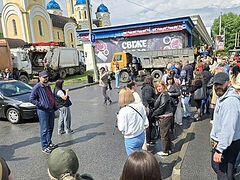
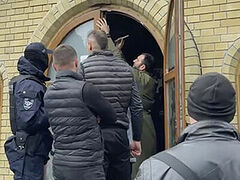
An appellate court has ruled that the centuries-old complex of a convent in Ukraine’s Zhytomyr Province must be transferred from private Church ownership to the state.
The Rivne Northwestern Appellate Commercial Court decided May 15 to return the St. Basil’s Convent complex in Ovruch to state ownership, canceling private property rights held by the canonical Ukrainian Orthodox Church community since 2006, reports Suspilne.
Legal advisor to Ovruch Mayor Anatoly Chizhevsky said the monastery shouldn’t remain in private hands because it’s an architectural monument of national significance.
“In 2006, the executive committee of the Ovruch city council adopted a decision on the basis of which private property rights to the monastery’s homestead were registered,” Chizhevsky explained. “Government authorities can’t cancel their own decisions if rights or obligations have already arisen based on them. But we consider this unlawful, so we turned to the prosecutor’s office to file a lawsuit in court.”
The ruling upheld an earlier February 10 decision by the Commercial Court of the Zhytomyr Province, which had been appealed by the Church.
His Eminence Metropolitan Vissarion of Ovruch (who is among the hierarchs personally targeted by the Ukrainian state) strongly disputed the court’s decision, arguing it violates constitutional principles of Church-state separation.
“The Holy Synod established a monastic community there. The nuns built the building and have been living in this monastery for over 100 years. It belongs to the Church. And the Church is separate from the state,” the Metropolitan said. “If someone wants to take it away, that’s a raider seizure.”
The monastery’s St. Basil’s Church was originally built in the late-12th century on the site of a 10th-century wooden church.
Following the appellate court’s decision, the state must now formally register ownership of the monastery complex.
***
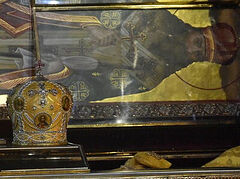
 Inside St. Basil’s Church. Photo: Wikipedia
The foundation of the monastic ensemble is the St. Basil Church, which together with the complex of monastic buildings is an architectural monument of national significance.
The stone church of St. Basil was built around 1190 by Prince Rurik Rostislavich on the site of a wooden church which, according to legend, was built in 997 by Prince Vladimir Sviatoslavich. The church repeatedly suffered destruction, most severely in 1321 during the siege of the city by the troops of Lithuanian Prince Gediminas.
In 1842, the stone vaults of the ancient Rus’ building collapsed. Only three apses and part of the northern wall with an arch survived, near which a chapel was erected in 1876 (dismantled in the early 1900s). In 1906, a women’s community was established there.
The following year, restoration of the St. Basil Church began in 12th-century forms according to the design of architect A. Shchusev. All reliable parts of the ancient church were included in the new building without changes, and fragments of 12th-century frescoes were also preserved. The rebuilt St. Basil Cathedral is a four-pillar, cross-domed, single-nave church. Two round towers with spiral staircases to the choir adjoin the western facade.
In 1910, on the initiative of Metropolitan Anthony (Khrapovitsky), the women’s community was reorganized into a monastery (the first abbess was Abbess Paula). In 1914, 75 nuns resided there. In 1929, the monastery was closed, and the buildings were first transferred to a military unit, then in 1934 to a children’s home.
During World War II, with the assistance of Bishop Leontius (Filipovich), 47 nuns again settled in the monastery, which was liquidated in 1958 by order of the Soviet authorities. A children’s hospital was placed in its buildings, and later a vocational school.
In 1979, St. Basil’s Church and the monastic building were granted the status of an architectural monument, and in 1984, restoration of the church began. The monastery was restored in 1990. In 1996, 40 residents were living there. Currently, the abbess is Mother Euphalia (Okhmak). Among the holy relics is an icon of the St. Makary of Ovruch with a particle of his relics.
Follow OrthoChristian on Twitter, Vkontakte, Telegram, WhatsApp, MeWe, and Gab!