Brailov, Vinnitsa, Province, Ukraine, June 11, 2025
 eparhia.vn.ua
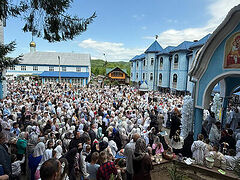
The Ukrainian Orthodox Church’s Holy Trinity Convent in the village of Brailov, Vinnitsa Province, celebrated two more anniversaries this week.
In March, the Church marked the 35th anniversary of the convent’s revival after the years of godless atheism, and yesterday, it celebrated the 390th anniversary of the founding of the monastery and the 30th anniversary of the transfer of the wonderworking Brailovo-Częstochowa Icon.
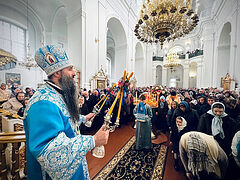
The feast began on the evening of June 9 with the All-Night Vigil, celebrated by His Eminence Metropolitan Barsanuphius of Vinnitsa. During the service, the hierarch awarded all monastery clerics with gramotas from the UOC primate His Beatitude Metropolitan Onuphry of Kiev and All Ukraine for their zealous service for the benefit of the Church of Christ, the Vinnitsa Diocese reports.
 eparhia.vn.ua
Met. Barsanuphius also led the Liturgy the next morning, concelebrated by clerics from Vinnitsa and other dioceses.
During the service, abbesses and abbots of monasteries from various corners of Ukraine joined in common prayer. During the Liturgy, special petitions were offered for peace, victory, and prosperity of Ukraine and its God-loving people.
After the Communion verse, Archpriest Ioann Lukanov delivered a sermon in which he recounted the historic event of the transfer of the miraculous Częstochowa Icon of the Mother of God and the monastery’s revival from oblivion.
 eparhia.vn.ua
During the service, the abbess of the Brailov monastery, Abbess Antonia (Stetsenko), was honored with a high Church award—the Order of the Venerable Anthony and Theodosius of the Caves, First Class. The same awards were received by the first residents of the monastery—the dean Mother Anastasia and Mother Theodosia.
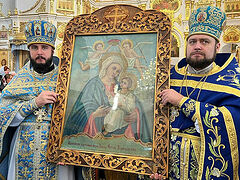
Following the Liturgy, a procession was held, during which the convent was gifted a copy of the ancient Bar Icon of the Mother of God.
***
 eparhia.vn.ua
The Brailov monastery was founded in 1635 in Vinnitsa at the request of the Bratslav sub-judge and royal secretary Mykhailo Kropyvnytskyi, who later became a Polish senator.
The current monastery building began construction in 1767 in Brailovo funded by Polish magnate Franciszek Salezy Potocki as a monastery of the Catholic Trinitarian order. Construction was completed in 1778.
After Podillia became part of the Russian Empire, the Orthodox convent from Vinnitsa was relocated in 1845 to the building of the Trinitarian monastery, which had been closed following the Polish uprising of 1830-1831.
The monastery was later closed by the Bolshevik authorities in 1932 after they found grain hidden there by peasants from Moskalivka and Kozachivka during the famine. During the Nazi occupation, the monastery was restored in 1942 with permission from the Romanian administration, but was closed again by Soviet authorities in 1962.
Until 1989, when the monastery reopened in this building, it housed the Brailovo vocational school and later a tourist base. In the 1990s, restoration work was carried out on the entire complex of buildings and the monastery courtyard.
The monastery is home to three revered icons:
- The Brailovo-Częstochowa Icon of the Mother of God, which is a copy of the Częstochowa icon and was donated to the Vinnitsa Annunciation Monastery in 1635
- The Brailovo Pochaev Icon of the Mother of God, originating from the Pochaev Lavra. It was found in the Lavra in 1887 by Professor A. Khoinatskyi, who proved that it was a copy of the miraculous image from Brailovo, which disappeared after the town was captured by the Turks in 1672. In 1890, silver-gilt vestments were placed on this icon, which disappeared along with other valuables after 1917. The icon itself is still preserved in the monastery
- Icon of the Mother of God of the Three Hands, painted in the early 19th century on Mt. Athos
Follow OrthoChristian on Twitter, Vkontakte, Telegram, WhatsApp, MeWe, and Gab!