Chisinau, July 15, 2024
 Photo: spzh.eu
As aggression against canonical UOC churches grows in Ukraine, similar tensions are growing in Moldova.
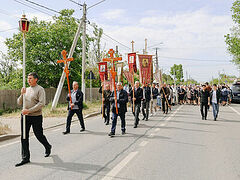
Recently, Archbishop Marchell of Bălți and Fălești accused the Romanian government and the Romanian Patriarchate of orchestrating takeovers of churches belonging to the Moldovan Orthodox Church. According to local media, an incident in Grinăuți lasted several hours and involved confrontations between faithful from the two jurisdictions. The event heightened tensions in the local community.
The bishop’s statement was prompted by events in the village of Grinăuți in the Rîșcani District, where, according to him, there was an attempted seizure of a local church by representatives of the Metropolis of Bessarabia—a structure under the Romanian Patriarchate.
“Like thieves in the middle of the night, like robbers, this is how the Metropolis of Bessarabia and all of Romanian policy behave toward us Moldovans,” said Archbishop Marchell, as reported on the website of the Union of Orthodox Journalists (UOJ). The Archbishop claims that such raids are financially supported by the Romanian government, on funds received from the EU.
The Metropolia of Bessarabia and All of Romania is a canonical ecclesiastical structure of the Romanian Orthodox Church, re-established in 1992. It operates primarily in Moldova (the Republic of Moldova) and asserts jurisdiction over Orthodox believers of Romanian ethnicity in that region. This would include Romanian populations in Ukraine, as well.
The complicated history of what is now the independent state of Moldova sets the stage for this recent ecclesiastical confusion.
In the 18th century, Moldova was a vassal of the Ottoman Empire, though with significant internal autonomy under its local princes. From 1711–1821, the Ottomans imposed Phanariot Greeks as rulers, reducing local autonomy and imposing heavy taxation and corruption, which weakened the national consciousness of the principality.
As a result of the Russo-Turkish Wars, the Russian Empire, removed Ottoman influence and rule from Moldova and Wallachia.
After the Treaty of Bucharest (1812), the eastern part of Moldova, Bessarabia, was annexed by the Russian Empire.
The remaining western part of Moldova remained under Ottoman suzerainty, with growing Russian and Austrian influence.
In 1821, native Moldavian rulers were restored, allowing for some reforms. The early 20th century saw Bessarabia as part of the Russian Empire, while western Moldova was integrated into the Romanian state. But in 1918, after the Bolshevik Revolution in Russia, Bessarabia (eastern Moldova) declared independence from Russia and shortly after united with Romania.
In1940, under the Molotov-Ribbentrop Pact, the Soviet Union took Bessarabia, creating the Moldavian SSR.
During World War II 1941–1944, Romania allied with Nazi Germany, and thus retook Bessarabia, but after winning the war, the USSR retook it, maintaining it as the Moldavian Soviet Socialist Republic.
During the Soviet period, Moldova became more integrated with Ukrainians and Russians. Moldovans retained their own language and culture, but often also migrated to other parts of the Soviet Union. In 1991, with the breakup of the Soviet republics, Moldova also became an independent state. Since then, most of the Moldovan leaders have leaned toward good relations with the Russian Federation, with the current President Maia Sandu—who studied Public Administration from Harvard University’s Kennedy School of Government and served as an advisor to the World Bank in Washington DC, and holds Romanian citizenship—being the notable exception. Her EU-leaning politics and possible election fraud have been controversial in Moldova. She is also disliked by many there for changing the national language officially from “Moldovan” to “Romanian.”
The Moldovan Orthodox Church is a self-governing body of the Russian Orthodox Church. Established in 1813, it currently includes six dioceses and over 1,200 parishes. Its conflict with the parallel jurisdiction—the Metropolia of Bessarabia under the Romanian Patriarchate—escalated after 2001, when the European Court of Human Rights forced Moldovan authorities to officially register the Metropolia’s activity within the country, according the UOJ.
As for Church life in the country: In the Autonomous Moldovan Church, both the Moldovan language (similar to Romanian) and Church Slavonic are used. It uses the Julian, or “Old” church calendar, while the Romanian Church uses the Gregorian, or “New” calendar.
As was also reported by the UOJ, Romanian hierarchs view all of Moldova as belonging to Romanian Patriarchate. However, if you count the date of proclaimed or recognized Romanian autocephaly as proceeding from the Romanian Church’s independence from Constantinople, the Moldovan Church predates the formation and autocephaly of the Romanian Church by 50-80 years.
It must be noted that the majority of Moldovans have good relations with both Russians and Ukrainians. But being a very poor country, much of their income comes from work abroad, both in Russia and Western Europe. In Western Europe, the Moldovan faithful more often attend Russian churches than Romanian ones, unless their numbers are large enough to form their own Moldovan parish. Many Moldovans feel that they are more accepted as compatriots by Russians and Ukrainians than they are by Romanians.
Follow OrthoChristian on Twitter, Vkontakte, Telegram, WhatsApp, MeWe, and Gab!