Maria Polyanskaya is a volunteer of the Patriarchal humanitarian mission. She’s been volunteering for almost ten years now. Her background is in language studies and foreign and Russian businesses. Maria’s story is about what is it like to see beauty in the patients of tuberculosis hospital, and why ministry is inseparable from obedience.
 Maria Polyanskaya, a volunteer of the Patriarchal humanitarian mission By the time I went to Donetsk, I already had vast and diverse volunteering experience. Since 2016, I volunteered as a mentor of orphaned children and young adults, from 2022, I assisted refugees at the Church Resource Center in Moscow, and in 2024, I became a volunteer of Jewish charity organizations. I travelled to children’s homes and asylums, communicated with adults orphaned in childhood and with retirees. I spent the same amount of time working at charity organizations. I thought it was very important to work not only for the money, albeit quite modest, and fulfill the goals of a given business, but also to keep a fresh outlook on social problems of each particular person.
As a volunteer coordinator, someone who brings in new people, conducts training, monitors trainees, motivates and inspires, I assumed I already knew it all. Especially since I had recently completed the course, “Volunteering as Service.” I learned during this course that a volunteer was someone who operates on a voluntary basis and in his free time. He can’t be coerced or controlled, and his opinion should be taken into account. He is to be treated gently, because his good intentions can evaporate at any moment, and his spare time will be occupied by some other activity. It didn’t matter that I knew another approach to volunteering—strict discipline, rigid accountability, and team spirit. I noticed that this approach was quite alien to the volunteers who would come then. To be sure, I did miss the clarity, definitiveness, and responsibility of the early days of my volunteering experience, but I accepted the reality of today.
 Maria Polyanskaya helping someone in need During my trip to Donetsk, I encountered yet another form of volunteer work—something I can describe only as a “ministry.” Ministry is when you set aside personal interests entirely and live for the sake of others, when your own identity recedes in the selfless labor of helping those in need. It is not necessarily tied to faith or religious rituals. Ministry is something anyone can undertake, if driven by a deep inner desire to serve—out of love and compassion.
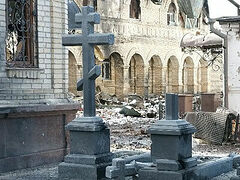
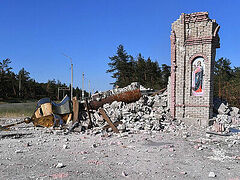
When I was en route to Donetsk, I had no idea—none at all—of the humanitarian crisis I was about to witness while caring for recipients of the Patriarchal humanitarian mission. The elderly, women, children, and the disabled are living in unbearable conditions: extreme poverty, in dilapidated and trashed apartments, without running water, often without gas or working plumbing. There are private homes, so impoverished and foul-smelling, that they physically overwhelm you—empty, moldy refrigerators, chronic ulcers, festering wounds, and bedsores.
Let’s be honest: I was not prepared for any of it—not even close. And that’s despite a long life behind me and years of experience in volunteer work.
I thought I would be working as a social worker, like I did in Moscow—handing out humanitarian aid or working in a warehouse. But on my very first day at the Mission, I realized there is a difference—let me be precise—between relatively easy volunteer work and true voluntary labor, or ministry. That difference lies in this: either you do the work with joy, love, and empathy—the kind of work you simply cannot do without those three things—or you won’t last even a single day.
Because caring for the bedridden, for the most severe cases—those who have been left entirely alone—is the most active, the most consuming form of volunteer service imaginable.
 Maria Polyanskaya with care recipients This is not some convenient volunteering you do in your spare time or when you feel inspired. This is a conscious choice—a voluntary commitment you make when you sign the consent form to enter a conflict zone in your own country. It’s a kind of obedience, a willful surrender of your own preferences for the sake of something higher. On my first day with the Patriarchal Humanitarian Mission, it became clear to me: ministry is impossible without obedience.
You simply go and do what you are called to do. You don’t bargain, don’t question, don’t set conditions or seek safety or convenience. You accept the task before you as your own personal mission, one that mysteriously corresponds to your deepest inner aspiration—even if it doesn’t feel that way at first.
And when you accept it—when you release that inner love—something miraculous happens. You begin to see the beauty and dignity of each person you serve: the stubborn, fiery old woman abandoned by her daughter; the wounded man confined to a wheelchair; the homeless women discharged from TB hospitals with nowhere to go; the mother raising a disabled daughter and an addicted son; and countless others I met during that unforgettable week.
It overwhelmed me so deeply that I simply couldn’t keep it to myself. I shared it with every person I helped—despite their grumbling, their resistance, their suspicion or bitterness. While changing their sheets and diapers, cleaning bedsores and emptying urinals, cooking meals and mopping floors, sorting closets and hauling out garbage, I kept saying: “My goodness, you are all so beautiful!”
I just kept saying it—talking and talking—and I couldn’t stop.
True obedience in ministry probably exists in its fullest form only in a monastery. But by the end of that week, I realized something: The modest apartment where we volunteers stayed with our coordinator—an apartment still bearing traces of the once-beautiful 1990s Donetsk—had become, for me, a kind of provisional monastery.
I made no decisions there. I was answerable only to myself and to the people who placed their trust in me. Everything was simple and clear: there was me—my arms, my legs, my mind, and my heart—and there were those who needed me.
It doesn’t matter how they treat me—my country, my background, my views, or my faith. And then there are my sisters—others like me, performing the same duties, even if they came to this path of volunteering by different roads. Now, there is nothing more precious than this sisterhood we share.
The realization of the meaning of this ministry gave me strength and enabled me to do things I had never done before—things I had thought myself entirely incapable of. It’s been rightly said that a journey of a thousand miles begins with a single step. But sometimes, the one walking that path pauses, unsure if he ought to continue.
I, however, felt free—light as a bird in the sky. I didn’t question whether I needed this experience; I simply embraced it with trust. If I am here, then this is where I am meant to be. It had been a long time since I had felt such clarity, openness, and ease—untouched by doubt or regret. And I believe that this inner freedom helped me carry out my ministry to completion, even in a place that was not yet considered completely safe.
One more priceless gift of this journey: the understanding that this kind of ministry eases life not only for those you are helping—but for you as well, if only you choose to do it freely.