Chișinău, August 4, 2025
 Photo: basilica.ro
The canonization of Sts. Iraclie and Hieromartyr Alexandru of Bessarabia was proclaimed locally on Sunday, August 3, at the Church of the Holy Apostles Peter and Paul in Chișinău.
The 20th-century saints of the Romanian Orthodox Church’s Metropolis of Bessarabia were among the 16 saints canonized by the Romanian Synod in July 2024 and proclaimed on a Churchwide level in February of this year.
Their local proclamation took place at the end of the Divine Liturgy on Sunday, celebrated by seven hierarchs of the Romanian Orthodox Church, led by His Eminence Metropolitan Petru of Bessarabia, reports the Basilica News Agency.
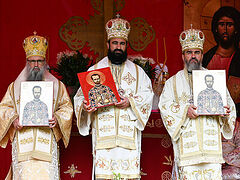
The Synodal tomos for the local proclamation of the canonization of Venerable Iraclie was read out by Bp. Veniamin of Southern Bessarabia, extolling him as a great preacher and confessor who translated spiritual texts for the edification of many.
 Photo: basilica.ro
Bishp Ignatie of Huși read the tomos for Hieromartyr Alexandru, praising him as a pillar of faith who nourished and protected his flock during the occupation by the Soviet Union.
The icons of the saints were presented to the faithful while the choir sang their troparia.
Abp. Casian of the Lower Danube read out a message from His Beatitude Patriarch Daniel praising both saints as “torches of faith in times of communist persecution.”
Today, we turn our thoughts to two luminous figures who shone in the land of Bessarabia, two chosen servants of the holy altars who perfectly fulfilled the call of the Lord Jesus Christ to be the light of the world and salt of the earth (cf. Mt. 5:13-14). Venerable Confessor Iraclie of Bessarabia and Hieromartyr Alexandru of Bessarabia confessed with great courage the name of Christ in times of trial and persecution.
These two servants of the holy altars, although they had different callings in the life of the Church—one to monastic life, the other to family life—fulfilled the commandment of the Lord Jesus Christ to be ready to give their lives for the sheep they shepherded with the same zeal and humility (cf. Jn. 10:11),
Bp. Veniamin of Southern Bessarabia gifted Met. Petru a fragment from the relics of St. Iraclie.
***
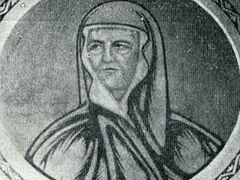
 St. Iraclie. Photo: basilica.ro St. Iraclie (Flocea) was born on March 11, 1893, in Pojorâta, Câmpulung County (in Suceava today), receiving the name Ioan in Baptism.
He was seriously wounded in war, nearly losing his left hand, but he was miraculous healed by God.
Fulfilling a promise he had made to God while in the trenches, he entered Hârbovăț Monastery, where became a monk in 1920, was ordained a hierodeacon in 1925, and a hieromonk in 1927.
From 1926 to 1930, he went to seminary in Chișinău, being distinguished by both his academic and spiritual pursuits. In particular, he was recognized as great homilist and wise confessor, merciful and generous to foreigners and devoted to his mission. He could also translate into several languages.
In 1940, after the dissolution of the monastery, he went to become a parish priest in Nisporeni. Seeing the persecution of the clergy and monks by the Soviet army, he sent whatever help he could to the surrounding monasteries until the return of the Romanian army in 1941.
He was then able to return to Hârbovăț Monastery, where he was involved in the renovation process and the return of monks who had been exiled by the Soviets.
Between 1941 and 1944 he served as Exarch of the monasteries of the Archdiocese of Chișinău, and in 1944, he was appointed diocesan vicar for the regions evacuated from the Archdiocese.
On August 2, 1945, he was arrested and sentenced to 8 years of hard labor in Siberia “for propaganda, agitation, and calls for the overthrow of the Soviet power.”
In the gulags, he zealously helped his fellow parishioners keep the flame of faith alive in their souls. He never denied his faith and never gave in to pressure.
He was released and returned home in 1953 and served at several monasteries. He spent the last years of his life as a spiritual father in the village of Chițcani until he reposed in the Lord on August 16, 1964. He was buried in the village cemetery under the watchful eye of the communist authorities.
On October 19, 1992, Protosinghel Iraclie was rehabilitated by the General Prosecutor’s Office of the Republic of Moldova.
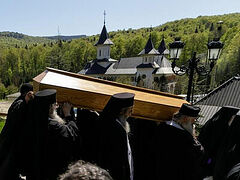
In 2019, his remains were reburied at the cemetery of Noul Neamț Monastery. His family was given a portion of his relics to keep in their home, and in 2022, on the day of his repose (August 16), they began to stream myrrh, which became the impetus to begin investigating his life for the possibility of canonization.
Fr. Iraclie is remembered as a monk of holy life, a tireless missionary, preacher, prison confessor, and miracle worker, preaching the Gospel and bringing many to Christ despite all external circumstances.
***
 St. Alexandru. Photo: basilica.ro
St. Alexandru Baltăga was born on April 14, 1861, the son of a priest.
He graduated from the Chișinău Seminary in 1883, and was sent to lead the parish community of the Church of St. Alexander Nevsky in Călăraşi in modern-day Moldova. There he was ordained to the diaconate in 1886 and the priesthood a decade later.
He raised two adopted children.
Fr. Alexandru was the only cleric in the Country Council when the union of Bessarabia and Romania was voted on in 1917-1918, and he was later appointed a member of the Committee for the Unification of the Churches of Greater Romania.
He was arrested soon after the Soviet Union annexed Bessarabia in June 1940. During his interrogation, he readily admitted that he voted for the separation of Bessarabia from Russia and its union with Romania and that he opposed the Bolshevik Revolution.
He also expressed discontent that services had to be celebrated in Slavonic in Bessarabia, rather than their native Moldovan language. In June 1941, he was sent to prison in Kazan, where he died on August 7, 1941, at the age of 80.
Follow OrthoChristian on Twitter, Vkontakte, Telegram, WhatsApp, MeWe, and Gab!