Gornje Zaostro, Montenegro, August 11, 2025
 Photo: cdm.me
A monument to World War II Chetnik commander Pavle Đurišić was unveiled on August 8, in the village of Gornje Zaostro near Berane, Montenegro, under the patronage of the Serbian Orthodox Church.
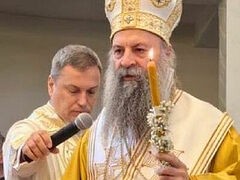
The unveiling ceremony was conducted by His Eminence Metropolitan Metodije of the Budimlje-Nikšić diocese following a Liturgy at the Church of St. Paraskeva, the diocese reports.
During his sermon, Met. Metodije praised Đurišić, stating that “the entire Serbian people, in their soul and heart, have long ago erected a monument to the Grand Duke Pavle Đurišić.”
The Metropolitan spoke of Đurišić’s wartime role, saying: “He was the first to raise an uprising together with his people against the occupiers and liberated Berane, liberated the Raška region, Sandžak from the Italians and fought all the time... defending his people who were targeted from all sides to be erased and swallowed up, and he did it.”
His Eminence also stated:
He grew up there, but know this, many graduated from military academies and became officers, but few were as inspired as Duke Pavle, such brave and great glorious knights who were respected not only by those who fought with him and his allies, but also by his enemies. And how and by what was he inspired? He was with his uncle, who had been with Duke Vuk, a warrior, a Chetnik in these liberation wars when we were liberating Serbia, Montenegro, these highlands, Old Serbia and Macedonia from the Ottoman Empire…
And then nothing else, no other path could young Pavle Đurišić take but the path of his glorious knights, Serbian heroes and warriors. He graduated from the academy, became an officer and immediately returned from Sarajevo to Berane to serve here before the Second World War where the Second World War found him. He was the first to raise an uprising together with his people against the occupiers and liberated Berane, liberated the Raška region, Sandžak from the Italians and fought all the time, maneuvering to defend the Serbian people and his nation whom the demons from all sides wanted to erase and swallow up, and he did it…
He perished with his people, at the greatest place of suffering - Jasenovac, the largest underground city, Serbian. There he left his bones, his grave is unknown, no marble marks it, but his spirit nourishes this people.
 Photo: eparhija.me
Met. Metodije even announced plans to place the monument inside the church itself, declaring: “That monument to Duke Pavle, I will put it in the church, so let them demolish the church.” He predicted that “the time will come, not only will it be erected here, but God willing, in the center of Berane, where it belongs, to the Grand Duke.”
The blessing of the monument has proven controversial amonst Montenegrin media outlets, with a slew of articles accusing Met. Metodije of supporting war crimes and leading a militaristic-nationalistic faction.
Pavle Đurišić (1909-1945) was a Royal Yugoslav Army officer who became a prominent Chetnik commander during World War II. While Serbian nationalists view him as a hero who defended Serbian populations against various threats during the war, his legacy is also deeply controversial.
According to historical records, including Đurišić’s own report to Chetnik leader Draža Mihailović dated February 13, 1943, forces under his command killed approximately 10,000 Muslims between January and March 1943 in eastern Bosnia and the Sandžak region—including about 8,000 women, children and elderly people. Đurišić wrote that his forces had destroyed all Muslim villages in the districts of Čajniče, Foča, and Pljevlja, stating: “During operations complete annihilation of the Muslim population was undertaken, regardless of sex and age.”
Đurišić collaborated with Italian forces from 1942, receiving arms, food, and wages for fighting the Communist-led Partisans. After the Italian capitulation in 1943, he was captured and later released by the Germans, subsequently collaborating with German forces and Milan Nedić’s Serbian puppet government. In October 1944, he was awarded the Iron Cross 2nd Class by the Germans for his service against the Partisans while commanding the Montenegrin Volunteer Corps.
Đurišić was killed in April 1945, most likely at the Jasenovac concentration camp, after being captured by forces of the Independent State of Croatia.
This is not the first attempt to erect a monument to Đurišić in Montenegro. In 2002, plans for a memorial complex near Berane were blocked by the Montenegrin government, which stated that such a monument “caused public concern, encouraged division among the citizens of Montenegro, and incited national and religious hatred and intolerance.”
The Serbian diaspora previously erected a monument to Đurišić at the Serbian cemetery in Libertyville, Illinois.
Follow OrthoChristian on Twitter, Vkontakte, Telegram, WhatsApp, MeWe, and Gab!