Cookham, Berkshire County, England, August 13, 2025
 Photo: arkeonews.net
Archaeological excavations at an 8th-century monastery in Cookham, Berkshire, have uncovered evidence suggesting the site functioned as one of Britain’s earliest hospices, providing care for seriously ill patients from across the region.
The monastery, ruled by Queen Cynethryth and King Offa of Mercia, was first discovered in 2021 behind Holy Trinity Church. University of Reading archaeologists have since unearthed a cemetery containing an unusually high concentration of individuals with severe health conditions.
Analysis of 23 skeletons revealed that nearly every individual buried there had experienced serious illness or injury. Dr. Ceri Falys, a human osteoarchaeology specialist at the University of Reading, found many adults were smaller than expected for their age, with several showing skeletal trauma. One individual showed evidence of skull surgery, while others had bone deformities from tumors. Several skeletons exhibited pressure sores, indicating long-term immobility and care.
“These signs of extended treatment point to a form of hospice care,” Dr. Falys stated. “People were brought here to be cared for, treated, and comforted in their final days.”
Professor Mary Lewis discovered that 11% of the remains showed signs of cancer—significantly higher than the 0.8% rate typically found in Anglo-Saxon populations. This unusual concentration suggests the monastery attracted patients suffering from serious illnesses.
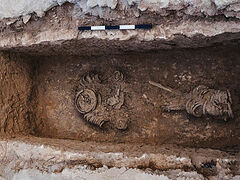
 The unusual position of the ribs suggests a tumor on the chest. Photo: University of Reading
“The conditions found here are so varied and severe that these individuals couldn’t all have come from the local population,” Professor Lewis explained. “It’s likely that the monastery had someone akin to a medic—perhaps a person skilled in herbal remedies or prayers aimed at treating tumours and swellings.”
The monastery operated during the 8th century, before the Great Schism of 1054 when Eastern and Western Christianity were still unified under a single Orthodox Church tradition. Professor Gabor Thomas, who leads the excavation, noted that monasteries like this helped spread Christianity throughout the Thames Valley while serving important medical functions.
Queen Cynethryth, who ruled the monastery as royal abbess after King Offa’s death in 796, was a uniquely powerful figure—the only Anglo-Saxon queen depicted on coinage. Historical records show that Charlemagne addressed correspondence jointly to both King Offa and Queen Cynethryth, acknowledging her equal status.
The excavation team has also uncovered a large wooden building and an ancient water mill. Researchers plan to analyze dental calculus from the remains to identify what herbal medicines might have been used and determine how far patients traveled for care.
Fr Stephen Mills, Vicar of the Benefice of The Cookhams, reflected: “Over twelve centuries later, Holy Trinity Church continues to offer comfort and hope. It’s remarkable that this excavation is unfolding the story of a place that may have been one of the earliest hospices in our land.”
Follow OrthoChristian on Twitter, Vkontakte, Telegram, WhatsApp, MeWe, and Gab!