Minsk, August 27, 2025
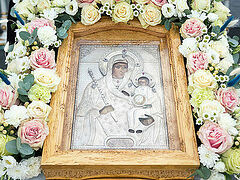
 Minsk Icon of the Mother of God. Photo: prilukicerkov.by
The Fourth All-Belarusian Cross Procession concluded yesterday in the Belarusian capital, marking the 525th anniversary of the discovery of the Minsk Icon of the Mother of God. The ceremonial procession along Victory Avenue brought together several thousand participants, culminating a nine-day, 155-mile pilgrimage from Zhirovichi to Minsk.
The pilgrims, who began their journey on August 17, carried revered copies of the miraculous Zhirovichi and Minsk icons of the Mother of God, along with other sacred relics. Throughout their journey, participants offered prayers for the Church, their loved ones, and the peace and prosperity of Belarus and neighboring nations, the Belarusian Church reports.
What began as a national tradition in 2022 has evolved into an international religious event. This year's procession attracted believers not only from across Belarus but also from Russia, Ukraine, Lithuania, Romania, the Netherlands, and Germany. More than 700 participants registered at the starting point in Zhirovichi, with hundreds more joining at various stages along the route.
 http://church.by//images/_conten/2025/08/2-39212/028.jpg
The pilgrimage route traversed four dioceses—Novogrudok, Pinsk, Molodechno, and Minsk—with pilgrims visiting 21 churches and covering daily distances ranging from 12.5 to 25 miles. His Eminence Archbishop Gury of Novogrudok and Slonim blessed the pilgrims at the Holy Dormition Zhirovichi Monastery at the journey’s start.
His Eminence Metropolitan Veniamin of Minsk and Zaslavl, primate of the Belarusian Orthodox Church, joined the pilgrims on the fifth day of their journey. Along the route, the procession was welcomed by several other hierarchs of the Belarusian Church.
Early yesterday morning, the procession departed from the Church of the Lord’s Ascension in Zhdanovichi, proceeding to the Church of the Protection of the Mother of God on Victory Avenue before continuing to the Holy Spirit Cathedral. Numerous clergy and faithful from all dioceses of the Belarusian Church joined the procession through central Minsk, along with city residents and visitors.
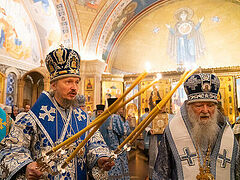
The pilgrimage concluded at the Holy Spirit Cathedral, where Met. Veniamin welcomed the participants. In his greeting, he expressed heartfelt gratitude for their spiritual endeavor on behalf of their loved ones, their homeland, and other nations united by faith.
Following the welcome, the Metropolitan, joined by hierarchs and clergy of the Belarusian Church, celebrated a festive Divine Liturgy marking the anniversary of the Minsk Icon’s discovery.
***
The Minsk Icon of the Mother of God, painted by St. Luke the Evangelist according to Tradition, is one of the most revered sacred items of Belarus. The Mother of God herself blessed the icon and promised to always be with the people through her icons.
One original icon was kept in Constantinople. St. Vladimir the Baptizer of Rus’ brought a copy of it to Kiev and placed it in the ancient Tithes Church. When the Crimean Khan Meñli I Giray captured Kiev in 1482, one of the invaders took the icon, tore off its golden riza, and threw the icon itself into the Dnieper.
However, the icon survived and later appeared in Minsk, where it was noticed by its “extraordinary radiance” on August 13, 1500. It was placed in the Nativity of the Theotokos Church, where it remained for 116 years.
Unfortunately, the icon was taken by Uniate Catholics in 1616, but when Minsk became part of the Russian Empire in 1793, it returned to the Orthodox.
When the atheists came to power in 1917, the icon was again robbed of its precious riza. The faithful raised more than enough money to buy it back, but the authorities took the money and kept the riza. The icon was given to the Renovationists in the Sts. Peter and Paul Cathedral that they captured. When the cathedral was blown up in 1936, the icon was transferred to a local museum.
When the Nazis came to the city in 1941, one pious woman, Varvara Slabko, managed to convince them to give her the icon, which she gave to the St. Catherine Church. After the liberation of Belarus from the Germans, the church was closed and the icon was transferred to the Holy Spirit Cathedral, where it has remained ever since.
Follow OrthoChristian on Twitter, Vkontakte, Telegram, WhatsApp, MeWe, and Gab!