Kiev, September 3, 2025
 Viktor Yelensky, head of the State Service for Ethnopolitics and Freedom of Conscience, is an open enemy of the Orthodox Church. Photo: spzh.eu
Ukraine’s State Service for Ethnopolitics and Freedom of Conscience (DESS) filed a lawsuit on August 29, with the Higher Administrative Court seeking to terminate the activities of the Kiev Metropolia of the canonical Ukrainian Orthodox Church (UOC), DESS head Viktor Yelensky said at a briefing yesterday, reports the Union of Orthodox Journalists.
The lawsuit follows DESS’s August 27 decision recognizing the Kiev Metropolia as affiliated with the Russian Orthodox Church, whose activities are banned in Ukraine under legislation protecting the constitutional order in religious organizations.
“According to the law, DESS is obligated to declare the Kiev Metropolia of the Ukrainian Orthodox Church affiliated with the Russian Orthodox Church, which is banned in Ukraine—that’s first. Second—to send letters about this to the Kiev Metropolia and those religious organizations that are part of it or connected with it. Third—to immediately, as stated in the law, file a lawsuit to terminate the activities of the Kiev Metropolia. This has been done,” Yelensky stated.
Yelensky claimed that terminating the Kiev Metropolia’s activities would not mean closing all UOC parishes and communities. If the court approves the lawsuit, the Kiev Metropolia will lose its status as a legal entity and its legal standing, meaning parishes will have no central authority.
“This also doesn’t mean that parishes will be forced to transfer to some other Church. The state doesn’t require, doesn’t drive anyone into the Orthodox Church of Ukraine or any other Church,” the service head claimed, although the state actively supports the schismatic OCU and aids in the violent takeover of canonical churches.
When asked by a journalist whether DESS found connections between the UOC and Russian intelligence services, Yelensky stated this was not the issue at hand.
“We’re not talking about connections of the Ukrainian Orthodox Church with intelligence services of the Russian Federation. If there are connections of certain priests with Russian intelligence services or with occupiers, or facts of collaboration with occupiers, then these cases are considered separately... We’re not talking about that. We’re talking about the fact that the Ukrainian state prohibits the activities of structures of the Russian Orthodox Church on the territory of Ukraine,” he explained, implicitly admitting that the UOC poses no threat to Ukraine.
Yelensky noted that the Kiev Metropolia has in turn filed several lawsuits against DESS.
The investigation that led to the affiliation decision relied on four main findings, including the UOC’s retention of references to a 1990 Moscow Patriarchal charter in its statutory documents and provisions in Russian Orthodox Church statutes that investigators claimed were binding on the UOC.
His Beatitude Metropolitan Onuphry of Kiev and All Ukraine had previously called DESS’s ultimatum demanding proof of separation from Moscow “fictitious” and a “gross interference” in Church affairs. He emphasized that the UOC already formally declared its independence from the Moscow Patriarchate at its May 27, 2022, Council and criticized the investigation for relying on Russian documents rather than current UOC statutes.
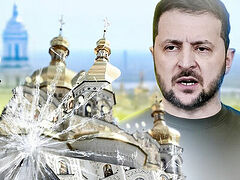
The lawsuit represents the first concrete application of Law 8371, signed by President Zelensky in August 2024, which enables the banning of religious organizations deemed connected to Russia.
Follow OrthoChristian on Twitter, Vkontakte, Telegram, WhatsApp, MeWe, and Gab!