Bucharest, October 1, 2025
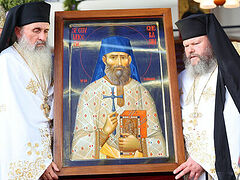
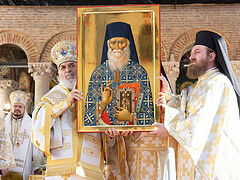
 The Icon of the Mother of God of Dintr-un Lemn Monastery (left), the Icon of the Mother of God of Craiova (right). Photo: crestinortodox.ro
The Holy Synod of the Romanian Orthodox Church met on September 29-30 and approved the establishment of two feast days honoring wonderworking icons of the Mother of God: the Icon of the Mother of God of Craiova (August 30) and the Icon of the Mother of God of Dintr-un Lemn Monastery (July 21).
The Synod also approved liturgical texts for their veneration, reports the Basilica News Agency.
The Icon of the Mother of God of Craiova, known as “Madonna Dudu,” is housed in the church of the Dormition of the Mother of God in central Craiova, which was built between 1750-1756. According to tradition, the icon was discovered in a mulberry tree on the site where the church’s altar now stands.
The Icon of the Mother of God of Dintr-un Lemn Monastery, located in Vâlcea County, is noted for its large dimensions and, according to tradition, was found within the trunk of an oak tree.
The Synod also formally added the Serbian-American saint Holy Hierarch Nikolai (Velimirovič) of Ohrid and Žiča to its calendar on March 18, in addition to various other decisions.
***
The Icon of the Mother of God of Craiova
 Photo: crestinortodox.ro The Icon of the Mother of God, located in the Madonna Dudu Church in central Craiova, is an ancient wonderworking icon. The church, dedicated to the Dormition of the Mother of God, was constructed between 1750-1756 and was rebuilt in 1844 after being destroyed in the earthquake of 1831. The church was named “Dudu” after the wonderworking icon of the Mother of God which, according to tradition, was found in a mulberry tree on the site of the altar.
The tradition recounts that in an orchard called Gaianu’s Orchard, which stretched across the intersection of the most important roads passing through Oltenia at that time, near the old market, merchants would rest in the shade of mulberry trees. On the site where the church now stands was an earthen mound called the Hill of the Orchard, covered with a rich orchard over which towered an ancient mulberry tree.
A local merchant who frequented the orchard one day noticed a golden gleam among the branches of a mulberry tree. Climbing the tree, he found a wondrous icon of the Mother of God. He took it and hid it in the attic of a house. A few days later, intending to sell it, he went to retrieve it but found the icon had disappeared. Shortly afterward, the merchant found the icon again in the same mulberry tree where he had first discovered it. After attempting again to take it to market, the icon disappeared once more, only to be found again in the same tree.
News of the merchant and the wondrous icon spread rapidly throughout the area. The owner of the orchard, Clucer Chiriac Gaianu, a great boyar of the time, convinced it was a miracle of the Mother of God, decided to build a church dedicated to her on the site of the mulberry tree, and to place the icon inside.
The first documentary attestation of the Madonna Dudu Church dates to 1758, when it had already been built on the site of an older wooden church.
In 1778, a silversmith from Sibiu whose daughter, through the grace of the icon, had risen from her deathbed, donated the beautiful mounting to the icon that is still visible today. In 1801, during a merciless Turkish invasion that burned a third of the town of Craiova, the only treasure that remained unharmed by the flames was the Icon of the Mother of God.
During a devastating earthquake that caused much damage to the town, the icon was found under rubble without the slightest scratch. As healings performed by the icon and the multitude of pilgrims increased, the church trustees established an asylum for the sick, known as Madonna Hospice.
Recently, a man from Slatina in an advanced stage of cancer arrived before the icon in a wheelchair. For two weeks, he stayed with a relative in Craiova, during which time he went every day to pray before the Mother of God and venerate her icon. After only two weeks, he left the church on his own feet, giving thanks to the Mother of God and glorifying God.
***
The Icon of the Mother of God of Dintr-un Lemn Monastery
 Photo: adevarul.ro
The Icon of the Mother of God of Dintr-un Lemn Monastery, in Vâlcea County, is one of the most venerated icons in the country, both for its antiquity and the mastery with which it was made, and especially for the countless miracles worked through it.
Dintr-un Lemn Monastery, located in the commune of Francești, approximately 15 miles south of the city of Râmnicu Vâlcea and another 3 miles from the town of Babeni, is one of the largest monasteries in Vâlcea County.
One of the oldest preserved testimonies about the existence of the Vâlcea monastery dates to July 29, 1745, when Metropolitan Neofit the Cretan stated that “a shepherd named Radu, during the reign of Alexandru Voivode (1568-1577), dreamed of the Icon of the Mother of God, mentioned by Paul of Aleppo, and cutting down the oak tree in which the icon was found, made from its wood a small church, called for this reason ‘Dintr-un lemn’ (‘From One Wood’).” The stone church dates from 1715, and documents in the monastery’s archives mention the name of Prince Matei Basarab and the year 1640.
The Icon of the Mother of God of Dintr-un Lemn Monastery is wondrous also in its dimensions: 5 feet in height and 3.5 feet in width. The wonderworking icon is today located in the stone church of the monastery, on the left side, in the place of the royal icon of the Mother of God on the iconostasis.
The details about the author of this icon, the year of its painting, or the conditions under which it reached the Vâlcea monastery are not known with exactitude. According to tradition, it was found in the trunk of a large oak in the area, one of several others located in the back courtyard of the monastery.
In 1929, Professor Andrei Grabor from the University of Strasbourg visited the monastery, studied the icon, and concluded that it was painted in the 4th century at the Theotokos Monastery in Greece, following a model belonging to the Apostle Luke, who first painted the Virgin Mary in an icon. According to tradition, there are only three such examples in the world: in Moscow, Constantinople, and Jerusalem.
The icon underwent years of restoration and was returned to the church on November 15, 2008.
Follow OrthoChristian on Facebook, Twitter, Vkontakte, Telegram, WhatsApp, and MeWe!