Veliky Novgorod, Novgorod Province, Russia, November 28, 2025
 Photo: rodina-history.ru
Restorers at the Novgorod Museum-Reserve have successfully reconstructed the scene “The Torture of St. George the Victorious,” one of the oldest 12th-century frescoes that once adorned the St. George Cathedral at the St. George Monastery.
According to the Center for Monumental Painting, the composition was pieced together from hundreds of thousands of small fragments uncovered during excavations, reports Rodina magazine.
The scene depicts the martyrdom of St. George, showing him bound to a wheel fitted with sharp blades. A warrior turns the wheel to inflict suffering, while the martyr himself remains calm. The figure of the saint and elements of the torture device are painted against a rich blue background typical of the Byzantine tradition that influenced the fresco’s creation.
 Photo: rodina-history.ru
Museum officials say the restored fresco is the first fully identified episode from a hagiographic cycle created around 1130 by Byzantine masters. Specialists note that the discovered composition holds tremendous value for understanding the artistic language of ancient Russian painting. Once restoration is complete, it will be displayed in the museum’s exhibition.
The Orthodox Church commemorates the Torture of St. George on November 23. During the reign of Emperor Diocletian in 303, St. George refused to renounce his Christian faith and was subjected to torture. One of these tortures was an agonizing execution in which iron knives and hooks mounted on a wheel tore through his body.
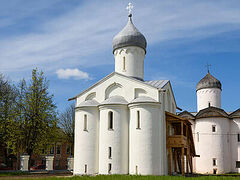
St. George Cathedral was founded in 1119 and is one of the key monuments of ancient Russian architecture. The church’s frescoes were knocked off during a 19th-century reconstruction, after which the fragments ended up beneath the floor. Archaeologists first discovered them in 1930, and then between 2013 and 2023 found a new collection of fragments, among which was the wheel scene.
 St. George Cathedral. Photo: archaeology.ru
Museum officials emphasized that this discovery represents a step toward recovering lost masterpieces of ancient Russian art and provides further confirmation of the high level of the Byzantine school that influenced Rus’ culture.
Follow OrthoChristian on Facebook, Twitter, Vkontakte, Telegram, WhatsApp, and MeWe!