Brookline, Massachusetts, December 9, 2025
 Photo: St Shenouda Press
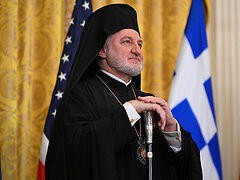
Archbishop Elpidophoros of the Greek Orthodox Archdiocese of America (Patriarchate of Constantinople) has stated that the division between Eastern and Oriental Orthodox Churches is not fundamentally theological and that there is no reason preventing their unity, despite formal theological agreement having been reached decades ago.
Speaking at the Huffington Ecumenical Institute’s conference Eastern and Oriental Orthodox Churches: Moving the Dialogue Forward on November 4-6 in Brookline, Massachusetts, the Archbishop challenged what he called “theological romanticism” about Church divisions.
“We always romantically think that all the reasons that we are divided are theological. This is a theological romanticism, an ecclesiastical romanticism which has little to do with the reality, the historical reality of the real reasons that we don’t have communion,” Abp. Elpidophoros said.
He pointed to historical events following the Fourth Ecumenical Council of Chalcedon as evidence that theological disagreement alone did not cause the split. “For at least 200 years after the Fourth Ecumenical Council, we had communion. 200 years,” he noted, despite the Christological disagreements that emerged from the Council.
According to the Archbishop, political rather than theological factors ultimately drove the separation. “Arab invasions approached the empire. The emperors thought that the Christians who were at the borders of the empire, very close to the Arabs and not having the same faith with Constantinople, were a threat to the empire. So the Byzantine emperors of the Eastern Roman Empire started persecuting these Christians who did not accept Chalcedon. And this then, the blood that was shed, led these Christians to separate, to create parallel hierarchy, and to interrupt communion with Constantinople. This is history.”
Abp. Elpidophoros noted that the theological dialogue between Eastern Orthodox and Oriental Churches “was concluded decades ago.” He described the subsequent impasse: “We agreed on theology. Everything. There is an agreement. It was concluded like decades ago. And then we realized, ‘Okay, now what?’ The bishops were really blocked because they saw that theologians agreed.”
“And then the bishops realized that they are not ready, for other reasons this time, not for theological reasons. They are not ready for communion, for unity. Which means we are not honest when we say that the real reasons that we are not united and we don’t have communion are theological reasons,” the GOARCH head said.
The Archbishop is referring to the Joint Commission of the Theological Dialogue Between the Eastern Orthodox Church and the Oriental Orthodox Church, which met several times from 1964 to 1993, producing agreed statements in 1989 and 1990, the latter of which states: “We have now clearly understood that both families have always loyally maintained the same authentic Orthodox Christological faith, and the unbroken continuity of the apostolic tradition, though they have used Christological terms in different ways.”
Abp. Elpidophoros suggested that even clergy lack understanding of the theological differences. “If we ask not the faithful, but do a survey among the clergy of both traditions, Church families, Oriental and Eastern, and ask them what is the difference between the two Churches—the theological, the Christological difference—the clergy, not the faithful, have no idea. That’s the reality out there.”
The Archbishop criticized how easily modern Orthodox Churches break communion over jurisdictional disputes, pointing in specific to the recently healed break between the Jerusalem and Antiochian Patriarchates over the jurisdiction of Qatar and the Moscow Patriarchate’s breaking of communion with those who accept Constantinople’s tomos of autocephaly given to the “Orthodox Church of Ukraine.”
Other recent examples include Patriarch Bartholomew and the Holy Synod of Constantinople breaking communion with Archbishop Christodoulos of Athens in 2004 over the issue of the jurisdiction of several dioceses in northern Greece.
The Archbishop concluded with a stark assessment: “Let us be honest, if we believe that theological agreement is enough to move forward with communion, or the other option is hypocrisy. We are not honest when we have dialogue.”
Follow OrthoChristian on Facebook, Twitter, Vkontakte, Telegram, WhatsApp, and MeWe!