Geneva, December 16, 2025
 St. Alexander Nevsky Cathedral in Tallinn. Photo: orthodox.ee
United Nations human rights experts expressed concern Sunday about legislative and administrative measures against the Estonian Orthodox Christian Church, stating these actions may amount to impermissible restrictions on freedom of religion or belief and minority rights.
“We are concerned that recent steps taken by the Estonian authorities—ranging from legislative amendments to administrative decisions—appear to disproportionately affect a single religious community,” the experts said. “Canonical identity, ecclesiastical hierarchy and spiritual allegiance are integral components of the freedom of religion and are fully protected under international law.”
Their concerns were reported by the UN’s Office of the High Commissioner of Human Rights.
The experts pointed to amendments to the Churches and Congregations Act, a May 2025 court ruling, and public statements challenging the EOCC’s canonical affiliation, which they said risk stigmatizing a major institution for both ethnic Estonians and Estonia’s substantial Russian-speaking community.
They expressed concern at the withdrawal of public funding, exclusion of the EOCC from consultations, restrictive residence-permit decisions affecting clergy, and reliance on undisclosed security assessments.
“National security is not a permissible ground for restricting freedom of religion or belief,” the experts said, recalling Article 18 of the International Covenant on Civil and Political Rights and Article 9 of the European Convention on Human Rights. They emphasized that any limitations must be justified with careful attention to full respect of human rights, including proportionality, necessity and non-discrimination.
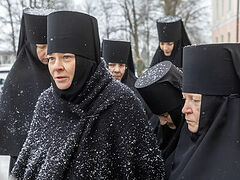
Among the measures cited were the abrupt termination of the Church’s long-standing lease in Tallinn, a significant and unexplained increase in insurance premiums for the Pükhtitsa Convent, and the expulsion or de facto removal of senior clergy without adequate procedural safeguards.
In 2024, His Eminence Metropolitan Evgeny of Tallinn, the Church’s primate, was forced to leave Estonia when authorities refused to renew his residency permit. Officials provided no cause for the decision despite having publicly stated they had found nothing suspicious in his conduct or in the Church’s activities.
The experts noted that although the amendments to the Churches and Congregations Act are drafted in general terms, they have been justified and applied in practice almost exclusively in relation to the EOCC’s historic canonical ties with the Moscow Patriarchate. Even before the legislation was adopted, certain state bodies had created what the experts described as “an adversarial environment” inconsistent with the state’s duty of neutrality in matters of religion or belief.
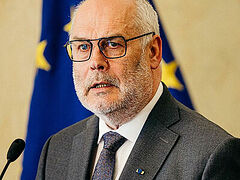
The experts welcomed President Alar Karis’s decision not to promulgate the amendments and to refer them to the Supreme Court for constitutional review.
They called on the Estonian government to halt administrative and judicial actions directed at the EOCC and its institutions, pending the outcome of the constitutional review by the Supreme Court of the amendments to the Churches and Congregations Act and launch inclusive consultations with affected communities.
The experts involved are George Katrougalos, Independent Expert on the promotion of a democratic and equitable international order; Nazila Ghanea, Special Rapporteur on freedom of religion or belief; and Nicolas Levrat, Special Rapporteur on minority issues. The experts indicated they are in contact with the Estonian authorities on this issue.
Follow OrthoChristian on Facebook, Twitter, Vkontakte, Telegram, WhatsApp, and MeWe!