Kiev, January 26, 2026
 Photo: risu.ua
The head of the schismatic “Montenegrin Orthodox Church” (MOC) testified to direct contacts with the Patriarchate of Constantinople in an interview in 2024, which contradicts the recent assertion of Metropolitan Emmanuel of Chalcedon.
The MOC has been a frequent topic in Orthodox news in the past few weeks. On January 12, the Russian Foreign Intelligence Service accused Patriarch Bartholomew and the Patriarchate of Constantinople of planning to grant autocephaly to the MOC, though Montenegro is the canonical territory of the Serbian Orthodox Church.
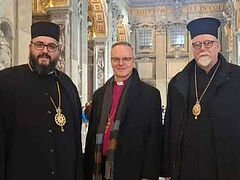
Met. Emmanuel of Chalcedon, one of the highest-ranking Constantinople hierarchs, contended in an interview a few days later that they have never had any contact with the MOC (though he and another bishop had, in fact, concelebrated the Divine Liturgy with Boris Bojović, who now leads the MOC, back in 2019). Archbishop Ilia of Constantinople’s Finnish Orthodox Church was seen a few days later in a photo with Bojović. According to the Archbishop, they simply ran into each other at an event in Rome and took a quick photo, though the MOC, which openly desires autocephaly from Constantinople, described it as a meeting.
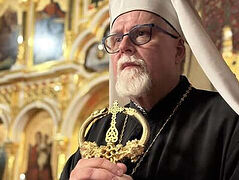
Against this background, an interview that Bojović gave to the Religious Information Service of Ukraine in May 2024 resurfaced.
Asked what progress had been made in resolving the MOC’s non-canonical status, Bojović expressed his hope in Constantinople: “We have contacts, and I hope that soon we’ll be able to travel to the Phanar to speak with representatives of the Constantinople Patriarchate about the spiritual freedom of the Montenegrin people, who have major problems in their relations with the Serbian Orthodox Church.” (In fact, The 2011 census and subsequent data suggested about 70-90% of the Orthodox population in Montenegro follows the Serbian Orthodox Church, with only about 10% supporting the schismatic Montenegrin “Church.” Thus, Bojović and his supporters are a small minority, and do not statistically represent the Orthodox believers in Montenegro, where according to the 2023 census 71% of the population identify as Eastern Orthodox.)
Further, in-person contact with the Patriarchate was already a reality at that time, he says: “The Patriarchate of Constantinople has now sent observers to see what the internal organization of the Montenegrin Church looks like.”
Thus, Bojović and Met. Emmanuel have presented contradictory accounts of the relationship between Constantinople and the MOC.
Before joining the MOC in the late 2010s, Bojović was actually a member and “cleric” of the “Kiev Patriarchate”—one of the schismatic groups that entered into communion with Constantinople in October 2018 and joined with the schismatic “Ukrainian Autocephalous Orthodox Church” that December to form the “Orthodox Church in Ukraine.”
He received his theological education at the KP’s Kyiv Theological Academy and became a “priest” in 2006. He was elevated to the rank of archimandrite within the KP in 2016. In entering into communion with the KP and unilaterally lifting the anathema against its leader, “Patriarch” Philaret Denisenko, in 2018, Constantinople, according to its own understanding, retroactively legitimized the ordinations performed by the KP.
Follow OrthoChristian on Facebook, Twitter, Vkontakte, Telegram, WhatsApp, and MeWe!