Prague, January 27, 2026
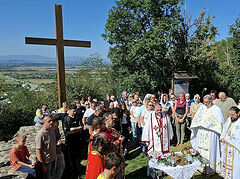
 In 2023, Abp. Michael of Prague was photographed with members of a Russian Orthodox motorcycle gang, which is cited as evidence of the Czech Church’s connection to the Russian state. Photo: info.dingir.cz
A policy brief published by the Czech Academy of Sciences raises serious allegations about security risks posed by the Orthodox Church of the Czech Lands and Slovakia, though the report relies heavily on speculation and provides limited concrete evidence to support its most serious claims.
The report, titled “Security Risks of the Orthodox Church,” was first presented at a non-public event at the Academy on January 14, before being made publicly available. It focuses on two Orthodox jurisdictions in the Czech Republic: the autocephalous Orthodox Church of the Czech Lands and Slovakia, and the Russian Orthodox Church, which has a representation parish in Karlovy Vary.
According to the 2021 census, over 40,000 Czech residents identified as Orthodox, making it the second-largest religious denomination in the country. This number has grown substantially with the arrival of approximately 500,000 Ukrainian refugees since the start of the war in February 2022.
The report alleges potential Russian influence and illegal activities within the Orthodox Church, but much of its argument is characterized by conditional language and speculation. The brief states: “While the majority of members of the Orthodox Church of the Czech Lands are opponents of Russian imperial policy, the Church leadership and some clergy are, on the contrary, closer to the Moscow Patriarchate, which supports this policy. The Orthodox Church of the Czech Lands may become a ‘fifth column’ for Russian interests and intelligence operations.”
The report alleges that Czech Church leadership:
-
Supports Russian policy through social media narratives and fails to publicly oppose the war in Ukraine
-
May have intelligence connections to Russian security services
-
Engages in opaque financial transactions and questionable property transfers
-
May facilitate illegal activities including smuggling, money laundering, false identity documentation, and illegal residence permits in the EU
-
Harbors pro-Russian Ukrainian clergy, possibly illegally present in the country
The report claims these concerns extend to the Russian Church representation, which was registered by the Czech Ministry of Culture in 2007. Regarding this registration, which occurred with the consent of the leadership of the Orthodox Church of the Czech Lands, the report speculates: “Given the close ties of this leadership to the Moscow Patriarchate, this is not surprising, as the pro-Russian leadership of the Czech Orthodox probably merely fulfilled Moscow’s order”
The report’s most substantial piece of evidence appears to be a 2023 photograph showing His Eminence Archbishop Michael of Prague, representatives of the Serbian Orthodox Church, and the Serbian ambassador together with members of the Night Wolves Russian motorcycle gang (which before the war was warmly welcomed in Orthodox countries throughout Europe) at an event in Jindřichovice near Sokolov. The Church itself posted the photograph on its official Facebook page.
Beyond this, the report cites other speculative ties, including that Abp. Michael and his secretary Igor Střelec both appear on Communist-era StB (secret police) lists and studied in Moscow, and that some other clergy studied in Russia or served in the Moscow Patriarchate in the past.
The report alleges that Abp. Michael “does not actively oppose the current Russian regime and its invasion of Ukraine” and that on “internal forums—including cyberspace and social networks—they take a positive stance toward them because they’re supported by Patriarch Kirill of Moscow.”
At the same time, the report itself states “not only the vast majority of Orthodox refugees from Ukraine and Orthodox believers originally from Bulgaria, Romania and other countries, but probably also the majority of Orthodox Russians living in the Czech Republic today reject Russian imperialism, aggression against Ukraine, and Vladimir Putin’s authoritarian regime."
The policy brief concludes with recommendations that Czech authorities consider revoking the registration of the Russian Orthodox Church and potentially withdrawing certain special rights from the Orthodox Church of the Czech Lands, and calls for enhanced monitoring by security services.
The report has potentially serious implications for the Orthodox Church, as Czech law allows the Ministry of Culture to revoke Church registrations for serious or repeated violations of obligations or legal requirements. However, critics note that much of the report relies on inference, historical associations, and speculation about possible activities rather than documented evidence of current illegal conduct or coordination with Russian intelligence services.
In a comment to a Czech news article on the Academy of Sciences report, Jakub Jiří Jukl, a member of the Prague Diocesan Council, writes:
[The author of the news report] is talking incredible nonsense here. What specific security threats does the Orthodox Church of the Czech Lands represent? How specifically does it support Russian policy? Well, apart from those “narratives,” where according to this logic everyone who doesn’t unconditionally support Ukraine, the EU and the USA supports Russia… How does our Orthodox Church participate in criminal activities? This is a serious accusation, so it really needs to be substantiated… The only stated fact is that three years ago our Archbishop was photographed with the Night Wolves, which seems pathetically insufficient to me.
Jukl also states that “the majority of our clergy are priests from Ukraine,” and asks the author of the news article, “How can they support Russia? But perhaps [the author] could explain to them how they should view the situation in Ukraine.”
***
This is not the first time that authorities in the Czech Republic have raised concerns about the Orthodox Church. In August 2024, it was reported that the residency permit of Archpriest Nikolai Lischenyuk, who served as representative of the Russian Orthodox Church in the Czech Republic from 2001 to 2022 without incident, was canceled.
That same month, the Senate Security Committee called for the state to investigate both the Russian Church’s representation parish and the entire autocephalous Orthodox Church in the Czech Lands, which prompted a strong response from the Prague Diocese.
In November 2025, it was reported that the Czech government was considering imposing sanctions on His Eminence Metropolitan Hilarion (Alfeyev), who was recently appointed rector of the Russian church in Karlovy Vary.
Follow OrthoChristian on Facebook, Twitter, Vkontakte, Telegram, WhatsApp, and MeWe!