Odessa, January 29, 2026
 Photo: nv.ua
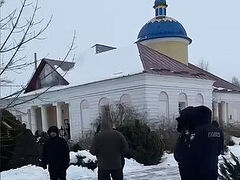
Buildings at the Ukrainian Orthodox Church’s Holy Dormition Monastery in Odessa sustained significant damage during an overnight attack on January 28, according to the UOC’s Information and Education Department, citing the diocesan press service.
The attack resulted in shattered windows in the monastery’s churches and damage to multiple structures. The cathedral church in honor of the Life-Giving Spring Icon of the Mother of God was affected, as well as the cemetery. A direct hit damaged the monastery’s dairy and agricultural facilities, while the greenhouse on the monastery grounds was completely destroyed. Other structures also sustained damage.
Throughout the night, emergency services brigades worked to extinguish fires on the monastery territory. Their efforts were repeatedly interrupted by air raid alerts, forcing personnel to take shelter during periods of danger.
“Most importantly, everyone is alive. One of our seminarians was wounded and has already been hospitalized by an emergency medical team,” the Odessa Diocese reported.
The Ukrainian Orthodox Church’s report states that the damage came during Russian shelling of the city.
This is not the first time historic Orthodox sites in Odessa have been affected during the conflict. In July 2023, the historic Holy Transfiguration Cathedral in Odessa was badly damaged.
In April 2020, before the war, Holy Dormition Monastery also suffered during a wave of arson attacks targeting Ukrainian Orthodox Church properties.
About Holy Dormition Monastery
 Photo: Facebook
Holy Dormition Monastery was founded in 1814 by Metropolitan Gabriel on donated land in the Bolshoi Fontan area of Odessa. Initially an archiepiscopal residence, it became a male monastery in 1824. The monastery’s original wooden church was replaced by a stone cathedral in 1825, with additional churches built in 1834 and later dedicated to the Life-Giving Spring Icon and St. Nicholas.
The monastery’s property was confiscated in 1922 and its main cathedral demolished after 1936. It reopened during Romanian occupation in 1942 and fully revived in 1944. From 1946, it served as the summer residence of the Patriarchs of Moscow, becoming known as the Patriarchal Monastery. The Odessa Theological Seminary relocated there in 1961, and the ruling hierarch’s residence moved to the monastery in 1965.
Major reconstruction occurred in the late 1990s-2000s under His Eminence Metropolitan Agafangel of Odessa, including a new cathedral in honor of the Life-Giving Spring Icon, completed in 2010 with capacity for 3,000 worshipers. The monastery necropolis contains burials of several hierarchs, including metropolitans from the 19th and early 20th centuries whose remains were transferred there in 1987.
Follow OrthoChristian on Facebook, Twitter, Vkontakte, Telegram, WhatsApp, and MeWe!