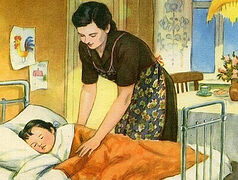
By artist Elizabeth Nourse
I have a friend. She is a foster parent of a disabled child with spinal muscular atrophy. Anyone who has heard of this disease would understand how serious this diagnosis is. If someone has never heard of it—just look it up online.
She once took her child to church—not the one she goes to regularly, but some other one. There, a good old granny greets her:
“Oh my, but how you must have sinned if the Lord gave you such a child!”
“He isn’t my own, I adopted him.”
“But how you must have sinned if you had to adopt such child!!!”
It does sound like a joke, but, sadly, it’s the stark reality of life.
This story came to mind because of a recent statement by a priest who, from the pages of an Orthodox publication, shared a thought that hereditary genetic diseases in children are the result of their parents’sins.
“Why do you have eyes, then?”
I took the trouble to find the priest’s number and called him. What if it was taken out of context? That’s happened many times before.
But no, nothing was taken out of context, his thought was communicated accurately. Nevertheless, he and I had a really friendly exchange. But we remained unconvinced. I was on the side of my Masha, who has Down syndrome, and he was with geneticists and their scientific conclusions about causal relationships of the following nature: the sins of Mom, Dad or more distant ancestors bring about a genetic disease in a child. And he completely agrees with them.
It’s not that I got very offended—I actually didn’t feel offended at all. But I really wanted to contemplate this topic a bit longer. Not only because it is truly important and painful at times, especially for those of us who raise disabled children. Or for those who are expecting a disabled baby. But I also wanted to do this because, during the eight years I’ve been a mother to a special needs child, I arrived at an amazing conclusion. It is the church-going people who take the birth of a disabled child most heavily.
You heard it right, yes, it’s we!!! We, who seemingly should rejoice, pray non-stop and seek Divine Providence and His Care for us.
It’s a peculiar paradox, isn’t it?
But what about everyone else—the people outside the Church? They may say: “All right, we had this child” (if they did not choose abortion). It just happened; it was a coincidence. And perhaps they think of themselves as strong people—or, depending on their personality, the opposite: “I’m a failure.” In any case, they say: “We somehow have to raise him” (if they did not give him up for adoption at birth). And then they raise the child, love him, and go on enjoying life. Not all of them, of course, but many.
As for us, we tend to think that nothing is simply a coincidence. We are always saying: “This happened for a reason!” Again, not all parents think this way, but many do. If something goes wrong, or turns out differently from what we expected, or pushes us out of our comfort zone or beyond our plans, we often attribute it all to our sins.
I remember how one priest, the father of two children with Downs syndrome (about whom people would say, “What terrible sins he must have committed…”), once said to a woman who also believed that everything in her life had gone wrong because of her sins:
“Then why were you given eyesight? You must have done something right, mustn’t you? And what about your arms and legs?”
“With quality guaranteed”
Why is that? Well, it’s certainly not because we Orthodox are especially bad, weak, or foolish. We are like everyone else—neither better nor worse. The Lord alone is the best, and the devil is the worst. As for us human beings, we are somewhere in between, swinging back and forth.
The real issue is that, deep down, we often feel as though we have a kind of “quality guarantee.” All we need to do, we think, is follow all the rules correctly.
We must observe every fast, confess regularly, receive Communion, attend the services of Holy Unction—and heaven forbid you should step onto the rug where the priest stands while anointing people with oil during the Polyeleos service…
We must learn which colors of clothing are appropriate for each feast (I myself once carefully chose color-coded prayer beads for such occasions) and which garments ought to be thrown away—or better yet, burned… along with the books of writers who have fallen out of grace.
We must know exactly when during the service we may sit and when we must stand; when to make the sign of the cross and when to bow—and how to bow: a full prostration, a waist bow, or just a respectful inclination of our stubborn heads.
We must also know how and when marital relations are permitted, and in what manner—so that we do not violate a day of abstinence or bring shame upon the moral image of a Christian.
And so on, endlessly.
Of course, this is partly my artistic—or perhaps semi-artistic—exaggeration. There are far deeper and more serious things: the commandments, the Gospel itself. Yet the underlying principle often remains the same: If you know everything and do everything correctly, then everything will work out perfectly. Here and now. Everything will be fine. Our life has the divine “quality stamp” on it.
Faith becomes something like effective management: you paid for it—you purchased it. But then we discover that we are still very much of this world. We are Orthodox, yes, but we remain people of the world, right down to our fingertips. I am not sure how to explain it more clearly. Again—not all of us, but many. Myself included. And I only truly realized this when I gave birth to a child with special needs.
“Now everyone will know everything about me”
It feels as if it happened only yesterday. The doctor delivers my daughter, looks at her for a moment, and then thoughtfully asks whether my husband might be of Asian descent. When he learns that he is not, he asks why I did not have any prenatal screenings. That was the moment I first heard that my daughter had Down syndrome.
Eight years have passed, but I still remember the first two thoughts that came into my mind.
First: Will my husband abandon us now? Why did I think that? Why would he ever leave us? But somehow that thought had been firmly planted in my mind.
Second: Why, Lord? What for? That terrible question: “Why?” After all, I had been doing everything right.
Vadim and I had a church wedding. We have a large family. We dress modestly. My husband serves in the altar, and I am an Orthodox writer. Nothing grand—more of a scribbler—but still, that is what I am.
I receive Communion every week. Every day I read a kathisma, the Gospel, and the Acts of the Apostles. Well… not every day, to be honest. But I try!
And we did not conceive our daughter during a fasting period. I had been taught that sick children were conceived during fasts! So… Why did this happen? Yes, I have plenty of sins—more than enough. But I was doing all the right things!
That little girl with Down syndrome seemed to me like a living accusation of some terrible hidden sin of mine: “Now everyone will see her, and they will know everything about me.”
It was painful. It was terrifying. And most of all—it was humiliating. At that moment this little, strange-looking baby with Down syndrome seemed like my public exposure before the world: “Everyone will see her, and they will know.” And all I wanted was to hide her, to show her to no one—so that no one would discover that I too must have been “punished for something.”
Only much later did I hear a truly horrifying story.
A woman once gave birth to a child out of wedlock. I cannot remember exactly what illness the child had—perhaps it was a disability. I do not know where the child’s father had disappeared to. The woman fell into deep despair. In that state, with the baby in her arms, she came to a monastery to confess. She told the hieromonk: “I had a child… I am not married.”
The priest began to admonish her, telling her she had lived in sin and that this child had been given to her because of her sins. There was a lake on the monastery grounds. The woman went there and threw the baby into the water. As she later explained, she believed that her punishment and shame were now gone, along with the child.
Thank God another monk happened to be passing by. He saw what happened and pulled the baby out of the water. Both of them survived.
There is another story—less dramatic, but also revealing. I once spoke with a priest’s wife. Their family also had a child with Down syndrome. At that time the baby was already more than six months old. Yet they still had not decided how to tell the parishioners about his diagnosis. After all—how could it be? A priest… and a child who looks “different.” People would surely decide that it must be because of some terrible sin.
“I am Orthodox in order to feel good”
Of course, there are times when illness comes as a direct consequence of sin. Still, I prefer to think of it not as happening “for something,” but rather “because of something.” The difference may seem small, yet it matters. The Lord does not sit on a cloud holding a sledgehammer, waiting to see whom He should strike next. But a person can easily turn away from Him and ruin his own life with his own hands.
For example, a woman may not want a child and attempts an abortion. But the procedure is somehow incomplete, and the baby is born severely disabled. I have heard of such cases. Or a couple abuses alcohol or drugs, and the child suffers as a result.
Yet in reality, I have often seen the opposite—such parents frequently give birth to healthy children. And here one can see the mercy of God toward those babies. With such parents, a disabled child might simply not survive.
But batiushka was speaking specifically about genetic diseases. Besides Down syndrome, there are conditions such as cystic fibrosis, Patau syndrome, Edwards syndrome, Williams syndrome, Turner syndrome, and countless others. There are also muscular dystrophy, Huntington’s disease, pituitary dwarfism, and so on—an endless list.
Whenever Masha and I travel to medical rehabilitation centers, I encounter diagnoses I had never even heard of before. And the parents of those children had never heard of them either—until the day their child was born.
And then there is hemophilia, the illness suffered by Tsarevich Alexei Nikolaevich.
So what then? Are we to say that all these children became ill only because of some parental or ancestral sin?
And who would dare to guarantee that if you fulfill all the commandments, you will give birth to a healthy child? That if you read a prayer rule or participate in a prayer “by agreement,” your life will automatically become joyful? Who could possibly give such a guarantee?
I remember another story. A young married couple once visited a monk. Doctors had told them that their unborn baby had Down syndrome. Naturally, they were frightened. But the monk assured them that if they prayed and lived according to the Church’s rules, the child would be born healthy.
They did everything he advised. Yet the baby was still born with the syndrome.
The young parents became angry—with God, with the monk, and with the Church—and they left. As if they had walked out of a store that had sold them a defective product. Apparently the “management system” had failed. They had been cheated.
But, truth be told, I myself began in much the same way. I prayed to St. Matrona of Moscow and gave up wearing pants so that I could be admitted to graduate school. Then I prayed to St. Xenia of St. Petersburg, adding forty days of reading her akathist, so that I might get married. And indeed, I was admitted to graduate school, and I did get married. And that is wonderful!
Many of us begin this way. We try to follow the rules and ask God for help in prayer. The Lord Himself tells us to ask. The problem was that I stopped there. My faith became something like this: I am Orthodox in order to live well and comfortably.
Others go to the opposite extreme. For them, the worse your life becomes, the more Orthodox you must be. The more suffering you endure, the more “correct” your Christianity must be.
Of course, many people truly do walk the path of sorrow, and I bow my head before them. But suffering in itself is not the goal. Christianity is not about wearing a permanently gloomy face and cultivating suffering as a virtue. And, on the other hand, being wealthy or successful does not automatically mean that a person is sinful.
In general, Christianity is not about everything going well. But neither is it about everything going badly.
God has His own logic
I understood all of this only later. But back then, in the maternity hospital, my faith nearly collapsed like a house of cards. What was the point of all those fasts, prayers, relics, and rules? Of everything I had been doing—if I still received this child?
I so wanted to turn away from God, to leave, to run. To run from that cruel and terrible God.
But apparently the Lord held me firmly by the scruff of the neck. I did not go anywhere. Instead, I began to rebuild my life—and my faith. Brick by brick. Through pain and tears. Turning my soul inside out. And to my amazement I discovered that all that doing—all those practices—are not a magic cure. They are the path, the means, but not the goal. And certainly not a guarantee.
Christianity is neither an efficient management system nor a kind of trade with God. What I was given was the chance to begin moving away from being a merely worldly and emotional person, and to start becoming a spiritual one. Whether I will succeed—that is another question. But I have been given a remarkable opportunity. And that is exactly what it is: an opportunity, not a punishment.
Yes, I am a sinful person. No—not even that. I am SINFUL. By rights I should long ago have been burned to ashes for my sins. But is Masha, with her genetic condition, really the result of my many falls?
For some reason, I do not believe so. I cannot prove it. I simply feel it. And, incidentally, geneticists cannot prove the opposite either—at least not scientifically. I feel that God’s ways do not follow our human logic.
If you refrain from abortion and struggle against sin, you do not do it in order to receive a healthy child as a reward. You do it to please God and to avoid harming your own soul. You pray and fast for the same reason. But what the Lord will give you for your salvation—whether illness, a child with special needs, great wealth, or its absence—He alone knows best.
God’s will might be that I should have a child with special needs. But His will for someone else might be something entirely different—perhaps an iron constitution and perfect health. If a person cannot accept this, he may leave the Church, saying: “I prayed and fasted, and all I received was a disabled child.” Many people do leave. They run away—especially when someone tells them, “This child was given to you because of your sins.” I have heard countless such stories.
A mother comes to church, exhausted and desperate, grasping at the last straw. And before she knows it, someone strikes her over the head with accusations of her sins—perhaps even with talk of some ancestral curse, just to complete the picture. But that is not how it works with God.
Yes, it is true that no sin disappears without leaving some trace. But that “trace” is different for every person. Very often, a person himself becomes his own greatest punishment. Nothing further needs to be added.
Try being a faithful believer when your plans fall apart
Yet I feel that by giving me this child, the Lord showed me that—despite everything—He had not given up on me, even though perhaps He should have. That He loves me and believes in me. He believes in my family. And He believes in Masha. By giving me this child, the Lord showed me that He had not been disappointed in me after all.
I remember the words of a priest who has two children with Down syndrome. When people try to “explain” his situation in a simplistic way, he answers like this: “The Lord gives everyone different talents—ten to one person, five to another, and one to someone else. And you know what? The Lord gave ten talents to disabled children, five to the parents of disabled children, and one to everyone else.”
This does not mean that one person is better and another worse. Everyone simply has their own strength and their own measure. A person can be saved with just one talent—or bury ten in the ground.
How can the life of this tiny child, given by the Lord, be considered a punishment? God has placed that life into your hands so that you may love and care for it. And through this, both of you may be saved. Perhaps this is the simplest and most direct path given to you. Whether a person is healthy or ill does not really matter. Each of us has our own shortest and easiest road to salvation—built from the resources the Lord has entrusted to us.
Do we not all pray to be saved? Then why do we reject the very means by which salvation may come to us? It is a little like finding a job. We want a high salary. We want our résumé to be accepted. But that is only the beginning—after that, you actually have to work. It is not enough simply to send out your application and sit back. The same is true here.
If you want to be saved—then work. Accept the “job” that has been offered to you and begin to “build your career.” Raising a child with disabilities is a great and demanding work. But even that guarantees nothing, just as keeping the commandments does not guarantee that your children will be healthy, and having a disabled child does not automatically guarantee salvation.
What it does mean is that you have been entrusted with many talents. I only hope we do not bury them. Because it is easy to be a believer and to save your soul when everything goes according to plan.
But try doing it when all your plans collapse.
Then trust.
“He that is joined unto an harlot”
This is precisely what I lacked during all those years of church life: reliance on God. Not simply faith in God, or faith in good works, but reliance on Him—trust in Him. Although, of course, faith without works is dead.
No, I am not going to tell parents of children with special needs how they ought to live. I am not going to say that if you are not happy about having a disabled child, then you are somehow failing to live according to God’s will. Parents of such children have every right to feel pain. Very often that pain is intense. They have every right to fear public opinion. They also have every right to fear what fellow believers may think of them. All of this is entirely human and entirely normal—when it feels as though the world has collapsed.
Of course, if our faith were stronger, we might have understood the main thing from the very beginning, and perhaps we would all be a little less complicated. At least a little. But every person has his own path, and his own first steps on that path. Some people take their first step a split second before death.
But I would very much like finally to get through to those who look at such people as great sinners, as Orthodox failures, as those upon whom the punitive will of God has at last been carried out.
Please—do not speak in clichés. Think about what you are saying.
Personally, I have not had to endure that kind of treatment. We were met with support by people in our church—and not only ours—and they continue to support us. They helped us lift our cross and carry it with us. In fact, for a long time now it has not even felt like a cross. I do not think I will ever be able to repay that debt of love.
And yet it turns out that something else still exists—something entirely different. Something supposedly even “scientifically proven.” You sat in the wrong place, dressed the wrong way, lived the wrong way, conceived during a fast—and now here you are: deal with the consequences. Since you did not live according to the will of God then, now try living according to it!
“We know from Scripture that he which is joined to an harlot is one body: for two, saith he, shall be one flesh. Whose heredity will the child receive? All of these things are very important. God help you, dear Elena,” wrote to me the author of the article in which batiushka expressed his opinion.
If it were only about me—that would be one thing. But why is it so hard even to admit the possibility that one of the parents of a disabled child may actually be living a righteous life? Both before the child’s birth and after? Why dismiss the possibility that they did seek the will of God before—and that they are still seeking it now?
“Not to love for something, but simply to love”
But if we allow ourselves to think this way, then we are no longer living according to God’s will. Because whenever we find ourselves near someone who is suffering or in sorrow, we enter the very sphere of God’s will concerning that person. And that will concerns not only them—it concerns us as well.
These people have taken up their cross and carry it, sometimes against their own desire. God’s will for us in this situation is to approach it with reverence. It is to recognize the greatness of God and the depth of His wisdom. It is to stand in awe before Him.
Sometimes it means standing silently, watching how another person accepts something that may be far beyond their strength. Something that might be beyond your strength as well—do you understand? And if you yourself have not experienced such misfortune, that does not mean you have received an “A” for good conduct.
There is another phrase that is often repeated: “The Lord will not give a cross beyond what you can bear.” And so people say: Well then, carry it, sinner! If you cannot, it must be because you simply do not want to.
But in reality, it often is beyond a person’s strength.
Even Christ’s Cross was beyond His strength as a man—He received help in carrying it. What, then, can we say about ourselves, ordinary people?
Sometimes God’s will is precisely this: that someone else’s unbearable cross should be lifted and carried together. Instead of labeling people, instead of puffing ourselves up with a sense of our own righteousness.
The parents of a disabled child may be more righteous than you. Or perhaps more sinful.
But each of us has been given our own shortest path to salvation.
One priest who himself has two children with Down syndrome once wrote to me:
“The birth of a disabled child is a profound act of trust from God. It is His confidence that you, of all people, will bear this in such a way that you become an example of humility and joy in everything He gives—so that we may learn, like Him, not to love for something, but simply to love.”
Remember this: it is very easy to finish off someone who is already lying on the ground. Or to push someone who is already standing on the edge of a cliff.
Do not do it.
And remember the words of the Gospel of John (9:1–3):
And as Jesus passed by, he saw a man which was blind from his birth. And his disciples asked him, saying, Master, who did sin, this man, or his parents, that he was born blind? Jesus answered, Neither hath this man sinned, nor his parents: but that the works of God should be made manifest in him.
Think about these words before drawing conclusions. And remember, it is easy to destroy someone who is already broken, to push someone who is already standing at the edge.
Do not do it.
Be merciful, as your Father is merciful.