Paris, April 1, 2026
 Photo: sortiraparis.com
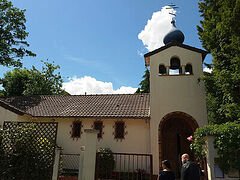
The Church of St. Sergius of Radonezh at the St. Serge Institute in Paris has been designated a historical monument by the French Ministry of Culture, with a ceremony marking the occasion scheduled for Sunday, April 19.
The event will run from 2:15 to 6:00 p.m. and will include a presentation on the history of efforts to secure the designation, public addresses, the unveiling of the historical monument plaque, an Orthodox religious concert, and a reception, reports the Archdiocese of Orthodox Churches of Russian Tradition in Western Europe (Moscow Patriarchate).
The inscription, which covers both the church and the surrounding gardens, was formally granted on August 14, 2025, and marks the centenary of the site’s acquisition by the Orthodox Church. The property at rue de Crimée was purchased at public auction on July 18, 1924—the feast day of St. Sergius of Radonezh according to the Julian calendar—by Metropolitan Evlogy (Georgievsky), who led the Russian Orthodox Churches in Western Europe from 1921 until his death in 1946. He acquired the site to establish both a place of worship and a theological school for the large wave of Russian emigrants who had arrived in France following the Bolshevik Revolution of 1917.
 Photo: archeveche.eu
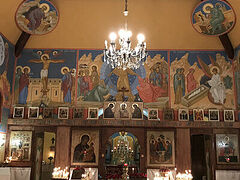
After its acquisition, the red-brick neo-Gothic building was adapted for Orthodox worship. The ground floor houses classrooms of the theological institute, while the church occupies the upper level. The interior iconographic program, including the frescoes, iconostases, and exterior facade decoration, was carried out by the painter Dmitri Stelletsky in the style of 14th- and 15th-century Russian iconography.
Over the following century, the St. Serge Orthodox Theological Institute became one of the most significant centers of Orthodox theological education in the Western world. Among its alumni are a patriarch, some forty bishops, and more than 400 priests. The institute has also served as a venue for ecumenical and interfaith dialogue.
The site had already received recognition in 2011, when it was awarded the label of Architecture contemporaine remarquable by the Ministry of Culture. The new inscription as a historical monument represents a higher level of legal protection under the French Code du patrimoine.
Efforts to obtain historical monument status for the site date back to 1960, according to the event program.
Follow OrthoChristian on Facebook, Twitter, Vkontakte, Telegram, WhatsApp, MeWe and Gab!