Mani, Greece, April 2, 2026
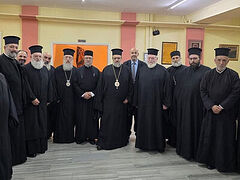
 Photo: Romfea
Metropolitan Chrysostomos of Mani of the Orthodox Church of Greece has strongly criticized the recent decision by Greece’s Council of State upholding the constitutionality of gay civil marriage and adoption, raising theological, legal, and social objections to both the ruling and the underlying legislation.
The Metropolitan’s statement comes in response to the decision issued by the Full Bench of the Council of State on March 20, which affirmed the constitutionality of the law that made Greece the first Orthodox country to legalize gay civil marriage. The Holy Association of Greek Clergy has likewise criticized the ruling.
On the question of marriage itself, Met. Chrysostomos argues that the constitutional concept of marriage in Greece carries a defined historical, cultural, and legal content—one that has always meant the union of a man and a woman.
Citing the 3rd-century Roman jurist Modestinus, he defines marriage as “the joining of a man and a woman, a partnership for life in all things human and divine,” and contends that the difference of sex is intrinsic to marriage as an institution. On this basis, he argues, same-sex marriage is not simply a modification of the institution but a contradiction of it, and the relevant legislative provisions are unconstitutional.
He notes that this position was also expressed in the dissenting opinion of the six Council of State justices who voted against the majority ruling.
The Metropolitan further grounds his position in Christian teaching, citing Genesis and the writings of the Church Fathers, including Sts. Basil the Great, Gregory the Theologian, and John Chrysostom, all of whom, he argues, understood marriage as a God-established union of man and woman. He also cites legal and theological scholars.
On adoption, Met. Chrysostomos challenges the court’s finding that gay couples adopting children does not conflict with the best interests of the child. He argues that the best interests of a child require the presence of both a father and a mother, who perform complementary and irreplaceable roles in a child’s development. He also echoes the minority opinion of the court, which noted that the legislature had not drawn on long-term studies examining the intellectual, psychological, and social development of children raised by same-sex couples.
Met. Chrysostomos closes by arguing that Greece, as a country whose constitution recognizes the Orthodox Christian faith as the prevailing religion and which has a deep historical and cultural tradition, should not allow such a slide on these fundamental issues.
He invokes both the legal framework governing Church-State relations and a moral, historical, and national obligation, pointing to the Holy Synod’s Encyclical 3085/2024 and its announcement of January 23, 2024, as expressions of the Church’s position.
Follow OrthoChristian on Facebook, Twitter, Vkontakte, Telegram, WhatsApp, MeWe and Gab!