Kazan, Kazan Province, Russia, July 21, 2026
 Photo: Google images
Sts. Peter and Paul Cathedral in Kazan, one of the most recognized architectural and spiritual landmarks in the capital of Tatarstan, is marking its 300th anniversary this year.
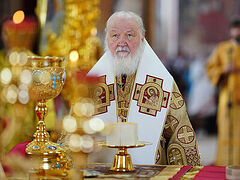
His Holiness Patriarch Kirill of Moscow and All Russia visited the cathedral on July 20 as part of a primatial visit to the Tatarstan Metropolis, according to a report on the Patriarchate’s website.
The cathedral's foundation was laid in 1723, and construction moved quickly by the standards of the time—the church was consecrated by 1726, with a freestanding bell tower added the same year. The building arose on the site of an earlier Sts. Peter and Paul church first mentioned in records dating to 1565. Its construction was tied to a visit by Emperor Peter I, who stopped in Kazan on May 27, 1722, en route to his Persian campaign and stayed at the home of merchant Ivan Mikhlyaev. To commemorate the visit, Mikhlyaev decided to replace a small wooden church on the site with a grand two-story stone cathedral.
 Photo: patriarchia.ru
The upper, main summer church was consecrated in honor of the Holy Chief Apostles Peter and Paul, while the lower, heated church on the first floor was consecrated in honor of the Meeting of the Lord. Two smaller side chapels were dedicated to the Life-Giving Spring and Unburnt Bush icons of the Mother of God.
The church remained active into the Soviet era until its closure in 1939, after which it was designated a state-protected architectural monument. From the 1950s through the 1980s, the building housed a planetarium. It was returned to the Church in 1989 through the efforts of His Grace Bishop Anastasy of Kazan and Mari El and the local faithful. Despite roughly 50 years without services, the cathedral retained its seven-tier iconostasis, built in 1723–1726 in the Russian Baroque style and later restored following the 1815 fire.
His Holiness Patriarch Alexei II visited the cathedral twice during primatial visits to the Kazan diocese, in 1997 and 2005.
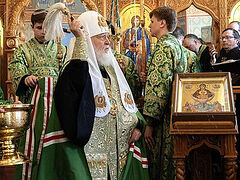
During his July 20 visit, Pat. Kirill was accompanied by Tatarstan head Rustam Minnikhanov, His Eminence Metropolitan Kirill of Kazan and Tatarstan, and other Church and civil officials. Addressing those gathered inside the cathedral, the Patriarch reflected on the survival of the Church through the Soviet period of religious repression: “When you look at these churches that lived through an era of ruin and the destruction of holy things, you understand how much stronger the power of God is than human power ... Churches are being restored, renovated, and newly built.”
The Patriarch presented the cathedral with an icon of St. Matrona of Moscow, recalling that even though blind and disabled from birth, she became “a center of attraction for thousands of people,” including, secretly, Soviet officials who feared being seen visiting her. “I wanted to give the image of St. Matrona to this church as a sign that the power of God is greater than any human power,” he said.
 Photo: patriarchia.ru
Pat. Kirill also venerated the relics of His Eminence Metropolitan Ephraim of Kazan, who crowned Tsar Michael Romanov in 1613, and viewed the Ephraim Gospel, now held in the cathedral and considered one of the most valuable items in the National Museum of the Republic of Tatarstan. St. Ephraim, who became Metropolitan of Kazan in 1606, was a close ally of the martyred Patriarch Hermogenes during the Time of Troubles, supporting the national volunteer militia and later serving as caretaker of the Patriarchal throne. He signed first among the hierarchs on the 1613 Zemsky Sobor act electing Michael Romanov as tsar.
St. Ephraim died in December 1613; his relics, lost after the Soviet destruction of the Kazan Kremlin’s Transfiguration Monastery, were rediscovered during archaeological excavations in 1995 and transferred to the cathedral. He was included in the Synaxis of Kazan Saints by decision of the Holy Synod on May 16, 2023.
Follow OrthoChristian on Facebook, Twitter, Vkontakte, Telegram, WhatsApp, and MeWe!