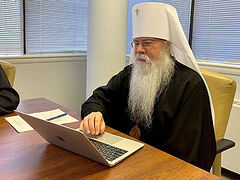
New York, July 29, 2026
 Photo: themoscowtimes.com
The Eastern American Diocese of the Russian Orthodox Church Outside of Russia has issued a Social Media & Digital Conduct Policy for clergy, employees, and volunteers.
The policy was announced in a letter to diocesan clergy by His Eminence Metropolitan Nicholas of Eastern America & New York, First Hierarch of the Russian Church Abroad, along with His Grace Bishop Theodosius of Manhattan, His Grace Bishop Luke of Syracuse, and His Grace Bishop Michael of Boston. The letter states that clergy and those in Church positions “have a higher level of responsibility and a lower bar to measure our actions for appropriateness,” and notes that time spent online is “already a problem for most, even under the guise of pastoral work.”
The policy applies to all diocesan clergy, priests and deacons, those in the Lesser Orders (readers and subdeacons), and lay employees and volunteers acting on behalf of the diocese.
The document states that its purpose is not to regulate private life or impose “intrusive oversight,” but to offer “pastoral guidance and prudent counsel” so clergy and others may exercise “restraint, vigilance, and wisdom in digital conduct.”
It instructs that online communications “should be measured, peaceable, and oriented toward edification rather than contention,” and advises that “silence and restraint are often preferable to public engagement in hostile or provocative environments.” Clergy and faithful are urged to reduce time spent on social media to guard against distraction from prayer, family life, and in-person fellowship.
On identity and representation, the policy states that digital expression should be offered “in one’s own name and voice, without misrepresentation or concealment of identity,” and that no one may present personal opinions as speaking for the Church without authorization. Those in the Lesser Orders are instructed not to use their titles or clerical identifiers online outside of liturgical or official Church contexts.
Regarding pastoral care, the policy states that digital media “is not a substitute for the lived sacramental life of the Church,” and that confession and spiritual counsel should ordinarily occur in person, with a believer’s confessor being their parish priest. Clergy, including monastics, are instructed not to accept remote spiritual children.
An appendix on accountability lists conduct that may warrant review, including public statements contradicting Church teaching, disclosure of confidential information, and engagement in “partisan political disputes or divisive geopolitical controversies” that alienates the faithful. It clarifies that “mere disagreement, personal offense, political dissatisfaction, or discomfort arising from faithful pastoral teaching” does not itself constitute a violation.
The policy comes a few weeks after Met. Nicholas issued an archpastoral letter on the same issue.
Follow OrthoChristian on Facebook, Twitter, Vkontakte, Telegram, WhatsApp, and MeWe!