New York, August 19, 2026
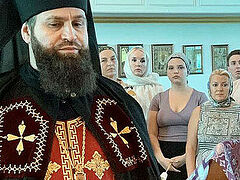
 The defrocked Alexander Belya (R) has been given refuge in GOARCH’s Slavic Vicariate
A federal appeals court has dealt a final blow to defrocked archimandrite Alexander Belya’s six-year legal battle against the Russian Orthodox Church Outside of Russia, affirming a lower court’s dismissal of his defamation lawsuit on First Amendment grounds.
The U.S. Court of Appeals for the Second Circuit ruled that the church autonomy doctrine bars Belya’s claims, finding that a Church’s selection and supervision of its clergy are inherently religious acts protected by the Constitution. The panel—Chief Judge Lohier and Circuit Judges Lynch and Menashi—affirmed summary judgment for the ROCOR defendants, which had already been granted by the district court in March 2025 on separate grounds, reports the Becket Fund, which is representing ROCOR.
Belya, a former priest who oversaw the St. Matrona parish in Miami, sued ROCOR’s senior clergy in 2020, claiming they defamed him by accusing him of forging letters related to his purported election as Bishop of Miami. The dispute traces back to 2019, when the Moscow Patriarchate announced its approval of Belya’s election—an announcement that caught ROCOR leadership by surprise, since, according to the defendants, no such election had actually taken place.
In response, diocesan leaders drafted a letter, later approved by the Eastern American Diocese’s leadership, raising concerns about irregularities in the documents purportedly confirming Belya’s election and calling for his suspension and an investigation. That letter became public after a former parishioner posted it on Facebook, and the story spread through Orthodox media, with some outlets describing the disputed letters as forgeries.
Writing for the court, Judge Gerard Lynch explains that resolving Belya’s claims would require a jury to wade into ROCOR’s internal governance, including its protocols for electing bishops and the communications among senior clergy about disciplinary matters.
“Requiring a church to accept or retain an unwanted minister, or punishing a church for failing to do so, intrudes upon more than a mere employment decision,” the opinion states, citing the Supreme Court’s Hosanna-Tabor precedent. The court finds this reasoning applies just as forcefully to defamation claims arising from a church’s internal disciplinary process as it does to employment disputes.
The court also rejects Belya’s argument that the case could be decided on the narrow, secular question of whether the now-deceased Metropolitan Hilarion’s signature on the disputed letters was genuine. Even that inquiry, the judges find, is inseparable from disputed questions about ROCOR’s election procedures and whether Church leaders acted reasonably given their understanding of those procedures—matters courts aren’t permitted to adjudicate.
Becket calls the decision a victory for religious communities’ right to govern their own affairs. “Churches can’t freely minister to the faithful if every internal leadership dispute can be the subject of a federal lawsuit,” said Diana Thomson, senior counsel at Becket and an attorney for ROCOR, in a statement.
His Eminence Nicholas, Metropolitan of Eastern America & New York and First Hierarch of ROCOR, said in a statement that the Church is grateful its work of ministry can continue “free to be guided by our best understanding of God’s leading.”
***
In terms of ecclesiastical court rulings, after the affair with his supposed episcopal election, and given a number of accusations against him, Belya was suspended from priestly functions by ROCOR on September 1/14, 2019, pending an investigation.
However, he instead fled to the Patriarchate of Constantinople’s Greek Orthodox Archdiocese of America without a canonical release from ROCOR. He was subsequently defrocked by ROCOR in February 2020, and thus is canonically only a lay monk.
GOARCH later created a “Slavic Vicariate” and placed Belya at its head. The Vicariate is largely made up of defrocked and suspended clerics.
The Greek Orthodox Archdiocese of America was forced to postpone its plans to consecrate Belya to the episcopate in the summer of 2022 after the hierarchs of the Assembly of Canonical Orthodox Bishops of America threatened to quit the Assembly if he became a bishop. The hierarchs affirmed that they recognize his suspension and subsequent defrocking by ROCOR, and also pointed to issues with the former cleric’s moral fiber.
Follow OrthoChristian on Facebook, Twitter, Vkontakte, Telegram, WhatsApp, and MeWe!