
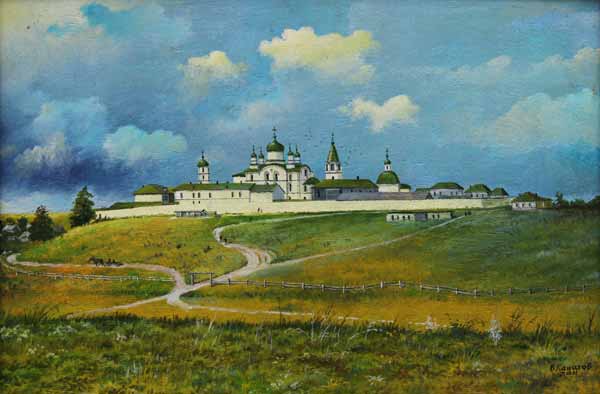
 Christ the Savior-Zelenogorsk cenobitic Monastery
Christ the Savior-Zelenogorsk cenobitic Monastery is located near the village of Zelenie Gori [Green Mountains—Trans.], in the Nizhny Novgorod region, near Pasmurov River, 23 miles from the city of Arzamas. On the spot where today stands a convent was originally the Christ the Savior-Belogorsk Monastery, founded in the seventeenth century by Monk Jonah. It was abolished after the monastery reforms [introduced under Empress Catherine the Great], but, by the grace of God, a women’s community was conceived in 1800 and gradually formed on the site of the former monastery.
The restoration of the ancient monastery was closely connected with the name of St. Seraphim of Sarov. During the years of his monastic obedience, St. Seraphim went to the Zelenogorsk market almost every year to buy honey, wax, sheepskins, and other items necessary for the Sarov Hermitage. When he was there, he couldn’t help but notice that dilapidated monastery fence with a tumbledown wooden church—the remains of the abolished monastery.
More than once he walked around the place and mourned its desolation. Once during such a visit, St. Seraphim noticed a small cell in the corner of the monastery wall where someone had withdrawn for the salvation of her soul. The saint joyously greeted the ascetics who had settled there and blessed them. He foresaw the coming rebirth of the ancient monastery, which was realized little by little, with his help, by the labors of the new inhabitants of this nascent nest of hermits.
From 1800, five widows and virgins who loved solitude and divine contemplation and were devoted to prayer and labor began to live there. The life of these first inhabitants, according to their contemporaries, was distinguished by extraordinary simplicity and was organized according to the monastic cell life. Having no means of their own, the poor sisters initially lived on alms for Christ’s sake. The Sarov elder, St. Seraphim, assisted them with his grace-filled prayers, advice, instructions, and material and other types of help until his own blessed repose.
Led and assisted by St. Seraphim from the first days of its existence, the poor, young community at Zelenie Gori was soon strengthened and began to grow and settled into a women’s monastery. The number of inhabitants grew and the number of monastic cells in the monastery walls began to grow. In 1893, the Zelenegorsk community was transformed into a cenobitic monastery of the third class. Thus, on the site of the ancient men’s monastery, a women’s monastery arose.
In the monastery wall, near the church, there is also the grave of one sister of the Zelenogorsk Monastery, outstanding in her spiritual life, Irene Lazareva, a beloved spiritual daughter of St. Seraphim of Sarov.
 Blessed Irеne of Zelenogorsk
Local tradition preserves her memory as an eldress renowned for her holy life. It is known from the manuscript of the hagiography of Eldress Irene Lazareva preserved in the monastery that she was the daughter of a peasant of the village of Murtaovka in the Sergachevsky region of the Nizhny Novgorod Governorate and was born in the first years of the nineteenth century.
At two years old, she lost her mother who was killed by a thunderstorm on St. Elijah’s day, and was then taken care of by her stepmother, a woman of contentious character. She lost her father a little while later. A difficult life began for Irene from that moment. Her stepmother really did not like her and tried every way possible to show her her poor disposition.
At twelve years old, Irene got married to the son of a peasant of her village, but immediately after the marriage she retreated to the forest, where she hid until her husband was recruited into the army. She would come out only secretly to help her beloved mother-in-law.
She began her monastic podvigs in Kiev, at the relics of the saints, becoming a sister of the Florovsky Convent. She labored there for nine years, bearing the different types of obediences laid upon her: She carried water, watched the gardens, baked and sold prosphoras, and so on. After nine years, Irene moved to the Diveyevo women’s community, in the Ardatov district, which was then under the direct patronage and guidance of the Sarov elder, St. Seraphim.
By her unquestioning obedience and precise execution of the obediences placed upon her, she drew the special attention of the blessed Elder, who called her his only spiritual daughter. After six years at the Seraphim-Diveyevo Monastery, Irene, with the blessing of Fr. Seraphim, moved to the Zelenogorsk community, where she labored until her repose in a particularly impoverished cell. Ceaselessly laboring, she carried out all the work assigned to her with the deepest of humility and her ever cheerful mood, inspiring the other sisters of the monastery to labors and exhorting the laity to be especially merciful.
In addition to her cell rule and public prayer, Irene bore the cross of foolishness-for-Christ, and dedicated entire nights in both summer and winter to her prayerful podvig, finding ineffable delight in ceaseless inner prayer, which disposed the nuns towards her: She was seen in prayer in the tower, at the well, under the church, and in other secret places.
The pious Eldress Irene, having suffered much grief from the foolish ones of her age, quietly reposed in prayer, being nearly 100 years old.