 Photo: foma.ru
It’s amazing how St. Nicholas is such a speedy helper in cases when people call out to him not only without faith, but not even suspecting that he really exists.
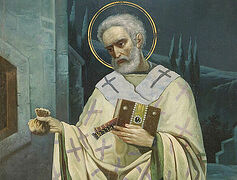
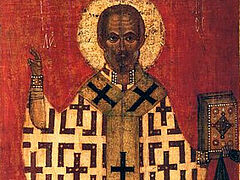
During the Russo-Japanese War at the beginning of the twentieth century, there was such a case. In a train station in China, the Russians had hung a large icon of St. Nicholas. At the inquiry of a Japanese general about that icon, a local Chinese man replied that he is the old man who helps everyone. Two Japanese soldiers were witnesses to this conversation.
Soon afterwards, there was a battle between the Russians and the Japanese. In this battle, the Japanese were defeated.
One of the soldiers who had heard that conversation ran with others of his unit from the battlefield. Their path lay through a swamp, and the soldier sank in it and was being sucked downward. When he had sunk up to his chest, and there was no one around to help him, he cried out with his whole soul, “Old man who helps everyone, help me!!!” Then immediately that old man appeared and pulled him out of the swamp…
He found himself in a Japanese hospital, where he was being given medical assistance. At the same time, the Japanese general who had asked about the icon in the train station lay on the ground seriously wounded, amongst the corpses of his subordinates. His was bleeding so heavily that he would surely have died very soon. There was no one around him who could help. And then he called out with the same words that the soldier sinking in the swamp used: “Old man who helps everyone, save me!!!” In an instance an old man appeared and took his arm… He lost consciousness and woke up many kilometers from the battlefield, in a Japanese hospital, where he was given help…
When he returned to his homeland, he became a parishioner of an Orthodox community headed by an equal-to-the-apostles holy hierarch, who bore the name of his savior—Nicholas. He married a member of this community and became the father of many children. And he gave each of them, both boys and girls, the same name: Nicholas.
Hieroschemamonk Balentine (Gurevich). From: Pravoslavie.ru [Russian]
Instructions from an “old man prisoner of war”
Some have their doubts about this author’s war stories, but we publish this here as one of the more believable.
It happened at the end of the [Second World] war, when our forces were standing before the fortified region of Eastern Prussia. There St. Nicholas appeared and commanded that we serve a moleben before the beginning of the storm, warning that otherwise, many soldiers would die because of unbelief, and they won’t take the city.
But our commanders did not listen to him and ordered the forces to attack; many thousands of our soldiers laid down their lives there, but we did not take the fortifications. It was only after the Polish army arrived, who when they learned that St. Nicholas had appeared, asked their priests for a prayer service, and then our combined forces captured the fortifications.
In spring of 1945, one of our commanders got it into his head to ply our soldiers with vodka before the attack. A whole tank division advanced, and the drunken tank drivers crushed some German refugees on the road.
Our mortar division followed after the tank division, and we were aghast at this cruelty.
By nightfall we had reached a village, and set a guard. I went to check the posts, then stepped off to the side of the road, looked at the sky, and stopped in my tracks. In the sky, written in Slavonic letters, which I couldn’t read at the time because I didn’t know the Slavonic language, I could only decipher the word, “GOD”. This was a kind of illumination, and I began to think about the meaning of existence, about whether I would survive to the end of the war, about what awaited me. I stood there the whole night, not noticing the time.
In the morning I entered a German home, recently abandoned by its owners. The stove was burning, and the beds were tidily made. I felt so sorry for the owners of the house; probably they were hiding not far away. I wanted so badly to sleep, and so I decided to lie down on the sofa so as not to wrinkle the beds. I took off my boots and had just lain down, when into the room came an old man. He appearance was that of a Russian, noble, in simple clothing. I decided that he must be a Russian prisoner of war or had been taking by the Germans to work, and was surprised that such old men would be considered suitable workers. I asked him, “Where are you from, grandpa, and how did you get here?” The old man replied, “You contemplated the meaning of life and about death—tomorrow you’ll meet it face to face, but you won’t die, and later you’ll serve me. Not a single bullet will hit you to the end of the war, not even a fingernail will be touched—at the prayers of your mother.
Then the old man began to rebuke me for my sins, and recounted my whole life. He reproached me for not fulfilling my promise given to my mother, that I had not taken Communion but only confessed before going to the front. “For that, you won’t see her for a long time,” said the old man. He also rebuked the Russian soldiers for their outrage, and foretold that they would be punished.
The elder stood before me during this conversation, and I sat on the sofa. At the end of the conversation I asked him “What is your name, grandpa?” and bent down to put on my boots. When I raised my head, there was no one in the house. I walked around the house, looked in the closet, then asked the guard if anyone had come out of the house just now. The guard answered that no one had.
On the next day, I really did see death face to face. I went out on duty, threw my machine gun over my shoulder, although I usually walked with a pistol. On my way I saw, about fifty meters from the road, something flashed. I wondered what it could be, as our forces were all around, and I decided to come closer. When I got right up to that place I was stunned—there were nine German spotters hiding there. Of course all their barrels were aimed at me and it would have been useless to grab my machine gun—I wouldn’t have time anyway. The commander took out his pistol and gave a sign to the others not to shoot, then he began to take aim. I changed my direction of movement and got further from them, expecting a shot at every moment. I also thought, “Death is not so terrifying as capture. After all, they could overpower me and seize me.” My whole life passed before my eyes, my muscles became like stone, and it seemed that those minutes would never end as I walked in front of that pistol aimed at my back. When I passed over the nearest hillock I fell to the ground; I thought I had been wounded but it was from nervous tension. The Germans didn’t shoot. Later I reported that there were spotters at the rear, but the German had managed to leave—and I was glad for it; after all, they didn’t touch me.
In November 1947, when I lived in Leningrad, that same old man appeared to me in a dream, this time in hierarchical vestments. He rebuked me for not fulfilling my promises: I had not had a church wedding with my wife, I didn’t wear a cross, and was afraid to keep icons in my home. Then he said, “You wanted to know my name—my name is Nicholas, come to me,” and he gave me an address. In three days, you will learn how you and your city were saved. Don’t forget it, and tell others about it.” I remembered the address, and when I searched for it, it turned out to be the St. Nicholas-Theophany Cathedral in St. Petersburg (then called Leningrad).
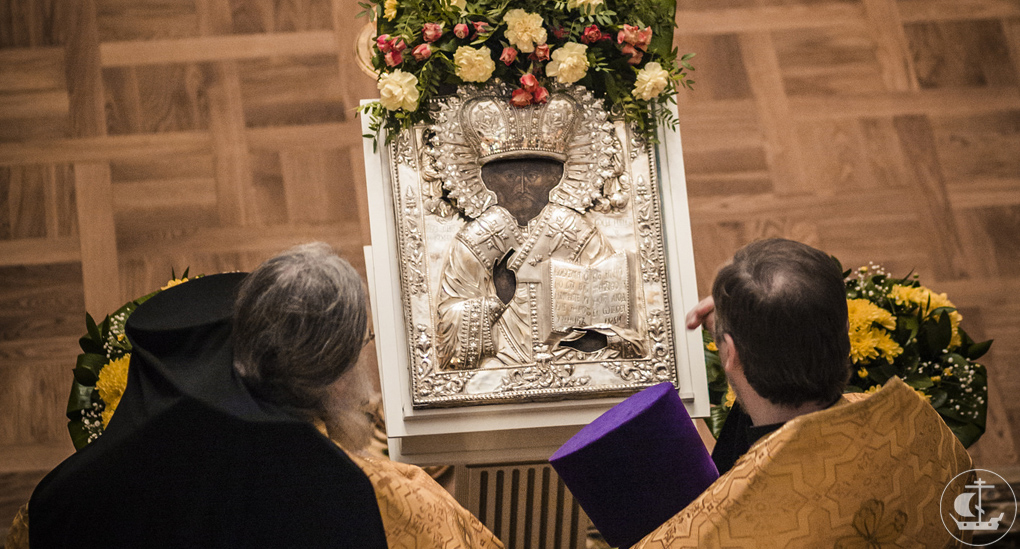
Three days later I found out that Metropolitan Elias (Karam) of Lebanon had come to Leningrad and that the next day he would be serving the Liturgy in the St. Nicholas-Theophany Cathedral. On November 9, after the end of the Liturgy, Met. Elias brought forth to the church a particle of the relics of St. Nicholas, which is kept to this day in an old church icon of the saint before the solea, to the left of the main altar. In a brief talk, Vladyka revealed the aim of his visit to the city of St. Peter: to tell its inhabitants about how Russian had been saved in the recent war through the intercessions of the Mother of God.
The years passed. And fulfilling my promise to the saint, I became a priest.
Archriest Vasily Shvetz. From: On the Intercessions of St. Nicholas during the years if the Great Patriotic War (Pobeda.ru)
The tale of a man who swore not to celebrate St. Nicholas
One of our brothers from Požarevac [Serbia] honored St. Nicholas as the patron of his family, his “Krsna Slava”. He honored him also on the island of Corfu, where he had been in exile. When the Serbian army was mobilized to the Thessalonian front, many army men continued to celebrate their Krsna Slava, while some stopped doing so.
Well, the brother from Požarevac stopped celebrating his patron saint, Nicholas. He told his comrades, “Why should I celebrate him if he doesn’t help me?” And when I return home, I’ll honor the saint who’ll lead me home to a free country; the saint whose feast is celebrated on the day of my return.”
In 1918 an advance began and our army returned home before the winter. With it returned our brother from Požarevac. True, he had forgotten how to count the days, and had forgotten about the feast days. He arrived at his family home at night and saw that the “Slava” festal candle was burning. “Who is the candle for?” he asked his wife. “Why, it’s for our holy patron, St. Nicholas,” she replied. Don’t you know that tomorrow is the feast of St. Nicholas?” The amazed and Požarevac brother was ashamed that he had not celebrated St. Nicholas at the front. And he became convinced that the Lord lives, and that St. Nicholas lives, and one must celebrate his Krsna Slava everywhere and always.
St. Nikolai (Velimirovic). From: Miracles of God, (Minsk: Dimitry Kharchenko Publisher, 2013) [Russian]