This year Orthodox Christians celebrated the Radiant Resurrection of Christ on April 20, remembering the most important Gospel event of the miraculous Resurrection of the Savior. “Christ is Risen from the dead, trampling down death by death, and upon those in the tombs bestowing life. These are the words of the Paschal troparion. Why is Pascha the feast of life? Why is it joy for all people? What lies behind it: tradition and culture or the true Christian meaning?
One of the meanings of the word “Pascha” (Greek: ΠάσχΑ) is “deliverance”. Holy Pascha is precisely deliverance, because by His sacrifice, Jesus Christ atoned for the sins of all people living on earth, delivering them from eternal torment and granting everlasting life to those who had already passed into eternity. Over time, a large number of traditions were associated with this festival. In Orthodox Russia, on the eve of Holy Pascha the faithful go to church in an endless stream to have their kulichi (Paschal cakes), colored eggs and paskha cheese blessed. These traditional festal dishes are usually served at the Paschal table. But where do all these customs originate from?
Kulich is homemade artos (a loaf of unleavened bread), which symbolizes the Resurrection of Christ; paskha cheese is a symbol of Mount Golgotha, on which the Savior was crucified; and Paschal eggs are a symbol of life. But where did the tradition of painting them come from? Not everyone knows that this custom appeared thanks to St. Mary Magdalene Equal-to-the-Apostles. It was as follows: St. Mary Magdalene, to whom the risen Christ had appeared, went to announce this joyful news to people. The Roman Emperor Tiberius was no exception. At that time, in order to get to the Emperor you would have to bring him something as a gift, so Mary Magdalene went to his palace, carrying an egg in her hands. “Christ is Risen!” she exclaimed. But Tiberius laughed at her, saying, “How could anyone rise from the dead?! It is as impossible as it would be for that egg to change from white to red.” At the same moment, the egg turned red.
Nowadays, for many, the essence of Pascha is precisely the observance of all these traditions. Its celebration has become different, more “secular” by nature. Pascha is deeply rooted in our culture, and itself has become a “tradition”. The first thing that comes to mind when we think of Pascha is kulichi and eggs on a long communal table and cheerful priests with holy water in their hands. It is demonstrated by the fact that people who do not live the church life and hardly ever attend services always come once a year to have kulichi and Paschal eggs blessed. “We had our kulichi blessed, went to the cemetery to visit the graves of our reposed relatives, and ate a Paschal egg—so our life is a success!” However, Pascha was and still remains the most important celebration of LIFE, the feast of the Savior, and a true feast of love, mercy and forgiveness. Christ is the Foundation of everything!
Just imagine: the Son of God, the Messiah, the King of all kings, suffered terrible torments, mocking, spitting, and insults from His negligent and careless children, was crucified by them on the Cross, and despite everything kept love in His heart. In the final moments of His earthly life, instead of wailing and murmuring, instead of tears and cries of physical pain and mental anguish, the Savior says: Father, forgive them; for they know not what they do (Lk. 23:34).
Passer-by, can you hear? Take a closer look
At His beautiful face.
Forgiving the evil, the treachery of the world,
Christ prayed fervently…
The Savior was betrayed by His own people, who a few days before had greeted Him in Jerusalem with palm branches, exclaiming: “Hosanna!” by the people who had seen Christ’s numerous miracles and revelations, including the miraculous resurrection of Lazarus, incomprehensible to the human mind, and then shouted furiously: “Crucify Him, crucify Him!” asking Pilate to release Barabbas instead, a notorious criminal who had been deservedly convicted for his evil deeds, and nail Christ to the Cross:
 Mihaly Munkacsy. Behold the Man! 1896
Now at that feast the governor was wont to release unto the people a prisoner, whom they would. And they had then a notable prisoner, called Barabbas. Therefore when they were gathered together, Pilate said unto them, Whom will ye that I release unto you? Barabbas, or Jesus which is called Christ? For he knew that for envy they had delivered Him. When he was set down on the judgment seat, his wife sent unto him, saying, Have thou nothing to do with that just Man: for I have suffered many things this day in a dream because of Him. But the chief priests and elders persuaded the multitude that they should ask Barabbas, and destroy Jesus. The governor answered and said unto them, Whether of the twain will ye that I release unto you? They said, Barabbas. Pilate saith unto them, What shall I do then with Jesus Which is called Christ? They all say unto him, Let Him be crucified. And the governor said, Why, what evil hath He done? But they cried out the more, saying, Let Him be crucified (Mt. 27:15-23).
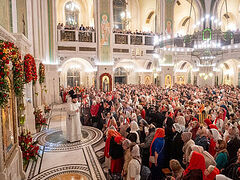
Pascha is a reminder to people of God’s mercy, His love and forgiveness. Christ sacrifices His life for the salvation of all people living on earth. Millions of believers gather on Paschal night for a festal service and look forward to hearing these words dear to everyone: “Christ is Risen!” Do you hear? He is Risen! He died in front of everyone, and before everybody’s eyes He endured extremely gruesome, inhumane tortures, but continued to pray. They beat Him, but He kept walking, carrying this heavy cross. He would fall, but then would rise and walk on. He was on the way to His crucifixion and death for the sake of those who wanted Him dead. Perhaps of all people the Mother of God alone felt the same way as Her Son. No one could help Him, no one could share in His suffering.
The Son of God is being led to Golgotha to be crucified,
Through beatings and curses, He is performing his Heavenly work…
Now the Son of God in the Crown of Thorns is shedding His blood on the Cross between two thieves. “It is finished!” The Spirit left His body. There was stillness and darkness. Sorrow and fear enveloped everything. Here He is already lying in the cave, and by His side is His Mother Who has gone through the most horrible thing, quietly bending Her head towards Her Son, wrapping Him in burial cloths.
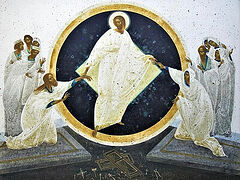
On the third day, the holy Myrrh-Bearing Women, with sorrow in their hearts, but without any fear, hurried to anoint the lifeless body of their dear Teacher. They came there only to find that the stone had been rolled away from the tomb. The tomb is empty! Who took Him?
 Annibale Carracci. Holy Myrrh-Bearing Women at the Tomb of the Risen Christ. C. 1600
And it came to pass, as they were much perplexed thereabout, behold, two men stood by them in shining garments: And as they were afraid, and bowed down their faces to the earth, they said unto them, Why seek ye the living among the dead? He is not here, but is risen: remember how He spake unto you when He was yet in Galilee, Saying, The Son of Man must be delivered into the hands of sinful men, and be crucified, and the third day rise again. And they remembered His words, And returned from the sepulchre, and told all these things unto the eleven, and to all the rest (Lk. 24:4-9).
Christ is truly Risen!
“O death, where is thy sting? O hell, where is thy victory?” (Paschal Homily by St. John Chrysostom).