Filip Stanisic I asked Filip Stanisic what color he’d choose as the background of his life. He says deep blue would fit him best: the color of depth. “The color of the night, when everyone is asleep, but I am awake. The color of a quiet, silent struggle, the color of a gaze that sees what bodily eyes can’t perceive. It isn’t black, no; for I feel neither blue nor despondent. Deep blue is a kind of balance between the light and the dark. It’s the color of cool water that surrounds the soul, the color of the sky I gaze at as I wait for my heart to calm down and the pain in my chest to subside. This is the color I live, breathe, remain silent and… paint pictures with.”
Filip Stanisic was born and raised in Donje-Bitinje in the south of Kosovo and Metohija. In childhood, he was diagnosed with nephrotic syndrome. He suffered from kidney disease since he was in an elementary school. At the age of fourteen, he was taken to dialysis and was later treated in Belgrade—staying there in almost complete isolation, far away from his friends, peers and home. In other words, practically removed from life. But he doesn’t see it this way. At least, not anymore— even if he does say that at first he reacted with hostility to the cross that God has arranged for him.
I knew it deep inside: my pain isn’t the end, but a threshold, a beginning of something truly deep and joyfully mysterious
“At first I was simply staring at the sky in silence. Yes, there were moments when I was thinking: I can't stand it anymore, I’ve no strength left at all. But then I began to realize that the cross isn’t given to break you down, but to build and develop you. The cross isn’t a punishment, but a path. That’s when I began to look at pain and suffering as teachers. I also looked at fear as a shadow, a cooling shade, yet no longer an enemy. Yes, illness separates you from friends, peers, and school—in short, from life. But one day, when the pain was particularly overpowering, suddenly a thought came in a flash, like fire: you’ve got to fight. Not to fall into despair, but to fight, no matter what. But how? By working. So as not to perish in this deafening silence. I must say that this thought, I guess, didn’t become established in my heart right away; it took time, quite a lot of time. And it came with a lot of pain, contemplation and hope. I realized with my heart that pain is not the end, but a threshold, a beginning of something truly deep, joyful and mysterious.”
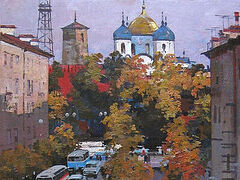
 Artwork by Filip Stanisic
Filip recalls how he stayed in his room in a Belgrade hospital, a place where he was able to daydream:
“I dreamed of being free from my illness. And of being able to simply walk around a village or a town, like everyone else. Of course, I was dreaming about my return home. Not just in a physical sense—but about reacquiring my real self. I was dreaming that, God willing, one day my suffering would become my strength and my spiritual power. I believed that my trials of today have meaning. I’ve been living almost in complete isolation from the outside world, and only my soul has remained a silent witness of the passing life. But then I decided for myself that it’s too sad to live the life of a silent spectator. What if I start doing something for others? And that’s how I started painting.”
In art, I had found the freedom my body was deprived of
“Has art become your salvation?”
“Yes, exactly so: it was my escape. When everything external has practically been taken away from you, all you have left is the inner world, the soul. Thus, in the silence of the hospital, I found paper and pencils and began to draw. In art I found the freedom my body has been deprived of. It’s hard to describe, but good old art gives me the ability to express what cannot be expressed in words. This is what has become my cure, my prayer, and my hope.”
 Artwork by Filip Stanisic Nowadays Filip has to travel to Belgrade for screening, but he says that his desire to return back to his home in Kosovo and Metohija urges him to make haste. Besides, the fact that he was studying at the fine art faculty in Kosovo, and not elsewhere in the capital city, has been an absolutely conscious decision. It was dictated by his desire to remain a part of his native Orthodox land. The land that is suffering, yet it is his own. Filip knows full well what suffering means: After a successful transplantation two years ago, he lives a life of daily trials.
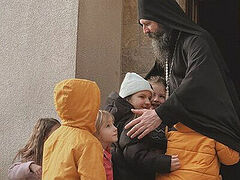
“Life after transplantation—I’d never say it is somewhat akin to a magic. But it is already another kind of life. Diets, medicine, thorough checkups in search of any specific symptoms… I can’t live like the rest of us, but I do live—and this fact transforms it all. You realize that every drink of water, a single breath you make, or every step—are possible because of the mercy of God. You also begin to look at people differently, as you are no longer fixated on yourself. I get to have daily encounters with kids, yes, kids, who chose to keep on fighting. I see a permanent battle of the light and the dark and I know deep inside that the light will win, and it will break through the gloomy clouds. I admit it’s been dark in the past, but this helped me to see life in a bright and lighter way. So today, I no longer race after some “cozy” comforts of life in order to “have it all”—no! I seek a righteous life, which brings out a genuine smile, a whole-hearted willingness to help your neighbor, where your heart isn’t racing from fear, but it throbs from love for people and God.
Love is the skill of giving a helping hand to a man without asking, “What will I get out of this?”
What would he now say to himself as a child? “I know you're hurting, but don’t give up. And don’t be a hypocrite; never adjust yourself to please others in order to be loved. You are already loved. You possess a darn good talent, man, so be patient, keep working and drawing, and run like a madman—but most importantly, have faith…” He acknowledged that during his illness, love was what he’s really been missing—not the kind that bends with the wind, but the kind that really understands you. He realized that love is the ability to help a man without asking, “What’s in it for me?” And that true courage is the ability to open your heart towards people in an unfriendly world, which demands your heart to live in isolation.
 Artwork by Filip Stanisic Filip Stanisic is one of the fellows of our humanitarian organization called “Kosovo Pomoravje.” We have developed a program to support education of schoolchildren and students in Kosovo and Metohija. This support is not simply material assistance; it gives hope and instills belief. People realize they aren’t alone, that there are others in this world who keep believing in you even when you have lost faith in yourself.
“A new life—that’s what it means to me. Thanks to this belief and hope, I continue my studies, I paint and I struggle—a lot of work lies ahead. For us, young Orthodox Serbs, this is equally our strength and hope, that we are not fighting and praying in vain here.”