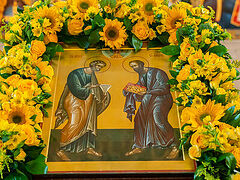
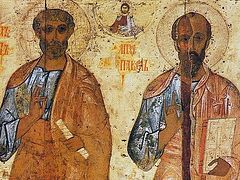
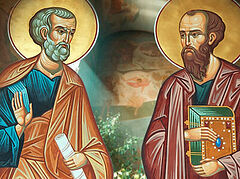
Photo: pstgu.ru
In the name of the Father, and of the Son, and of the Holy Spirit!
Dear brothers and sisters! Today we praise the holy Apostles Peter and Paul. And since it is hard to describe their whole lives and all their works in a few words, we will touch upon some thoughts that come to mind as we carefully read their lives, set forth in the Holy Gospels, in the Acts of the Apostles, and in the traditions of the Church. Why were they chosen by Christ and placed above all the other apostles—at the head of the entire Church?
 St. Peter The Apostle Peter was one of the first people whom Jesus spotted among the multitudes. He was a simple fisherman, called from his simple trade to become a “fisher of men” (cf. Mt. 4:19). St. Peter is distinguished from the other disciples by his amazing ardor in all his actions. After Christ had fed 5,000 people with five loaves of bread, He told His disciples to cross before Him to the other side of Lake Gennesaret (cf. Mt. 14:22). At night, the Savior caught up with the apostles’ boat, walking on the water as on dry land (cf. Mt. 4:25, 26). And, seeing this, the Apostle Peter exclaimed: “Lord, command me to come to Thee on the water!” Christ answered, “Come” (cf. Mt. 4:28, 29). And St. Peter truly started walking on the water for a while, until his faith faltered and he started sinking.
Another time, seeing his Teacher (Who had already appeared after His Resurrection) on the bank, St. Peter, without waiting for the net to be selected, the anchor lifted and the sail set, threw himself into the waters of the lake and swam towards Christ (cf. Jn. 21:7). His ardent love could not wait a single moment. And we understand that, despite the seemingly naïve and childish spontaneity of all these actions, there is the boldness of love behind them, not mischief or a desire to show off.
It is impossible to undertake and accomplish a single feat, a single super-difficult task without this boldness. This virtue is nourished by faith and a strong confidence in the trueness of your love. And only it can lead to a miracle. We can say that boldness is the sword of love dissecting the ordinariness of the rational and conscious, conventional and boring: “You can do this, but you can’t do that.” It is the hammer of love that crushes the stronghold of the seemingly impossible. There is a well-known incident when an ordinary, fragile woman overturned a multi-ton car that had run over her son. When we say “ordinary”, we mean her physical characteristics. But, of course, her boldness of love was awesome and extraordinary. But kindred love, earthly love, is often fickle. Years will pass, and the same mother may tell her son: “Why did I give birth to you?”
Divine love alone is purified of selfishness from within, because it does not exist without God, for it is dedicated to God and aspires to Him. This is the energy of union with God. All the saints lived this way. They were ablaze with an inner flame that urged them to walk on the waters when all others retreated. That is why we do not have many descriptions of the ascetic feats of a lot of saints. There is no time to write about life if it goes by in swirling waves. You must live. Most of Christ’s disciples did not write anything. Indeed, it is a great blessing that there was St. Luke the Evangelist who wrote for us with amazing accuracy, with the remarkable flair of a historian, about much of what had happened with Christ’s disciples and with His Church after His Ascension. The only disciple who wrote extensively was the Apostle Paul. In truth, it was another amazing soul, the same fire of love, the same ardent longing, the same thirst for knowledge of Christ, yet with an absolutely different character, a very different destiny and ministry, similar yet completely different from that of the Apostle Peter.
The most amazing thing is how a man who did not even see Christ became one of the Chief Apostles. It turned out that St. Paul did not need to walk with Christ in Judea and Galilee for three and a half years. Christ Himself gave him everything. He appeared to him as a Light on the road to Damascus: I am Jesus whom thou persecutest (Acts 9:5). This election of St. Paul is incomprehensible. No one could have imagined that in order to spread His Church around the globe, God would choose a man who had mercilessly persecuted the Church. He had not done it just out of thoughtlessness, but being inspired by the ideas of purity of faith and his people’s faithfulness to their covenant with God. But in the light that appeared to him, St. Paul realized that his love was hate and his light was darkness.
Jesus named his simple disciple Simon, who was not prone to self-exaltation, “Peter”, which means “rock” (cf. Jn. 1:42). And since every name is a symbol, the renaming that Christ did for His closest disciples is all the more symbolic. None of this was accidental. By “rock” we mean weight, strength. This was the case with the Apostle Peter. And the Lord said: And upon this rock I will build My church; and the gates of hell shall not prevail against it (Mt. 16:18). That is, it was the cornerstone laid in the foundation: not so much on St. Peter’s personality as his faith and daring love.
 St. Paul The Apostle Paul, who had been called Saul before his renaming, was given this name by Christ; it means “small”, “humble”. Afterwards, St. Paul said that he was the least of the apostles and unworthy to be called an apostle, although he labored harder than all of them. However,” he adds, Yet not I, but the grace of God which was with me (1 Cor. 15:10). It was no coincidence that the evil spirit wondered, addressing uninvited healers in the name of Jesus: Jesus I know, and Paul I know; but who are ye? (Acts 19:15). Truly, St. Paul’s name is well-known in Heaven as well as in hell. This is the meaning of this “smallness”, which, like a small mustard seed, has leavened the whole world with the words of his preaching. The apostle refers to his sermon as to a sacrifice of the word, a spiritual gift, and ministering. And these are no mere words, since St. Paul’s teaching is not human. The Lord spoke through his lips, as well as through the lips of the other apostles. This is a Heavenly teaching. The apostle repeatedly referred to his epistles and preaching as spreading the Gospel. It means that we can speak about the “Gospel of the Apostle Paul”, which for us is not inferior in importance to the four canonical Gospels.
The Epistles that St. Paul would send around the world were written decades earlier than all the Gospels. Although, of course, the apostles had kept some records for themselves since the very first days, these were written and formed as Gospels from the 60s A.D. onwards. Apart from the fourteen Epistles that have come down to us, the Apostle Paul wrote several more that were lost during the persecutions of the early Church. With special poignancy and frankness, without embellishments or omissions, the Apostle Paul testified to his infirmity: O wretched man that I am! who shall deliver me from the body of this death? (Rom. 7:24). He also teaches that There is therefore now no condemnation to them which are in Christ Jesus, who walk not after the flesh, but after the Spirit (Rom. 8:1).
What kind of teaching is this that someone living on earth will not be judged? In fact, if we read the Gospel of John, we will see the same statement there: Verily, verily, I say unto you, He that heareth My word, and believeth on Him that sent Me, hath everlasting life, and shall not come into condemnation; but is passed from death unto life (Jn. 5:24). The apostle reveals that sin consists of renouncing Divine love. It will be erased, removed, forgotten and fully destroyed only if a person returns to the love of God and to the extent that he returns back to a Christian life. It is this return, this unceasing reversal that the Lord expects from us. In the Old Testament God repeatedly calls Himself “jealous”, because love cannot but be not jealous—it will always demand wholeness and fidelity. This is the nature of love.
And in the life of the Apostle Peter we see it most vividly. He was not an ideal hero. If we read the Gospel carefully—this book full of profound realism—we will see that before the Crucifixion of Christ St. Peter had made mistakes at every step. He was doing everything wrong. First he asked Christ to avoid suffering, trying to dissuade Him from going to Jerusalem (cf. Mt. 16:22). The Lord stopped him, calling him satan, pointing out that his thoughts were not directed at what is Divine, but at what is human (cf. Mt. 16:23). Then he swore that he would not betray the Savior, even if everyone else did (cf. Mt. 26:33), and a few hours later he alone would renounce Christ (cf. Mt. 16:74). In the Garden of Gethsemane he was eager to fight to the death, drawing a sword, rushing at a servant of the high priest and cutting off his ear. But Jesus had to stop him, as the time had already come for Him to suffer (cf. Mt. 16:51–54). When St. Peter followed Christ after His arrest to the high priest’s courtyard, trying to hide, to get lost among the people there, and wishing to help Jesus somehow, he—imperceptibly for himself—denied Jesus once he had been identified by the high priest’s maidservant. Christ looked at him with great regret and silent reproach. And that wretched rooster! Its crowing broke his heart with the belated awareness of his denial.
St. Peter left to weep. But if we think deeply about the essence of his lament, it was not so much about his Divine Teacher (Who was about to go through His Passion) as about himself who had renounced Him and had not kept the faith. And in those hours St. Peter was perhaps the closest to Judas, with the only difference that St. Peter had never sought after anything of his own, while Judas had always sought after just that. Judas was waiting for Jesus to become the earthly king of the Jews so that he could rise up. He would steal from the money box, and by his betrayal he only took revenge for his ruined dreams. St. Peter also got carried away. And his denial was his self-knowledge. But unlike Judas, what separated him from Christ was crumbling. And having experienced the fullness of his fall and self-confidence, St. Peter saw and realized everything from the abyss of his humility. At the very beginning, St. Peter had asked Christ to give him the power to do the impossible—to walk on the water. How much is hidden in this, how amazing these words are: “Lord, command me.”
But I can say to Christ: “Lord, command me if I am bound by many bonds of habits and passions.” Will I be able to bear what I want, what I ask of God? There is a shortage of courage and determination nowadays. The plague of lukewarmness, satiated indifference and superficial righteousness is spreading more and more throughout the globe. The rooster in the high priest’s courtyard is already hoarse from crowing, but we still do not hear it and keep whispering: I know not the man (Mt. 26:74). “I don’t know, I don’t know, leave me alone! I am here just to warm myself a bit—don’t touch me! I am no saint, I am no ascetic. I am here for no particular reason, I came here by chance.”
The Lord allowed St. Peter to undergo an extremely harsh trial. But Christ did not doubt His disciple at all, because He knew the depths of his loving heart. After His Resurrection, standing by the campfire on the bank of Lake Gennesaret, He asked the apostle three times: Lovest thou Me? (Jn. 21:15-17). Triple renunciation and triple testimony of love. The Holy Fathers see in this threefold question St. Peter’s restoration to his former rank of chief disciple. This is true. But it is also important for us that our question was answered here. Where does this faith, which moves mountains, come from? Where does the determination to the point of death, boldness, streams of tears of repentance that are able to completely put out and dissolve the fires of renunciation, arrogant stubbornness and cowardice, come from? The answer is short, but how all-embracing it is: Thou knowest that I love Thee (Jn. 21:17)! The ministry that was being entrusted to St. Peter by the Lord was not a reward for his faithfulness. It had nothing to do with his merits, deeds, feats, or his closeness to Christ. It was a work of love, a manifestation of the love that St. Peter was capable of. He was becoming a pastor. And the flock that he was to tend did not belong to him. Feed My sheep (ibid), says Christ.
We know from tradition that during the persecution of Emperor Nero St. Peter, who was in Rome at that time, left the city. It was in line with the words of Christ: But when they persecute you in this city, flee ye into another (Mt. 10:23). But on the famous Via Apia St. Peter unexpectedly met Christ, Who appeared to him. Confused, he asked: “Lord, where goest Thou?” And he receives the answer that Christ was coming to the world again to be crucified. Where will you go, St. Peter, after these words? Can your love take another step away from Christ? Haven’t you mourned enough for your former denial? And, of course, he returned to Rome with his Divine Teacher, Who was already invisible, as the time had come for his suffering. It was not a special time of his faithfulness, since he had stayed in this fidelity permanently. It was the time of his being nailed to the cross, because everyone who wants to be with the Lord and enter into His glory must necessarily suffer with Him.
At about the same time, the Apostle Paul was beheaded with a sword, which is why their commemoration was established on the same day. We have spoken little about St. Paul today, because it’s impossible to cover everything equally. The Lord miraculously arranged it that from Jerusalem—the spiritual center of the universe—these two apostles came to Rome, the capital of the empire at that time, and were put to death there. Their relics are still in Rome. When we talk about saints, recounting their feats and sufferings, one may get the impression that we are talking about some historical figures from bygone ages, the greatness of whose deeds prompts our grateful feeling to remember them. But the situation is different. The saints are alive, their prayers and their participation in our lives are living and miraculous. The Church addresses them in this way: “Coming together from Rome, make us steadfast.”
Yes, the Apostles Peter and Paul still stand on the bridge of our Church’s ship, sailing into eternity. Its steering wheel is in strong hands. Therefore, we should not be confused about some difficulties inside the Church. The Church will always be shaken by persecution both external and from false brethren. And the devil does his best to throw us off balance, to suggest that if other people are in power, then everything will be sorted out and everything will change. Of course, this is the greatest lie. The path of external revolutions, the path of rebellion, is most often fatal. What we really lack is our inner revolution. But it’s the hardest to decide on. If the labor of our faith brings us to the throne of Christ in our hearts, then we will look at everything with different eyes, and first of all—we will see the sin that separates us from Christ and removes us from His love, which we came to know in Him, in His holy apostles, whose memory we are now commemorating.
Amen.