The following homily was delivered by Fr. Kirill Zawatski, rector of Holy Ascension Orthodox Church (OCA) in Frackville, Pennsylvania, who was one of several guest celebrants at the Divine Liturgy for the patronal feast of Holy Apostles Orthodox Church (OCA) in Mechanicsburg, Pennsylvania, on June 30.
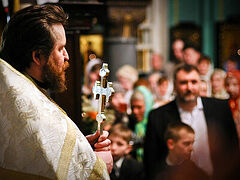
 Photo: simvolik.ru
In the name of the Father, and of the Son, and of the Holy Spirit. Amen.
Joyous Feast, brothers and sisters in Christ. It’s a joy to be with you again. I do enjoy my visits down here thoroughly, so it’s a wonderful honor for me to be here on your patronal feast day today.
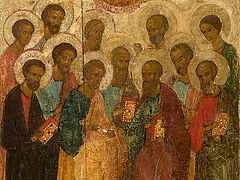
I was thinking all week, every time I come down to visit this parish, I can’t help but reflect on how proper, how fitting it is that the patronage of this parish is the Synaxis of the Twelve Holy Apostles. And I reflect on this for a number of reasons, but the one that stands out the most to me is that you can see the work of the Holy Apostles lived out in this parish community, in a very direct way. And that’s by the efforts, the commitment, the love, and the care of the people, each of you here today that make up this parish community, and by the hands of a very dedicated, committed, and loving priest.
It’s not hard to see the work of the Apostles at work in this holy parish. To go from a small community that used to worship faithfully each Sunday in an office complex to this magnificent parish that is virtually busting at the seams. It’s beautiful. And it’s a remarkable testament to the work of the patrons of this holy parish. The twelve chosen men that carried the Church into the world to spread the Gospel message of Christ to all nations, to all people that they encountered.
And who were these men? If you really think about it, who were these men that were chosen? Fishermen, tax collectors, zealots—regular, simple, ordinary people.
Most people wouldn’t even have seen them as remotely qualified during that time to do this work. They weren’t scholars, they weren’t princes, they weren’t popular, they weren’t powerful in the eyes of the world. Simple, ordinary people. Ordinary people from different walks of life, from different backgrounds, all different skills and all different talents. Yet, despite this, Christ calls them by name and entrusts them with this massive responsibility of carrying His Gospel message into the world. And what a great responsibility that is. To be sent out and proclaim the coming of the Kingdom of God.
And that’s exactly what “apostle” means. It comes from the Greek apostolos, which means one who is sent out, a messenger. Such a tremendous responsibility given to simple, ordinary people. And we might find ourselves asking, “Why would God entrust such a great mission to a bunch of average Joes?” And I’m sure they asked themselves this question during that time. “How are we worthy to fulfill this mission?” Why would the greatest mission ever be given into the hands of ordinary men? Men that each had their own weaknesses:
Peter: impulsive;
James: overly zealous;
John: too much ambition;
Philip: slow to understand;
Matthew: was considered a traitor to his own people;
and Thomas: a doubter.
And the list goes on and on. Ordinary men with their own weaknesses. And from the outside looking in, we probably find ourselves saying, “Man, you picked a team of winners here. This is the worst draft team in the history of the world. It’s going to be a disaster.” They have all these flaws. So why would Christ select these men? It’s because by their weakness, by these shortcomings, God shows His strength; that normal, ordinary people can be transformed by God’s grace—if they allow themselves to be.
We have to think about this—if the Gospel had been spread by kings, by politicians, by philosophers, the success of Christianity would have been credited to them. It’s no different than politicians today; it’s the same thing. The Apostles had nothing. Nothing. No armies, no money, no status, nothing. Nothing in the eyes of the world, at least. The only thing they possessed was that faith in the Crucified and Risen Christ. And for this mission, the greatest mission that was entrusted to them, that is all they ever needed. They had nothing, but they changed everything. They accepted this mission, dropped everything, and followed Christ. And despite their many flaws, they allowed themselves to be transformed by God’s grace into fierce creatures for many people, spreading the Gospel message that we hear 2,000 years later.
One of my favorite quotes from Fr. John Parker at St. Tikhon’s—I believe this one is attributed to him—is that the Apostles told those who told those who told those, all the way through the ages, until someone told me so that I could tell you. And this was given to ordinary people for centuries. It’s a remarkable story. And their lives are such incredible examples to us today of what that mission is. Examples of what it means to live out the faith. It’s one thing to come here and learn about it, to hear what we’re supposed to do, but to put that into action in our everyday lives. To teach others, whether we realize that we’re teaching them or not, by the things we say, the things we do; the things we don’t say, the things we don’t do.
There’s a popular TV series in the last few years called The Chosen. I’m sure many of you have seen this or at least heard about this show. And I have a truly love-hate relationship with this show. There are many things I love about it, there are many things I don’t love about it. But there’s two positive takeaways I have had in my experience of watching this show, which highlights the lives of the Twelve Apostles during the time of Christ.
First, being that it shows the ordinary lives of the Apostles. It highlights this. It’s one of the first televised programs that placed an emphasis on the fact that these men were just normal people. I appreciate that about the show. Just like you and me. They had interpersonal conflicts and struggles. They had moments of doubt in their faith. They dealt with uncertainty, not knowing what comes next. The same things that we experience in life today.
The second thing I appreciate about the show is the logo, which I love. I actually bought the sweatshirt because I loved it so much. It shows fish swimming in a circle. There are gray fish swimming in a circle, and twelve colored fish. And the colored fish are swimming the opposite direction of the other fish. And really, that is essentially the call of the Christian life—to swim in the opposite direction of the world. When the world tells you this, we do the opposite. We know what we’re called to do. And most of the time for us, in 2025, as it has been for thousands of years, that means going against the current of what the world promises us.
That’s the call of the Christian life. And these two things are so relevant to the life of a Christian in 2025 because it reminds us, we too are called, just like the Apostles, who did this very same thing—to swim in the direction of our salvation. Not the world. The promises of the world, of the secular world, are empty. They don’t have much meaning. They promise comfort, profit, material things, and it’s all fleeting. It’s all temporary. At the moment of our death, it goes poof and it’s gone. All these things we spend so much time being anxious about and thinking about and worrying about. The world promises us these things. Christ promises eternal life, resurrection, something that’s eternal and will never end.
This parish is a beautiful reflection of the work of the Twelve Apostles. Because it is living proof that the Gospel message of Christ is continuing to be spread this very day, thousands of years later, by regular, ordinary people.
At some point in your life, in your journey to the Church, whether it be from Baptism at birth, whether it be a Church and a faith you received later on in life, a flame has been lit in the hearts of each and every one of you in some way. And that flame then lights the hearts of other people. That’s a beautiful thing. That’s a tremendous thing. And this is the work of the Church. This is the work of the Twelve Apostles.
We take this piece of us that’s so incredibly important—our faith in Christ, the most valuable thing that we possess as human beings—and we give it to someone else, in our homes, in our schools, in our workplace, so that those people can share in the joy of our faith and that they can come to know Christ. That is what makes the Church the Church. And the day that we ever stop doing that, we cease to be able to call ourselves a Church. That is the work we’re entrusted with.
So we remind ourselves today on the feast of the Twelve Apostles, if God could do such incredible and mighty things through twelve ordinary men, imagine what he can do in our lives as well. He only asks that we love Him, we trust Him, and answer that call. God does not call the qualified—He qualifies those He calls.
Let us place our faith in Christ, and like the Apostles, let us offer our lives to Him. Brothers and sisters, I wish you a joyous feast.
In the name of the Father, and of the Son, and of the Holy Spirit. Amen.