Holy Trinity-St. Sergius Lavra
In the name of the Father, and of the Son, and of the Holy Spirit!
Dear brothers and sisters in the Lord, I cordially greet all of you on the great feast! Today we honor the memory of two saints whom a huge number of people in the Russian Church and in Russia in general love and venerate very much—these are St. Sergius of Radonezh and the New Martyr Elizabeth Feodorovna (together with Nun Barbara).
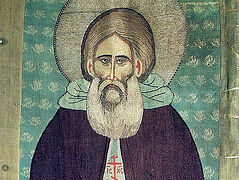
St. Sergius is called the “Abbot of the Russian Land”. By this title the Russian Orthodox Church expresses the extent of St. Sergius’ influence on the life of the Russian Church, Russia, and the Russian people. There is a liturgical book entitled The General Menaion, or The Book of Services Common to the Festivals of the Different Orders of Saints. For example, when there is a saint to whom no service has been composed, we take The General Menaion and find a general service for the venerable, the martyrs etc. The people who wrote the service to the venerable studied the Lives of the venerable fathers and looked for similarities, common points between them that could be said and sung about all the venerable saints. There are interesting words in a sticheron there: “When Divine zeal came upon thee, thou didst follow Christ.” That is, we sing and say that the venerable one was first overcome by “Divine zeal” and only then did he follow Christ and choose the life he lived.
What is “Divine zeal”? There are the following words in the Gospel: I am come to send fire on the earth; and what will I, if it be already kindled? (Lk. 12:49). This is what St. Sergius’ feats were about—his answer to this fire. When we read about his life, there are many things that we find incomprehensible and incredible. Why did he stand naked to the waist praying to God when gadflies were literally eating his body and it was bleeding? What for? Why did he choose to almost starve? Why did he have to make painstaking efforts to fulfill an order to build a house for a piece of rotten bread—just not to starve to death? All the more so since the owner told him: “Let me give you the pay first—the bread—and then you will build it.” But the saint refused.
We can’t understand these people and what they experienced. For example, St. Seraphim of Sarov stood in prayer on a stone for 1000 days and nights. We ask why? Because this “Divine zeal” is love and fire. It happens that a young man and a young lady fall in love with each other, and at some stage they start doing things that seem weird and even sometimes lead to administrative violations. For instance, they write a declaration of love on the walls or on the pavement (I don’t know how about our days, but formerly young men used to sing songs outside the windows of their sweethearts). Why do they do all this? Because it’s love. Only those who have experienced this love can understand it. It’s the same with St. Sergius—he was driven by love.
We know how much he influenced Russian history. In general, history is a very important thing. St. Seraphim of Sarov said that we should study history in order to see Divine Providence. And our famous historian Vasily Klyuchevsky (1841–1911) stated: “History does not teach—it punishes those who fail to learn from it.” If we look at history, we will see that by miracle, certainly through the intercession of the Theotokos and All Saints, at the most critical moments of our history, when the Russian nation was on the brink of disaster, the Lord sent us absolutely amazing people.
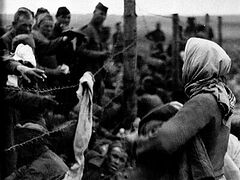
In the time of St. Sergius, these were Grand Prince Dimitry Donskoy, Metropolitan Alexei of Moscow and St. Sergius himself—three figures. The first one was the head of the State, the second was the head of the Church, and the third was the spiritual leader, the heart of the Russian people. And we know that as this storm-cloud brewed, the Battle of Kulikovo took place, and the result of that battle was to be or not to be for the Russian nation. And we know that if it hadn’t been for St. Sergius, everything would have ended in disaster. Because it’s hard to imagine the state of the people who went to war at that time: they had a psychological breakdown. The Tatar-Mongols literally swept through Russia with fire and sword; cities were burned to the ground, people were killed, and Prince Yuri Ivanovich of Kozelsk reputedly drowned in blood. Of course, no one could believe that we would be able to defeat them and rise from our knees again.
 Photo: информа.рус
And who became a guiding light? St. Sergius! When the army arrived and saw who they would have to deal with, everybody started losing heart. And then a messenger from St. Sergius came running and announced, “Don’t worry—you will win!”, that was the last point.
It is important to analyze all these events. What saved Russia? Russia was saved by holiness and piety. It was literally held together by several pillars: Sts. Dimitry Donskoy, Metropolitan Alexei and Sergius of Radonezh. Three pillars, three great men, three saints. Holiness saved Russia! And, interestingly, despite all this, we still had to forge swords, give the last of our money, and shed our blood. According to one version, only a tenth of those who had fought at the Battle of Kulikovo returned.
But the point is that you can’t avoid sacrifices. And the fruits were such that Russia only grew stronger and stronger from that moment on. St. Sergius famously had a vision of innumerable birds flying away from the monastery he had founded. And we know that many centuries have passed, but the Holy Trinity-St. Sergius Lavra still remains such a citadel, a seedbed from where abbots and monks come. Our Optina Monastery is no exception. Monks of the Holy Trinity-St. Sergius Lavra, disciples of its great father-confessors—Elders Kirill (Pavlov), Naum (Baiborodin) and Tikhon (Agrikov), amazing men who had gone through the war—came to Optina and had it reopened in 1988.
Remembering St. Sergius, we think: “Well, it was so long ago. These are just lessons from the past.” Nothing of the kind! Our life is a great mystery, because it is not only material, physical, but also has a spiritual dimension.
Here is a recollection of one man. When the Great Patriotic War broke out in 1941, several boys living in Sergiev Posad (then Zagorsk) went to collect firewood and got lost in the forest. They said to one of their companions, “Misha,1 you know something about God. Come on, pray!” Misha started praying, but nothing changed. It got dark, and they completely lost their way. And then they saw a small light among the trees. They decided that it might be the watchman’s hut and went towards the light. However, its source was not a hut, but an old man in monastic vestments with a cross and a censer. The boys were so scared that they began elbowing Misha, “Misha, pray, pray quickly!”
Misha began to pray and make the sign of the cross, after which the old man started making the sign of the cross before the boys, and a glowing path appeared in front of them. They ran down the path. When they got back home and came to their senses, the boys realized that there had been no real path. They told everything to their parents, but it turned out that the parents and the whole village were preparing for evacuation, because the Germans were close. But when they heard about this vision, all of them were so astounded and wholeheartedly believed that it was St. Sergius. Not only did he help the children who had been lost in the forest, but he did not forget his earthly homeland, walking and praying as if in cross procession, thereby giving a sign that He was with us and that he continued to pray and save us.
So, something is always happening in the spiritual realm. We do not just direct our prayers to nowhere: something happens, but it is hidden from us. And these miraculous cases are revealed to us to prevent our faith and prayer from growing weak.
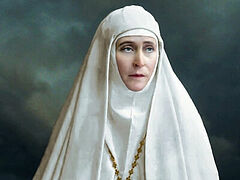
 New Martyrs Abbess Elizabeth (Romanova) and Nun Barbara And today we also commemorate this wonderful saint: Grand Duchess Elizabeth Feodorovna the New Martyr. There are many amazing points in her Life. We know that her husband was assassinated by a terrorist who threw a bomb at him. The Grand Duke was blown to pieces, St. Elizabeth herself collected them and wrote an epitaph on her husband’s cross: “Lord, forgive them, for they know not what they do.”
Anyone who has experienced something like this in his life knows that probably the hardest thing is to forgive and love your enemies. And the Lord calls such a person “perfect”: someone who loves and forgives his enemies. And we also know that St. Elizabeth became a martyr too, and her last words were the same: “Lord, forgive them, for they know not what they do.”
If you ask, “What is Orthodoxy?”, that’s what Orthodoxy is—it is exactly what she showed. There are the following words of the Apostle Paul—a kind of advice, but it works in life, as the experience of many people has shown. Be not overcome of evil, but overcome evil with good (Rom. 12:21). The fulfillment of this commandment requires the shedding of blood. Because the Holy Fathers teach, “Give blood and receive the spirit.” To overcome evil with good is to shed our blood, to trample on our selfishness, pride, and the most painful places.
There is another Grand Duchess and New Martyr, a daughter of Nicholas II—Olga, whose feast we celebrated yesterday. She wrote one of the last entries of her diary after all these humiliations, arrests, and in anticipation of being shot and martyred: “Evil will not conquer evil in this world, but only love.” And she suffered a martyr’s death. How did love triumph? Firstly, it was on an invisible, spiritual level, when these victorious martyrs appeared before the throne of God.
And, secondly, we can definitely say that we still live and stand here thanks to their sacrifice. In an interview our President quoted Christopher Münnich (1683–1767), a political figure in the Russian Empire, who said: “If you look at Russia, it is unclear how Russia still exists. It exists only because there is God Who protects Russia.” That is, this is evidence of a miracle. And the way out of the whole difficult situation we are currently in (blood is being shed all the time) is what has always been—piety, prayer and repentance. There will be victims anyway, but the most important thing is that it all bears fruit.
We now see some fruits. What love is awakening in people: one goes to the front, someone else helps, another brings humanitarian aid and dies right there! Isn’t it love? Of course, this is love, the highest level when a person sacrifices his life. Therefore, dear brothers and sisters, armed with these thoughts, let us at least give ourselves the right attitude to begin with: only love will prevail. And then we will ask God for strength: “Lord, give us the strength to overcome evil with good.” Amen. Happy feast to all!