Those under GAOORDI care in the village of Lebyazhye
The spiritual support of people with mental disabilities is very special. These people are often referred to in Russia as “special”. It can be said that the graduates of the relevant children’s boarding schools and neuropsychiatric boarding schools for those over eighteen are “the special of the special”. To congenital diseases, which are often severe, the consequences of many years spent in State social institutions are added—such a life can affect the mental health of neurotypical people too. In 2025, the Finding the Light project was launched in St. Petersburg, thanks to which several graduates of boarding schools for people with special needs now have a chance to be introduced to the faith in God and Church life.
Finding the Light came into being within the St. Petersburg Association of Public Organizations of Parents of Disabled Children (GAOORDI)—one of the oldest charities in the city. This work became possible thanks to a grant received by GAOORDI from the Orthodox Initiative contest. It should be said that GAOORDI has long been supporting not only children and adults with disabilities living in families, but also those deprived of family warmth.
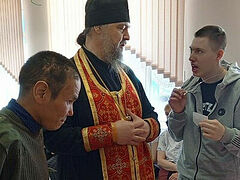
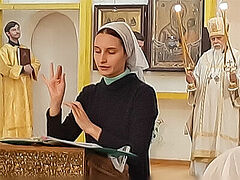
The main activity of the Finding the Light project is the visits of groups of those under GAOORDI care with their escorts to the village of Lebyazhye in the Lomonosov district of the Leningrad Region, where they are received by the rector of the local Church of St. Nicholas the Wonderworker—Priest Alexander Mikheyev. Each visit is from Thursday to Sunday. There are about ten people in each group, and a total of thirty-six people are expected to visit over the summer. During this period, they talk with Fr. Alexander, pray, and work.
“Such a trip can impact their spiritual life as well,” says Svetlana Polivanova, the curator of the project. “And in general, they feel that they are welcome, accepted and safe here, so they are happy to go to Lebyazhye again and again.”
Fr. Alexander has a lot of experience working with people with mental disabilities. In the late 1990s, while still a student at a theological seminary, he began visiting the Special Needs Boarding School No. 1 in Peterhof, and later even became a teacher of extracurricular education in the Basics of the Orthodox Faith at this institution. When Fr. Alexander became rector of St. Nicholas Church in Lebyazhye, he took on the organization of visits of people with special needs there. At first, these were children from the same boarding school, and then—those under GAOORDI care, both children and adults. Some parishioners of the church and volunteers who come from the city help Fr. Alexander receive his guests.
 A conversation with Fr. Alexander Mikheyev
“It seems to me that communicating with people with special needs requires not so much special training as attention, modesty, and amiability,” Fr. Alexander believes. “I can see it in our volunteers. When we invite volunteers, we always say that people without special training can come to us. We only hold short preparatory meetings for these people to get into the swing of things. And then, if a person is determined to accept our guests, then even without special training he will interact with them without problem. Although, of course, any such training helps the cause.”
But the Finding the Light project grew out of another GAOORDI project called, So As not to Die in Loneliness, and it was also created specifically for the graduates of State social institutions of this type. As orphans, some of them obtain apartments from the State and try to live independently, but they are very poorly prepared for such living. GAOORDI has a Center for Temporary assisted Living, and as part of the So As not to Die in Loneliness project groups of such people come to this Center for a while. There, with the help of teachers and other staff of GAOORDI, they develop their living skills, including learning to navigate the city.
 In Lebyazhye
The project also aims to acquaint these people with each other so that they can be in a supportive environment and have their own community, which would consist of both graduates of State social institutions and neurotypical people who are ready to support them. With such support, a graduate of a children’s boarding school or a neuropsychiatric boarding school can learn to navigate the area he will live in, and understand which institutions and how he can apply for different needs. For such a person, even visiting the MFC [Multifunctional Center for Provision of State and Municipal Services) is a big challenge, and he may get confused. In addition, not all employees of State services are prepared to communicate with people with special needs.
This work is extremely important, as very little is being done at the State level to adapt people with mental disabilities to independent living, so many of them become victims of fraudsters who take advantage of their naivety and gullibility.
The Finding the Light project is a logical continuation of the So As not to Die in Loneliness project. Communication in a church parish, where people with special needs are understood and accepted, becomes a great support for them. And the spiritual theme becomes crucial for some people with mental disabilities.
 A conversation with Fr. Alexander Mikheyev
“Many such people perceive the spiritual theme rather positively,” Svetlana Polivanova shares her observations. “I don’t mean a deep spiritual life, but still everything associated with church makes them glad. True, some of them are opposed to it, but these are few. The soul does not depend on your intelligence level. A full-fledged soul lives even in a very defective body.”
Svetlana also holds classes for those under GAOORDI care who live in families; it happens at the Day Care Center. This is what she says about it:
“We call our classes the Fundamentals of Traditional Culture, but in fact they are dedicated specifically to Orthodoxy. By the way, Muslims also come to us—their parents ask for it themselves. We go on pilgrimages regularly. Sometimes pilgrims who had not known our group before join us, and they marvel that those under our care behave calmly and know how to conduct themselves in church, where to put a candle and why. We also use very short prayers that are clear to everybody: ‘Lord, have mercy!’, and ‘Glory to Thee, O Lord!’ So, the Finding the Light project continues the work that we have been doing for many years, trying to give people an understanding of where to look for the support and guidelines that anyone needs.”
And here, too, sometimes the point is the person’s adaptation in an unfamiliar environment and his safety.
 On the church territory
“We have a guy who got his own apartment, but because of his gullibility he is often swindled out of his money by fraudsters. When I ask him how it happened, he answers, ‘I’m a believer.’ And to prevent such a generous believer from giving away all his money we explain to him that in some situations it is hard to size everything up alone, and then it is better to seek help from people you trust and can discuss these topics with, who can help you. This is normal—sometimes each one of us needs some kind of support.”
Some of those who go to Lebyazhye as part of the Finding the Light project have already been there and know Fr. Alexander, since they stayed with him when they were still boarding school students. Svetlana relates:
“Father Alexander finds a common language with these people and as a priest can talk to them on the most intimate subjects. Some words from the lips of a priest are probably perceived in a special way, all the more so since batiushka is so open and amiable. There is a chance that one of them will go to church himself in due course.”
The grant will end. And what next? Svetlana Polivanova is confident:
“We will continue to accompany those under our care. It is vital to maintain relations if only on some human level. Surely, this is our responsibility. As for Father Alexander, his doors are always open. The people involved in the project are adults: some of them are already forty. And yes, unless we support them, they will get lost. I believe we must help them form a useful habit of knowing where to turn, including which church to go to in order to be accepted there. It is important for those under our care to have well-trodden paths to avoid embarrassment.”
 On the church territory
But how deeply do people with mental disabilities, and even with a lack of normal communication, perceive their visits to church and talks with the priest? After all, it is clear that almost any event organized for them can evoke positive emotions. Fr. Alexander Mikheyev notes:
“After visiting our parish, many people with special needs change, and these changes are seen by their teachers who tell us about it. That is, even non-religious teachers from the boarding schools noted that the children did not come from us as from, say, a water park, but were more peaceful, joyful, less likely to get into conflicts, and communicated better. That’s very gratifying to hear. After all, in our talks with them we do not focus on the ritual aspect of church life (‘Make the sign of the cross here, bow here’). What really matters is that they should have the experience of prayer, repentance, hearing the Word of God, and the Eucharist as the foundation of church life. Through all this, such a peaceful spirit permeates their lives!”
Svetlana Polivanova adds:
“The questions of life and death concern those under our care, just like any other people. And here they can get answers to them. They are adults, and some of them have already lost their close ones. And they are very encouraged after being told that the soul is immortal. In addition, we have some people in our project who live independently. These are the rules of life that we all learn through the commandments. They can take them as a guide to action.”