One day, as I was reading the Life of St. Olga, it occurred to me that something akin to what happened to Holy Equal-to-the-Apostles Olga also happens to us in our modern lives. And here is what.
As we know, one of the most puzzling pages in Olga’s biography is the place and time of her Baptism. There have been many suppositions concerning this, and the arguments have not yet died down. In this story is one detail that often remains unnoticed. The detail is perhaps secondary; but you know, secondary things often determine primary things.
Olga’s baptism was connected with her trip to Constantinople. The princess was numbered among the saved either in the very city of Tsargrad,1 or (which is less likely) after her visit there. Undoubtedly Olga’s visit to the Second Rome made a strong cultural impression on her. And most likely the peak of her astonishment was the famous Hagia Sophia Cathedral. The pagan temples2 that Olga knew in her own lands could in no way compare with scale and beauty of the Great Church. The heavenly grandeur of Hagia Sophia always amazed people of all confessions. There are many tales of this. It could not but have stunned Olga’s impressionable heart also.
We can only imagine how the princess entered this church for the first time. Timid, uncertain steps… She enters… The enormity of the dome overspreads her like a heavenly firmament. And indeed, this is a whole heaven—only a new heaven, transfigured by the golden light of the Resurrection. The entire church was filled with this light. It beams not only from the gold of the dome, but also streams in torrents from halos on the icons, mosaics, from the entire glittering adornment of the church, and from the clergy’s vestments. An invisible choir of a thousand voices fills the entire space. The faces of the saints, painted with thin brushes by the greatest Byzantine masters, gaze directly into the heart. Puffs of incense smoke rise slowly from special openings in the floor. You feel as though you’ve found yourself in the center of heaven, and there is nothing higher save the Lord Himself…
Perhaps Olga felt something like this, after living her whole life under the low ceilings of Russian log houses. And perhaps these impressions became the final steps in her long spiritual journey. Standing under the broad domes of the Hagia Sophia, Olga felt that she was at home. And her heart made its final choice—she received Baptism.
It could have happened like this. And the famous chronicle tale in no way diminishes this understanding, but even supplements it. Ideological and political factors can easily be threaded onto the core of one’s personal spiritual choice. Like for example what took place later with Prince Vladimir.
And if that was how it happened, then we could say that Olga’s conversion was a kind of prototype of the Russian soul’s path to God. In my own life, the turning point in my spiritual quest came during my visit to the St. Nicholas Cathedral in Kiev’s Protection Convent. This church was built with the money of the holy royal family of Tsar Nicholas II, and it is the largest church in Kiev. And as it seems to me, it is also the most beautiful. When I first stepped into it, a new world opened to me and a new life began. It was precisely through a church that God put an end to all my doubts and opened the breath of my inner man for life.
But who am I? All of Rus’ acquired faith thanks to a church. Didn’t Prince Vladimir’s emissaries once say as they returned from their mission to compare different world religions, “When we stood in the Hagia Sophia, we didn’t know where we were, in heaven or on earth…” After this testimony Vladimir made the historical decision to baptize Rus’. And as a consequence, millions of Russian people, not yet understanding the services, not knowing any prayers, were convinced of the truth of Christianity precisely through the miraculous atmosphere of church.
Truly, through the church God always speaks to people. That is why the church is in a certain sense a living thing, and has a missionary service. As one well-known [Russian] rock group once sang:
The wooden churches of Rus.’
Ancient and leaning ramparts.
Go, you can ask them much.
These logs have veins and hearts…
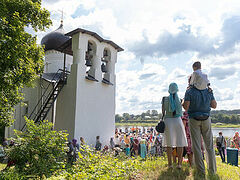
The church is a living and important participant in Russian history, which basically began with a church. The building of very important churches—or, to the contrary, their destruction—are steps upon which one or another era entered Russian life. Is it even possible to imagine the history of Kiev, for example, without the St. Sophia Cathedral, the St. Elias Church, or the Dormition Cathedral of the Kiev Caves Lavra? Or the history of St. Petersburg without the St. Alexander Nevsky Lavra? Or Moscow without St. Basil’s Cathedral? Our churches, which survived with us through the onerous era of godlessness, and are now being reborn, continue to call us to Christ and preach to us with their very appearance—just as the Hagia Sophia once preached to St. Olga.
Churches must be built, regardless of anyone’s carping that “there are enough of them as it is.” The fleshless carper will die, but the church will remain for the ages, and in them people will preach, serve Communion, marry, and serve funerals. There can never be too many churches, and if we’re talking about such a huge megalopolis as Moscow, then there should be a church in every microdistrict. Every sixteen-story apartment building contains a whole village of people, and a church should stand for them in their courtyard. Furthermore, we have to go to the churches, if you’ll excuse the banality. If all baptized Russians were to rise every Sunday and go to divine services, we would see that we need ten times more churches. Alas, this is not currently the case.
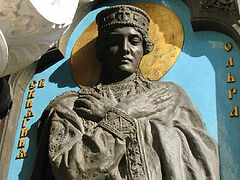
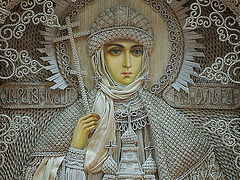
A person who enters a church becomes a participant and continuer of Christian history. It is a history in Russia that is senseless without a church; a history created by Orthodoxy. It is to this continuing history of Holy Russia that the image of Holy Equal-to-the-Apostles Olga calls us—and with it also the doors of the church, now open to all of us.