Beware of false prophets, which come to you in sheep’s clothing,
but inwardly they are ravening wolves
Matthew 7:15
 Emile Delpere. Luther at the Diet of Worms. 1878
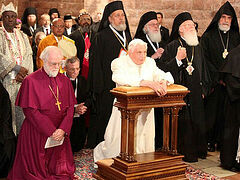
In today’s globalized world with confusion and spiritual crisis, “ecumenism” is no longer an honest dialogue between religious communities. It has become a political strategy in the name of religion. Protestantism, born from a deep rebellion in the Western world, reduced Christianity to the most basic and emotional elements. In this reduction, we can clearly see that they have lost the ability to be “katholikos” (meaning universal and complete) in the mystery of the Church. Today, many Protestant groups have become perfect tools for the Roman Catholic Church in its ecumenical plans and political goals in the Orthodox world.
“He who praises another faith, denies his own. And he who praises both his and others’ faith together is double-minded. If someone tells you, God gave both religions, tell him, Is God double-minded?”
—St. Theodosius of the Kiev Caves.
In the history of Western Christianity, the Reformation of Martin Luther was a major turning point. At first, it came from a good desire to clean the Roman Church from serious moral and theological problems. But history is not a straight line. Luther’s ideals could not save the Latin Church. Instead, he accidentally opened a deep crack that changed the very being of Western Christianity. It became anti-institution, anti-mystical, and disconnected from tradition. It is important to say that many Roman Catholics still believe in the myth of Martin Luther as a “hero of reform,” without any critical study. In fact, Luther never wanted to destroy the Church, but by rejecting apostolic tradition, denying priesthood, and replacing the liturgy with “personal preaching,” he helped turn Christianity into a speech, and not a sacred mystery.
From that point on, a new kind of Christianity appeared, no longer centered on the living God but shaped by cultural tastes. That is why many Protestant churches today from Lutheran to Pentecostal and Evangelical have become easy tools for fake “ecumenical unity.” This unity has no common faith, only shared feelings! It is not unity in truth but in private experiences. In other words, it is an organized breakdown of the true Church, covered in sweet words about love and tolerance. Even worse, this weak and empty theology of modern Protestantism has become a model for some reform groups inside the Roman Catholic Church itself. While Luther started by fighting against falsehood, what came later turned his legacy into a new kind of falsehood—a Church without a body, theology without foundation, faith without the cross, and a “unity” without the One who said, I am the Way, the Truth, and the Life.
Progressive Roman Catholicism after losing its living connection to Sacred Tradition and Apostolic continuity, has easily embraced the spirit of modern ecumenism from Liberation Theology to Ecumenical Councils, from the post-Vatican II liturgical reforms to interreligious dialogues full of political motives. They speak about “being together,” but avoid the word “truth.” They pray “with our brothers” yet never mention the danger of heresy. They speak of love but dare not speak of the death of the Cross or the life given by the true mystical Body. That alone reveals the false nature of today’s ecumenical movement!
Ye adulterers and adulteresses, know ye not that the friendship of the world is enmity with God? whosoever therefore will be a friend of the world is the enemy of God (James 4:4).
In the modern religious world, almost everything has been melted down into soft, comfortable, but vague language terms like “universal love,” “interfaith unity,” or “praying for world peace.” The Roman Catholic Church is not only part of this ecumenical wave, it leads it. And this is not accidental; a powerful institutional system already exists structured like a state with the Pope as head of state, the Roman Curia as its government and a global diplomatic network. Of course, such a system needs a global religious strategy, and in that strategy “unity” becomes a tool for gaining influence, and not a path to Truth.
10th Apostolic Canon, Rule 45: “A bishop, presbyter, or deacon who only prays with heretics shall be excommunicated. And if he allows them to act as ministers of the Church, he shall be deposed.”
10th Apostolic Canon, Rule 65: “If any clergyman or layman enters a synagogue of Jews or a meeting place of heretics to pray, he shall be deposed and excommunicated.”
How can an organization that claims to be “the one true Church” call communities that deny its core doctrines “brothers in the faith”? Since when can Truth be in dialogue with error on equal terms? Since when has the mystery of Christ become a topic for diplomatic compromise?
This isn’t mercy, it’ s a theological betrayal, legalized by a language of false virtue, a betrayal more dangerous than open heresy, because it wears a holy face: soft words, joint prayers, interfaith summits… But behind these is the abandonment of the difference between Truth and non-Truth.
In modern Roman Catholic theology, truth has been reduced to a gradual path, every heresy is considered to “contain some truth,” and salvation is no longer tied to the Church. This doesn’t just destroy the ontological nature of the Church, it eliminates the truthfulness of Revelation itself.
Be ye not unequally yoked together with unbelievers: for what fellowship hath righteousness with unrighteousness? and what communion hath light with darkness? And what concord hath Christ with Belial? or what part hath he that believeth with an infidel? (2 Cor. 6:14–15)
In an uncompromising interview, Fr. Aleksandr Ilyashenko boldly stated that ecumenism isn’t just a correctable theological error. Rather, it’s the product of a post-Christian world order. Faith is deconstructed by atheistic hands, salvation is reframed in secular humanist terms, and Christian doctrine is diluted under euphemisms like “respect for differences,” “multiculturalism,” and “interreligious solidarity.”
This decline didn’t begin with theological missteps but with an ontological crisis; modern man no longer knows who he is in relation to God. Since Vatican II, the Roman Catholic Church has adopted a new diplomatic language, altering its theological tone and of course. Rome doesn’t act alone! The Protestant denominations, themselves born from a modern rupture, have unknowingly become carriers of an agenda they no longer control. With sincere reformist zeal, many Protestant churches have been swept into the spiritual globalization movement.
Meanwhile, the Roman Church, while claiming “faithfulness to tradition,” has taken on the subtle role of a narrative engineer, reconstructing a “shared Christian memory” that rewrites history. In this, Orthodox Christians are no longer seen as the living witnesses of the undivided Church, but merely as “brethren not yet in full communion,” to be led back to Rome.

In this way history is rewritten—the One, Holy, Catholic, and Apostolic Church, indivisible by Orthodox doctrine, is now presented as a fragment in a story of division and reunion, scripted and directed by Roman ecclesial diplomacy. So, what is ecumenism if not a religious-political project? A global strategy that exchanges sacred realities for sociological terminology, and suspends truth in favor of majority consensus? In this system, Protestants become technicians of a mechanized faith, and Roman Catholics are its religious PR experts.
Sanctify them through thy truth: thy word is truth… That they all may be one; as thou, Father, art in me, and I in thee, that they also may be one in us: that the world may believe that thou hast sent me (Jn. 17:17, 21)
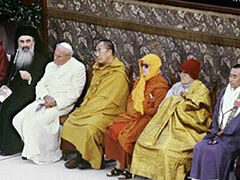
We need unity! But it must be unity in the Truth, not unity in the silence of truth. Because when all religions hold hands together in front of the altar of a so-called “universal god,” the One who is absent is the true God, the God of our Father Abraham, of Isaiah, of the Holy Apostles, and of the Church Fathers.
Ecumenism isn’t a path to truth. It’s a post-Christian idea that serves a modern atheist ideology. Behind beautiful words like “unity” or “interfaith dialogue” is a plan to weaken the faith, to turn Christianity into a cultural product and the Church into a lifeless social organization. Those who don’t see this are either sleeping under the fake light of the “spirit of this age” or are ready to trade the truth for praise from the world, welcoming the Anti-Christ.
The true Orthodox Church doesn’t need approval from anyone, because the One who founded the Church was crucified by this world. The Church doesn’t need “human communion” if it means losing the Truth. Even more, it doesn’t need “interfaith dialogue” if it means staying silent about heresy; it doesn’t need “religious civilization” if the price is to deny Christ!
If the world hate you, ye know that it hated me before it hated you (John 15:18).