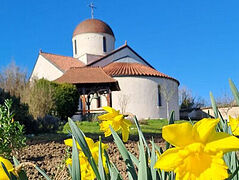
Sts. Boris and Gleb-Anosino Monastery (Anosino Hermitage) is a convent in the Moscow suburbs along the Riga railroad line that has existed for 200 years now. Let’s examine the history of the monastery in detail.
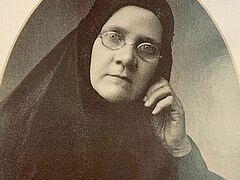
The foundress and first abbess of the monastery was Igumena Evgenia (Mescherskaya), named Evdokia in the world. She was the closest relative of the poet Fyodor Tyutchev. The monastery was named in honor of the holy Passion-bearers Boris and Gleb, in memory of her departed husband, Prince Borish Ivanovich Meschersky. Immediately after her marriage, the princess was widowed. Having raised her daughter at her family estate in the village of Anosino, on the picturesque banks of the Istra River, she built a church in honor of the Lifegiving Trinity and an almshouse. A women’s dormitory was built at the church with the widow’s money in 1821. With the blessing of Metropolitan Philaret (Drozdov) of Moscow, by decree of the Holy Synod, the entire territory of the estate was transformed into a monastery. In 1823, the princess received monastic tonsure from the hand of the Holy Hierarch with the name Evgenia in honor of Venerable Martyr Evgenia of Rome. The next day, she was elevated to the rank of abbess at Chudov Monastery and appointed to rule the monastic community in Anosino. The monastery’s typikon was developed by St. Philaret on the basis of the Studite Monastery typikon.
Matushka lived an extremely strict, ascetic life: She wore a hair shirt and slept on a board covered with felt. By the abbess’ labors, a church in honor of St. Dmitry of Rostov, another named for St. Anastasis (her daughter’s Heavenly patroness), an orphanage, a hospital building, a trapeza, and other outbuildings were built, and two fishing ponds were dug in the monastery. The monastery charter didn’t allow any hired labor—the sisters labored over all the obediences themselves. The services began at three in the morning and were long, with simple chanting. The sister’s cell rule included the Jesus Prayer. The nuns lived under the abbess non-acquisitively, contenting themselves with only what was necessary. According to the reminiscences of the sisters, “We had candles for handiwork in the winter. We would gather in one large cell and one of the sisters would read a spiritual book aloud.” Lampadas were not allowed in their cells. It was forbidden to talk to visitors.
 Abbess Evgenia As the granddaughter of the first abbess (later Abbess Evgenia the Younger) recalled:
During her stays in Moscow on monastery business, she always stayed with her children, my parents. Once, returning from Metropolitan Philaret, she related to them with embarrassment that when she arrived at the dependency, she found one of the Moscow abbesses there, and when they went in together, the Holy Hierarch invited Mother Evgenia to sit on the couch beside him, but said to the Moscow abbess: “You stand there, you’ll get wrinkled.” The Moscow abbess was wearing an elegant silk cassock, while mother Evgenia was wearing coarse woolen cloth, as was her custom. Vladyka loved simplicity and even poverty in monastic attire.
Mother Evgenia set an example for her sisters in everything: She slept little, ate little and only simple food, read Patristic books at night, reverently prayed at the services, and was humble in relations with others. Until the closure of the monastery in Soviet times, it was forbidden for lay people to walk around the territory.
The abbess of the Anosino Monastery and Metropolitan Philaret of Moscow were spiritually close. He loved to visit the hermitage for spiritual talks with her and the sisters. They also kept up a correspondence in which the Holy Hierarch called Mother Evgenia “sister in the Lord,” gave her advice on organizing the monastery (in particular, he advised her to avoid excesses and save money), and treated her with care and trust. The monastery was the first endeavor of this kind for St. Philaret.
Mother was distinguished by her lively mind, gift of eloquence, kindness, love for God, and strong faith. As a true nun, she had constant remembrance of death. Long before her death, she made herself a coffin and had a grave dug. In 1837, at the age of sixty-three, after giving every sister good instruction, the first abbess of Anosino Monastery reposed. She was buried in the Church of the Lifegiving Trinity that she had built. Metropolitan Philaret wrote to her son-in-law:
You have lost a greatly loving mother, and I a spiritual sister, whose pure intentions, obediences, and trust made it easier and more pleasant for me to fulfill my duties to her and the monastery. Therefore, I advise both myself and you to remember her with gentle memories of love and prayer, and to soften the feeling of loss with remembrance of the good, which never dies.
 Princess Mescherskaya’s former serf, goddaughter and ward Anastasia became the new abbess. Finally, in 1850, the Lord also called Mother Evgenia’s granddaughter, Evdokia Ozerova, to the monastery. Like her grandmother, Evdokia enjoyed the favor of Metropolitan Philaret of Moscow. In 1854, after her novitiate, he elevated her to the rank of abbess and placed her in charge of Anosino Hermitage, taking the name Evgenia in the mantle in honor of her grandmother. Under Abbess Evgenia the Younger, the hermitage became an exemplary monastery—one of the most revered in the Russian Empire, distinguished by its eldership (the monastery had eldresses to whom novice nuns were entrusted). Contemporaries called it the “Women’s Optina Hermitage.” It was precisely there that the Optina elders blessed those desiring monastic life to enter. A portrait of Abbess Evgenia (Ozerova) hung in the abbot’s quarters at Optina. During her abbacy, the wonderworking icon of the Dormition of the Mother of God was discovered. Mother was a great woman of prayer. The sisters raised by her became abbesses of other monasteries throughout the Russian land.
The subsequent abbesses continued the work of their predecessors. Abbess Ioanna (Makarova) governed Anosino Hermitage for forty years until the 1917 revolution. She was also a strict ascetic. She wore a hair shirt, went to church until her repose, and acquired the Jesus Prayer. According to Bishop Arseny (Zhadanovsky), the famous elder Schema-Igumen German (Gomzin) of Zosima Hermitage went to see her “to learn monasticism and be consoled by conversation” with her. The monastery was truly the largest of its time.
In addition to the spiritual life, the monastery was also distinguished by its material life. People traveled there from all over the Russian Empire to learn craftsmanship and similar skills. A pilgrims’ hotel was opened at the monastery and a dependency in Moscow. In the pre-revolutionary years, the monastery had three churches, dedicated to the Lifegiving Trinity, St. Dimitry of Rostov, and Great Martyr Anastasia the Deliverer from Potions. A brick wall with four corner towers was erected. Before the revolution, the hermitage had about 180 nuns and novices who, among other things, did embroidery and handicrafts. With the blessing of Frs. Alexei and Sergei Mechev, parishioners from the church on Maroseika Street often visited Anosino.

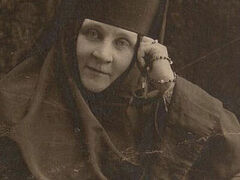
After the revolution, by the grace of God, the amazing Women’s Optina existed for another ten years. Under the Bolsheviks, in 1923, the monastery celebrated its centenary. But one by one, the godless authorities closed the monasteries across the Russian land, and this lot fell to Anosino Hermitage as well. Before the closure of the monastery, a spiritual daughter of Schema-Abbess Tamar (Mardzhanova), Igumena Alipia (Taisheva), became the abbess. She tried to preserve the monastic way of life even under the anti-Church policy of the Soviet authorities. During her time, Schema-Abbess Tamar and the persecuted Hieromartyr Seraphim (Zvezdinsky) found shelter at the Anosino Monastery. Vladyka celebrated the Divine Liturgy every night in one of the monastery’s churches and spoke with the sisters about the monastic life, thereby exerting a great influence on them. The nuns’ living conditions became increasingly difficult—the church wasn’t heated in winter and food was scarce. The sisters were worried that the monastery would be closed and they’d be evicted. But Vladyka Seraphim replied: “No, as long as Schemanun Seraphima is with us and praying, the monastery won’t be closed.”
In June 1928, the eldress that Vladyka was talking about reposed. Then a fire broke out. The monastery was sealed up and the sisters were told it was from thenceforth government property. They weren’t allowed to bury the eldress in the monastery. The abbess and several sisters were arrested. During the campaign to seize Church valuables, the monastery’s icons, archives, and library were seized. The church where Vladyka Seraphim previously served was turned into a club.

In 1941, the front line passed half a mile from the monastery. The bell tower and chapels of the Holy Trinity Cathedral were blown up. The cathedral stood for a long time without any roof. Tractors and trucks drove into the monastery through holes in the wall. A store was set up in the Church of St. Dimitry of Rostov. The sisters were driven out. They lived wherever they could. Some of them voluntarily went into exile with their eldresses. Abbess Alipia was also sent into exile, and upon her return, she lived in banishment. At the same time, the sisters stayed connected and they even continued to perform secret monastic tonsures. Two Anosino sisters were later glorified in the host of New Martyrs and Confessors of Russia—Venerable Martyrs Daria (Zaitseva) and Tatiana (Fomicheva).
 One of the novices of Sts. Boris and Gleb-Anosino Monastery, who joined before its closure, lived to see its revival in the early 1990s—Schemanun Anna (Teplyakova). Monastic life was revived in Anosino Hermitage in 1992 when the remaining buildings and the adjacent land were transferred to the Moscow Patriarchate. As the head of the rural district recalled, in those years:
In my official capacity, I was informed about the transfer of the monastery territory to the Russian Orthodox Church, but I thought it was impossible to revive anything from the ruins and desolation. But by the will of our Lord Jesus Christ, it proved possible. Through the labors of many, with the support and participation of locals, organizational leaders, and benefactors, in ten years the monastery became Anosino Hermitage again.
Indeed, the monastery was restored, the buildings were renovated, and its practical affairs were put in order. The first abbess of the monastery, Mother Evgenia (Mescherskaya), was depicted on the iconostasis of the Sts. Boris and Gleb chapel of the Holy Trinity Cathedral.
Documents are currently being prepared for her canonization. A beautiful fountain inscribed with the words of the Jesus Prayer was installed on the territory of the monastery. The water flows peacefully and quietly in this fountain, as if reminding us that, despite persecutions and outward desolation, the stream of faith in people’s souls won’t dry up until the end of the age, for it flows from the eternal Source of “living water” (cf. Jer. 2:13).