Mt. Sinai, August 1, 2025
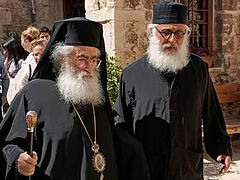
 Abp. Damianos, abbot of Mt. Sinai. Photo: Romfea
A dramatic internal conflict has erupted at the ancient St. Catherine’s Monastery on Mt. Sinai, where 15 monks have moved to depose their longtime abbot, His Eminence Archbishop Damianos, amid an ongoing legal crisis that threatens the monastery’s very existence.
The crisis began with Egypt’s Ismailia Court of Appeals ruling in May 2025 that has been interpreted as threatening the monastery’s property rights, despite the monastery’s 1,500-year presence at the site.
In response to these Egyptian legal challenges, Greek authorities worked to establish legal protections for the monastery. The Greek Parliament recently passed legislation granting legal status to the monastery and establishing a body to represent its interests in dealings with Egyptian authorities. Abp. Damianos praised this move as “long overdue,” describing it as a moment when “the Holy Monastery of Sinai became a point of unity for Hellenism and Orthodoxy.”
However, this very legislation appears to have triggered an internal rebellion. On Wednesday, July 30, fifteen monks convened what they called a General Assembly and “unanimously decided to remove Archbishop Damianos of Sinai, Faran and Raithos from the position of abbot and Archbishop of the Holy Basilica and Autonomous Monastery of the Holy and God-trodden Mount Sinai,” according to Romfea. The decision was reportedly sent to the Patriarch of Jerusalem for ratification.
Abp. Damianos, who at 91 has served as abbot for over five decades, strongly condemned the monks’ actions and rejected their authority to remove him. In a lengthy statement, he declared: “Some fathers of the Holy Monastery of Sinai ‘moved, deliberated, planned the betrayal’ with the purpose not to observe but to conspire to violate the divine and sacred canons and the statutes of the Holy Monastery of Sinai.”
The Archbishop characterized the monks’ actions as “an ecclesiastical coup” and accused them of conducting “unconstitutional activities” that “scandalize the faithful people of God, undermine the unity of the brotherhood, lead the monastery to ‘Babylonian captivity’ and, above all, offer the best service to those who wish that the Golgotha of the holy monastery should NOT end.”
He particularly criticized the timing of their revolt, lamenting that just when hope had returned and efforts to resolve the monastery’s legal crisis were beginning to bear fruit, internal discord had erupted to undermine progress. The Archbishop noted that Egypt’s Foreign Minister is scheduled to visit Athens on August 6, and had expressed hope that “we rightfully expect the end of the Golgotha of the holy monastery.”
The Archbishop insisted the monks failed to follow proper canonical procedures, noting that monastery regulations require a synod to be convened by two-thirds of the brotherhood, and that he was invited to the assembly but did not attend.
Following the monks’ attempted removal, Abp. Damianos sent a formal letter to His Beatitude Patriarch Theophilos of Jerusalem, who has jurisdiction over the monastery. In the letter, he “expresses his deep sorrow and strong protest against the actions of specific monks, which he characterizes as uncanonical, seditious and offensive against the monastery, its spiritual order and canonical administration.”
The letter also “raises questions about the procedure for convening the ‘General Assembly’ and the legitimacy of the decisions attempted to be made.”
As abbot, Abp. Damianos declared his intention to apply canonical sanctions against the rebellious monks, stating: “As their spiritual father, I have the duty to make every effort so that they understand their mistake and do not become patricides.”
He concluded with an appeal for unity: “Let us all be inspired by the unity shown by the Greek Parliament from one end to the other these days for the salvation of the Holy Monastery of Sinai.”
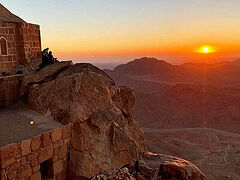
The monastery, which houses approximately 20 monks and sits at the foot of Mt. Sinai where Moses received the Ten Commandments, now faces both external legal threats from Egyptian authorities and internal division among its own brotherhood over how to respond to the crisis.
Follow OrthoChristian on Twitter, Vkontakte, Telegram, WhatsApp, MeWe, and Gab!