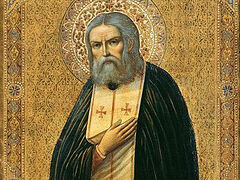
Archpriest Seraphim Gan’s entire life has been closely connected with St. Seraphim of Sarov. In his childhood, he served in the Church of St. Seraphim in Monterey, California, and for the past twenty years he has led the parish of the same name in Sea Cliff, near New York. Even his name, Seraphim, was not given to him by chance, but according to a vow.
 Archpriest Seraphim Gan —Father Seraphim, is being the rector of a parish dedicated to your heavenly patron a special honor, a blessing, a responsibility?
—I would say it is the mercy of God. Throughout my entire life—and, in fact, in the life of our whole family—St. Seraphim has always been present through his help and prayer. I’ve always turned to him as my heavenly protector. But since becoming the rector of our parish twenty years ago, I now turn to him also as its head.
When problems, temptations, or concerns arise, I try to turn to him—and I see how he is involved not only in our parish life, but also in the lives of those who ask for his intercession. Our parishioners venerate him, turn to him with their needs, and he responds.
So for me, it is a great joy and a mercy from God to have my heavenly patron as the head of the parish, because he is such a swift helper. In times of joy, in trials and temptations, he is always present and makes his presence known. That is very precious to us.
—How does he make his presence known?
—In our family, there was always a tradition of venerating St. Seraphim. One of our ancestors, Archbishop Juvenaly (Kilin), who ordained my grandfather, Archpriest Rostislav Gan, was even present at the glorification of St. Seraphim and took part in the washing of his relics in 1903.
—We always turned to the Saint in all circumstances. I remember, as a child, how my parents would ask him for help. And after becoming rector, I myself have repeatedly turned to him with specific requests—such as for help in resolving practical, administrative issues in the parish. In particular, in 2012 I was deeply worried about a certain problem in the parish, and at that time I happened to travel as part of a delegation of the Russian Church Abroad to celebrate the fifth anniversary of the reunification of the Russian Orthodox Church. As part of that trip, we visited Diveyevo and served the Divine Liturgy and a moleben with an akathist at the reliquary of St. Seraphim.
While I was there, praying before his relics, I brought my specific requests to him. And when I returned home, I saw that all those issues begin to be resolved very quickly. One could say that from that point on, I have constantly turned to St. Seraphim—to ask that he help us, strengthen our parish, and aid us in preserving and increasing the heritage that has been entrusted to us by previous generations of clergy and parishioners. That we may continue to serve as a source of joy and comfort for those who have connected their spiritual lives with our church. And that St. Seraphim might help not only our current parishioners, but also those who have not yet come to us—those for whom we are still waiting.
—I’ve heard you were a child of promise, and that you were named Seraphim for a special reason. Can you share that story?
—My mother told me the story. She was undergoing surgery when the doctors discovered she was pregnant. They tried to convince her that she needed to have an abortion. At that time, the Third All-Diaspora Council of the Russian Church Abroad was taking place in the United States, and my grandfather, Archpriest Rostislav Gan, had come to attend. He advised my mother not to abort the child, but instead to choose a saint and pray to him that the baby would be born healthy—and then name the child after that saint.
My mother immediately chose St. Seraphim and began praying to him. And when I was born, she named me in his honor.
—So, to put it in secular terms, you are Seraphim, son of Seraphim?
—Yes, my father was also named in honor of St. Seraphim. He wanted to name me after a different saint, but my mother got ahead of him and very confidently gave me the name Seraphim.
As for my father, he was named after St. Seraphim because my grandfather had been rector of the Church of St. Seraphim of Sarov in Tianjin, China. I believe that parish was part of the Russian Ecclesiastical Mission in China.
 —You were baptized, I believe, in the Church of St. Seraphim in Monterey, California?
—Yes, I was baptized there by its first rector—Father Grigory Kravchina. He was a remarkable and very prayerful priest who had endured much: persecution of the Church, war, and wandering. Finally, in 1950, he settled in Monterey and founded that parish in honor of St. Seraphim.
He was a man of saintly life. As a child, I served at the altar with him and saw how he prayed, how he conducted the services. He was our neighbor and often came to visit us and speak with us. A kind shepherd who was very approachable even for little boys, he would tell us stories about his own childhood at the Pochaev Lavra.
Before his death, Father Grigory told me that I would go to seminary and become a priest. That was in early August of 1988. Of course, I didn’t know then that it would be our final conversation.
—So it turns out that the story of your whole family, at least in the twentieth century, revolves around St. Seraphim. You have two Seraphims and two rectors of churches dedicated to St. Seraphim.
—Yes, it turns out that way—quite interesting, really (laughs).
—Does this family continuity somehow feel tangible?
—I would say it feels like the care of the Venerable One. He supports, guides, and always hears our prayers.
 —What is your parish living through now?
—Our parish mainly consists of the older generation of émigrés and their descendants, as well as new immigrants. I would say there are now many of them, coming from different countries of the former Soviet Union. Whereas before, in our little town of Sea Cliff, there were maybe 200 or 250 Russian households, now our parishioners are spread all over Long Island and Queens, and even some come from Brooklyn. I think it’s because we make a conscious effort to preserve Church Slavonic and the Russian language in our services and activities. So, many people who are looking for traditional Russian Orthodox worship are drawn to our church.
—And how is parish life going? What are your goals, hopes, thoughts? Are you able to keep your flock together in these rather difficult times?
—Yes, these are very difficult times. And New York City is not an easy place to live. Because of this, there are challenges. New York—and especially Long Island—is known for its traffic jams. In addition, people work a lot. That in itself creates a kind of obstacle to active parish life during the week. Of course, we do serve during the weekdays and we hold events, but it’s very hard to gather people—simply because of the distances and work schedules. Still, we try. And I believe the fact that we hold together as a close-knit family helps us maintain unity during such challenging times.
 The blessing of kulich on Holy Saturday There has always been a very family-like atmosphere in our parish, one cultivated not only by my predecessors as rector but also by the very kind people who loved and valued everything connected with our history—the history of the Church. That’s what we are rooted in—love for the Russian Church, our traditions, and, of course, mutual support. We have very kind parishioners, and a warm, caring sisterhood. When someone is in trouble, people respond readily and extend a helping hand. That brings me great consolation.
For example, when someone falls ill, they call the priest. And it’s very moving for me to see that sometimes the parishioners beat me to it. I’ll arrive at the hospital room, and several of our people are already there. They just found out—and came straight to the hospital to say a kind word and support the person in need. That’s very comforting.
Such kindness from people who strive to live a Christian life and feel like part of the parish family is truly inspiring. And I think this also draws people in. I’ve been told more than once that our parishioners are very warm—that they’ll come up, ask who you are and where you’re from, invite you to the parish meal, or simply introduce you to the priest and show you the holy objects. That means a great deal. It fosters unity and strengthens others in the faith.
—You mentioned relics. What are the main relics in your church?
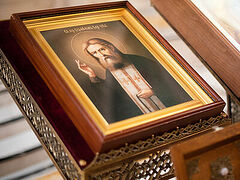
—We have a pre-revolutionary icon of St. Seraphim containing a particle of his relics. It once belonged to Grand Duchess Olga Alexandrovna, the sister of Emperor Nicholas II. We also have icons from the Ipatiev House, discovered there by the investigator Nikolai Sokolov. He first took them to China, then to Paris, and later gave them to another sister of Nicholas II, Grand Duchess Xenia Alexandrovna.
 Altar of the Church of St. Seraphim We also have many relics of God’s saints, including those of St. John the Wonderworker, Archbishop of Shanghai and San Francisco, who served in our church in the 1960s. There’s even video footage of him serving here. A relic of his was given to us exactly when I became rector—twenty years ago. It now rests in an icon painted especially for it. We also have his Great Lent miter, which rests on the altar throne.
In addition, I’ve temporarily placed in the church a family relic—the kamilavka of Father John of Kronstadt, which was received long ago by Bishop Juvenaly (Kilin). When I became a priest, this relic was passed on to me. Over the years of my ministry, I’ve witnessed many instances of people receiving help through the intercessions of St. John after venerating this kamilavka, so I decided to leave it in the church for the time being.
—You’ve spoken about the importance of family unity. Your church is also a memorial church commemorating the reunification of the Russian Church. Tell us more about that.
—Yes, our church was officially designated a memorial church to the restoration of unity within the Russian Church after we began a unique iconographic project dedicated to the Church’s centuries-long history and the reunification.
The theme of unity and reconciliation within the Church runs like a red thread throughout the murals of our church. When the fifth anniversary of the reunification was being commemorated, the bilateral Commission on the Strengthening of Church Unity raised the idea of creating a memorial church in Russia—and another abroad. The Synod of Bishops chose our church for this role, precisely because of the iconographic program we had gradually been carrying out over ten years—since 2009. The idea to dedicate this project to reconciliation within the Church came to us because in 2008, both Metropolitan Laurus, First Hierarch of the Russian Church Abroad, and His Holiness Patriarch Alexy II, had reposed in the Lord. We wanted to commemorate not only them, but the great work they accomplished at the end of their lives.
In Moscow, the church meant to serve as a similar memorial is the one dedicated to the Kursk Root Icon of the Mother of God. As far as I know, it is still under construction and has not yet been consecrated, though services are already being held in a temporary church on the grounds.
—This year is an anniversary year for you, isn’t it?
—(Laughs) Yes, I turned 50 this February.
 Archpriest Seraphim Gan with his wife Irina, mother, and nephew
—And what do you ask of St. Seraphim on this occasion?
—I ask for wisdom, humility, and patience, so that I may continue to serve God and people. I don’t ask for anything special regarding our parish—just that he help us continue the work we’ve inherited from our predecessors. That we may be worthy of it, and that we may bear the Light of Christ to all who are seeking God, the Church, and a life of goodness. That we may help them bear their crosses. For us, this is what matters most.
And I always ask that, as I approach my own grave, I may have become a true Christian and a true priest. And if that doesn’t happen—then at least a wise thief.