Father Feodor twice planned to go to Jerusalem. The first time, instead of the Holy Land, he ended up beyond the Arctic Circle. He was sent to De-Kastri—a settlement in the Ulchsky District in the north of Khabarovsk Krai. There, in nine months, he transformed an abandoned former laundry building into a church dedicated to St. Olga, Equal-to-the-Apostles and Princess of Rus’. They carried out a full renovation, erected an iconostasis, and painted the ceilings and walls of the church. Services began, and a parish grew.
“We did the renovation work ourselves, through the efforts of the parish. The freezing, snowy, and windy winter was brightened by the love and help of the parishioners—in winter the temperature dropped below minus 40 degrees!” says Father Feodor.
The second time, instead of visiting the Holy Land, Father Feodor was sent to serve in a village deep in the central Russian forests, ninety kilometers from Vyatka, now called Kirov—one of the most ancient settlements in these lands. Only 327 people lived there 15 years ago. Coniferous forests, quietness. You leave the village, and the road immediately runs downhill toward the Velikaya River. And in the heart of the village stand ancient churches.
Holy Land
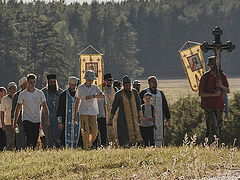
It was here, 600 years ago, that St. Nicholas the Wonderworker first revealed himself. It is known that an icon of him was found by a local peasant named Agalakov. The icon worked many miracles, and the small village became the keeper of a holy object venerated throughout all Rus’. Indeed, one of the churches of St. Basil’s Cathedral in Moscow is dedicated to the Velikoretsk Icon of Saint Nicholas the Wonderworker. The famous six-day Velikoretsk Procession, which this year was undertaken by 21,600 people, comes precisely here—to the village of Velikoretskoye.
The Velikoretsk Procession is a treasure of all Russia. For all 600 years since the icon’s discovery, each year the faithful have carried it from Kirov, ancient Vyatka, to the place where it was revealed, and then back again.
A Metropolis of Ancient Rus’
 St. Nicholas Church
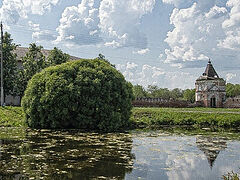
 Velikoretsk Grad—this is what the village of Velikoretskoye was once called in these parts. The Transfiguration Church, St. Nicholas Church, St. Elijah’s Bell Tower, trading rows, the guest yard, a school… Before the Revolution, it was a site of all-Russian pilgrimage and a very lively settlement.
In the 1930s, the wonderworking icon of St. Nicholas of Velikoretsk, which pilgrims had carried in veneration for half a millennium, was lost. Today, a revered 17th-century copy is kept in the Holy Dormition-St. Triphon Men’s Monastery in Kirov—it is this icon that the Velikoretsk Procession carries each year.
 Velikoretsk Procession. Trading rows Time and change did not spare Velikoretsk Grad. The remoteness of Velikoretskoye from the transport routes of the modern age only made matters worse. The village became depopulated, and the church complex fell into decline. In an effort to revive this spiritual pearl of the Vyatka forests, in 2014 a metochion (dependency) of the Holy Dormition-St. Triphon Men’s Monastery was blessed to open here.
It was Father Feodor—the happy seeker of the Holy Land—who became its rector.
That the Orthodox capital of the Kirov forests was due for revival was suggested by its very patron. In 2016, St. Nicholas the Wonderworker revealed his image in Velikoretskoye for the second time.
“It’s a miracle!” cried the novice.
 The icon of St. Nicholas revealed in 2016 On the wall of the Transfiguration Church hangs an icon of St. Nicholas the Wonderworker: a simple, austere covering, once-bright but now somewhat faded paints, the saint’s recognizable red vestments, white curls, a piercing gaze… Beneath the covering hangs a gold chain with a ring—someone’s touching “thank you.”
You would never guess that before you is not a painted icon at all, but a sheet of iron. For years, it had been used in the monastery to cover a hole in the wall of the cowshed—and of course, there had been no image on it.
“Every day the novice caring for the cows would look at this utterly ordinary metal sheet, leaving his pitchfork in front of it after work,” says Mother Anastasia, the metochion’s churchwarden. “On December 19, 2016, the first Divine Liturgy in eighty-five years was celebrated in St. Nicholas Church since its closure, and on December 21, as we were clearing snow around the cowshed together, we were very surprised to see the icon—but understood nothing. Only when the novice Mikhail came and cried out, ‘It’s a miracle!’ did we realize what had happened.”
 Nun Anastasia (Fedotova), Churchwarden of the Metochion Now, the revealed image of St. Nicholas the Wonderworker can be seen by all in the Transfiguration Church of the monastery’s metochion in the village of Velikoretskoye, Kirov Region.
Veneration, glorification, and proclaiming the miracle as loudly as possible—all this is in the plans of Father Feodor and his brethren—to revive the town on the Velikaya River, increase the number of monastics, and restore the churches. The sign of God’s will has appeared marvelously—now it is time to gather strength and call the whole world to this common work.
They have begun with repairs to the bell tower, which is in dangerous condition. The Foundation of Archangel Michael—the heavenly builder of churches—has helped. Now father has called for aid in collecting chalices and cups for Holy Communion. Many are needed in the monastery to commune the thousands who come here with the Velikoretsk Procession. Thus, one can participate in the procession’s grace even in this way. Father knows that once there is conciliar prayer, other labors will also move forward, restoration will begin, and this wondrous habitation will receive the glorification it deserves.
Temples Not Made by Hands
 Valentina
Valentina has been living in Velikoretskoye for six months now. She came to visit her spiritual father, Father Feodor, from Khabarovsk—she has been his spiritual child since the days of his ministry in the Far East. She found herself in central Russia not of her own choice, but out of necessity—the doctors had given her a diagnosis with the verdict, “Immediate surgery—or you will no longer be able to walk.”
“I came to Velikoretskoye to seek advice from my spiritual father. He said firmly, ‘No surgery. Pray.’ And so I stayed in the monastery. A day, another, a week… And I didn’t notice how month after month went by, and I was still here—helping, helping, and sometimes even running around…”
She is in no hurry to return home to Khabarovsk—her children are grown, and nothing there holds her anymore. But she has warmed to Velikoretskoye and found shelter here, so much so that each day she feels more and more like staying. And, most importantly, her legs serve her well—more than well! Down to the river and back to the village, up and down the great bell tower—she has even forgotten about the surgery that not so long ago seemed inevitable.
“This place is holy—I am convinced of it every day. I think I will stay here. Nowhere else have I felt such grace as I do here. And Father is a great man of prayer.”
Every year, Velikoretskoye becomes a place of pilgrimage for tens of thousands of believers. For several days, the ancient village—which preserves holy relics and bears witness to miracles—comes alive. It is time to make it so that this spiritual place and its inhabitants welcome guests more often, ministering to pilgrims from all over the country. Helping to glorify Velikoretskoye is within everyone’s power—the good work has already been set in motion.