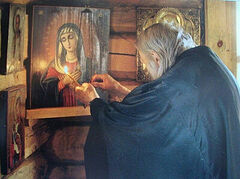
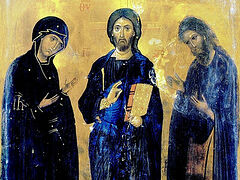
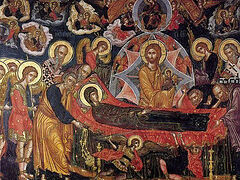
If outside observers were to turn their attention to Orthodox Christians, they’d notice a special liturgical and doctrinal veneration of the Most Holy Theotokos in the Orthodox (Greek-Eastern) Tradition. As we begin the Dormition Fast, which concludes with the celebration of the Dormition of the Most Holy Theotokos, we turn to the deep meaning of the veneration of the Mother of God.
The veneration of the Most Holy Theotokos Mary originated in the earliest Christian communities, as attested to by apocryphal texts of the second–fifth centuries, such as the Protoevangelium of James and the Infancy Gospel of Thomas. Although these works weren’t included in the canon of Holy Scripture, they were used by the teachers of the Church to expand and clarify the short Gospel narratives. They demonstrate the deep desire of the first Christians to know more about the life of the Virgin Mary, her childhood, upbringing, and ultimately her earthly repose.
The Theotokos is revered not as a deity, but as more honorable than the Cherubim and more glorious beyond compare than the Seraphim—the highest of created beings. Her special role is due to the fact that she became the instrument of God’s Incarnation. By her obedience, humility, and purity, she made the Savior’s coming into the world possible. Through her, God became Man, and therefore she’s called the Theotokos; that is, the Birth-Giver of God.
The Holy Fathers, including St. John of Damascus (8th c.), approached the life of the Theotokos with reverence. They recognized her greatness but couldn’t speak of her without calling upon her for help. In his works, St. John of Damascus, like other Fathers and teachers of the Church, theologically comprehended and refined the ancient traditions about the life and Dormition of the Virgin Mary. His teaching, according to Bishop Athanasy (Jevtić), always remained within the framework of Christology, that is, the doctrine of Christ, and was never separated into a distinct Mariology. Thus, the veneration of the Theotokos was not an end in itself, but a path to understanding the lofty truth of the Incarnation.
St. John of Damascus and other Fathers of the seventh–tenth centuries turned pious traditions into a part of the Church’s liturgical life. A striking example of this is the Dormition service, which reveals the image of the Mother of God in its poetry and rhetoric and presents deep theology about her, about us, and about the whole of God’s world. St. John of Damascus used authoritative sources, including the works of St. Dionysius the Areopagite, for his sermons dedicated to the Dormition of the Mother of God.
But for us, it’s not just the feast of the Dormition of the Most Holy Theotokos that’s important, but also the two-week fasting period leading up to it. What then characterizes the Dormition Fast?
The Dormition Fast is one of the four extended fasts of the Orthodox Church, lasting from August 1/14 to 14/27. It concludes with the great feast of the Dormition of the Most Holy Theotokos on August 15/28. In its strictness, this fast is similar to Great Lent, forbidding the consumption of meat and dairy products. Fish is only permitted once, on the feast of the Transfiguration of the Lord on August 6/19.

In the Russian tradition, the fast is popularly known as “Spasovka,” derived from the word for Savior (“Spas”), due to the three “Spas” feasts that fall during and around this period:
-
Honey Spas: August 1/14, when the new honey harvest is blessed
-
Apple Spas: August 6/19 (Transfiguration), when, according to tradition, the apple harvest is blessed
-
Nut (Bread) Spas: August 16/29, celebrated on the feast of the Translation of the Icon of Christ Not-Made-By-Hands, when nuts are blessed
These folk customs reflect the desire to sanctify the fruits of earthly labor by associating them with Church feasts. The blessing of honey, apples, and nuts symbolizes our gratitude to God for the gifts of nature and the desire to sanctify our whole lives, offering Him the best fruits of our labor. It reminds us that everything in our lives should be dedicated to God.
The Dormition Fast has its own liturgical features. According to the typikon, on weekdays, “Alleluia” should be sung instead of “God is the Lord” and the Prayer of St. Ephraim the Syrian should be read. This ancient practice, which makes the services like those of Great Lent, is rarely found in modern parish life, although the Church hierarchy is calling for its revival.
Thus, the Dormition Fast is a time of deep piety and reflection that precedes the feast of the Dormition of the Most Holy Theotokos. This fast symbolizes our spiritual path, similar to that of the Virgin Mary, who served God throughout her entire life, and whose Dormition was not an end, but the beginning of eternal joy.
This fast isn’t just about restrictions on food, but an opportunity to purify your soul and body, to get closer to the Theotokos, who is for us the ideal of humility, purity, and love. Reflecting on her life, we learn to accept God’s will with complete confidence. Fasting helps us to be delivered from worldly worries and focus on what’s most important—the salvation of the soul, just as the Virgin Mary freed herself from earthly life in order to be united with her Son.
The Dormition Fast is a time when we prepare to greet the Dormition of the Most Holy Theotokos not as a sorrowful event, but as a great celebration of eternal life and joy, which the Mother of God has given us as the greatest example.