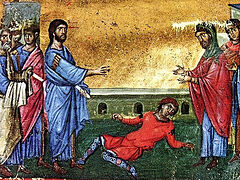
James Tissot. Healing of the demoniac boy. Photo: ekzeget.ru The cases of demonic possession described by the Evangelists make it possible to form an idea of the characteristic signs of this affliction. Of these signs, the most typical and absolutely common to all cases is this: The possessed do not acknowledge themselves to be ill and make no request for help. Such people never come to Christ for healing of their own accord—they are brought to Him. Or else, Christ Himself heals them out of His mercy, or at the request of their relatives and friends.
In form, however, possession is very diverse. The most severe form is the possession of the two Gadarene men, who exhibited violent madness and self-mutilation continually for many years. The case of the lunatic boy was also very severe, for in that instance both the body and the soul of the man were affected, though there were intervals or lessening of the fits between new moons.
In other cases, possession, without touching the depths of the human spirit, affected only certain organs (hearing, sight, speech) or the entire bodily constitution (as in the case of the woman who was bent over). Thus, “possession,” as can be seen, may afflict the soul, or the body, or both together. From this one may conclude that there is no definite “clinical” symptom complex for this affliction; it is an illness “of the spirit” and may be associated with any bodily ailment, because of the close unity of the entire human constitution. The devil makes use of human infirmity, which is a consequence of original sin, in order to strike at the most sensitive point.
In any case, there are no “medical” remedies for possession. It is an illness “of the spirit” and is treated exclusively by spiritual means. One should not be mistaken in discerning “possession”: not every case of “epilepsy,” nor every case of “paranoia” or “circular psychosis,” and so on, is “possession.” There is no equal sign here, though there are often overlaps, which can be discerned only by true physicians untainted by the prejudices of a “materialistic worldview.”
According to the testimony of St. John of Kronstadt, the character of the illnesses of a significant majority of patients in mental hospitals is of a spiritual, and not psychophysical, nature.
The Healing Of The Demon-Possessed Lunatic Boy
(Matt. 17:14–21; Mark 9:14–29; Luke 9:37–42)
The healing of the demon-possessed boy took place in Galilee, on the day following the Transfiguration of the Lord. The Evangelist Matthew gives a brief account of this miracle, which the other Synoptics supplement.
The Gospel of Matthew says: And when they (that is, Christ and those who had accompanied Him to Tabor—Peter, James, and John) were come to the multitude, there came to Him a certain man, kneeling down to Him, and saying, Lord, have mercy on my son: for he is lunatic, and sore vexed: for ofttimes he falleth into the fire, and oft into the water. And I brought him to Thy disciples, and they could not cure him. Then Jesus answered and said, O faithless and perverse generation, how long shall I be with you? how long shall I suffer you? Bring him hither to Me. And Jesus rebuked the devil; and he departed out of him: and the child was cured from that very hour.
The Evangelist Mark presents a vivid picture of Christ’s appearance before the people. He writes that when Christ arrived, a great multitude surrounded a group of His disciples and the scribes from Jerusalem, who were disputing among themselves. The dispute was apparently sharp and unpleasant for the disciples. But the appearance of Christ interrupted the quarrel.
And straightway all the people, when they beheld Him, were greatly amazed, and running to Him saluted Him. It is possible that the heavenly light which had shone upon Christ on Tabor was still shining in His eyes, and was reflected in His whole body, countenance, voice, and movements.
Christ asked the scribes, What question ye with them? The scribes were silent. And one of the multitude answered and said, Master, I have brought unto Thee my son, which hath a dumb spirit… and I spake to Thy disciples that they should cast him out; and they could not.
It may be supposed that the boy’s father had at some earlier time brought his son directly to Christ, but not finding Him, had turned to the disciples for help—and they had been unable to cast out the demon. It is not unlikely that this was the very subject of the dispute between the scribes and the disciples, and the cause of their embarrassment.
From the Evangelist Mark, one can form a complete picture of the characteristic symptoms of the boy’s illness. By outward appearance they are very close to what modern medicine calls epilepsy. However, to speak of complete identification here is hardly possible.
According to the Gospel, the “epileptic” symptoms of the boy were as follows: the seizures occurred “at the new moons” and came “suddenly”; the boy, as though “seized” by someone, would fall to the ground, “gnash with his teeth,” “foam at the mouth,” and be “wrenched” in his whole body by convulsions; he also made attempts at self-destruction, for he “falleth into the fire and into the water.” At the same time, he was “deaf and dumb.” Yet even this periodicity of the attacks—at the new moons—is entirely uncharacteristic of classical epilepsy. And, most importantly, the cause of the illness is understood entirely differently by clinicians and by the Evangelists.
For physicians, the cause of seizures is assumed to be certain abnormalities in the condition of the brain substance or in the composition of the blood; for the Evangelists, such abnormalities—if they exist—are not the cause, but the consequence of the entrance into the person of an alien, pathogenic spirit. The boy’s father had no doubt that his son was “possessed with a dumb spirit,” and his misfortune lay only in the fact that the disciples of Christ had been unable to “heal” him.
Furthermore, deafness and dumbness are likewise uncharacteristic of epilepsy, although they may occasionally coincide with it.
Finally, the tendency toward suicide can in no way be considered a constant symptom of epilepsy; it is rather a rare companion of the disease. Therefore, the Gospel case of the boy possessed during the new moons might be classified by modern physicians as epilepsy of a “psychogenic” or “hysterical” nature, rooted in the patient’s psyche. And this would not be incorrect, for it was precisely the pathogenic “spirit,” having taken hold of the human psyche, that brought about all the pathological phenomena in him.
Thus, according to the testimony of the Evangelists, the illness of the boy with seizures was so severe that the disciples of Christ could not heal him. Then Christ, grieving in His heart and marveling at the unbelief of people enslaved by the spirit of evil, said: “O faithless generation! how long shall I be with you? how long shall I suffer you?” And He commanded that the sick boy be brought to Him. And when the boy was yet approaching Christ, “the spirit tare him; and he fell on the ground, and wallowed foaming.” A most violent seizure began.
And He asked his father, How long is it ago since this came unto him? And he said, Of a child. And then he turned to Christ with a desperate plea: Iif Thou canst do any thing, have compassion on us, and help us. In this petition there was the sound of hope rather than of faith. Then the Lord, in His mercy, strengthened the father’s hope and helped him to find in himself the beginnings of faith: If thou canst believe, all things are possible to him that believeth. And immediately, according to Mark’s testimony, the father of the boy cried out with tears: Lord, I believe; help Thou mine unbelief! (Mark 9:19–24).
These words did not pass unnoticed; for many centuries they have been repeated by all who are weighed down with grief and long to find its resolution in faith in God’s help. Here, out of many years of suffering and tears, there was born in the soul of the unhappy father a faith that overcame his former unbelief.
But while the conversation between Christ and the boy’s father was taking place, the people continued to gather from all sides to see the extraordinary spectacle. Then Jesus rebuked the unclean spirit, saying unto him, Thou dumb and deaf spirit, I charge thee, come out of him, and enter no more into him. And the spirit cried, and rent him sore, and came out of him: and he was as one dead; insomuch that many said, He is dead. But the boy was alive, and Christ delivered him again to his father (Luke 9:42).
Afterwards, when the crowd had dispersed, the disciples privately asked Jesus Christ why they themselves could not cast out the demon. And Christ said to them: Because of your unbelief: for verily I say unto you, If ye have faith as a grain of mustard seed, ye shall say unto this mountain, Remove hence to yonder place; and it shall remove; and nothing shall be impossible unto you (Matt. 17:20). And to this the Lord added: This kind can come forth by nothing, but by prayer and fasting (Mark 9:29).
Therefore, here is the true path of healing such sufferers, as indicated by Christ Himself: faith, prayer, and fasting.
But what could modern psychiatrists, in most cases infected with unbelief, say to this? Most likely, they would only smile at such advice. Yet, alas, their smile would have no healing power and would not save the sufferer from his grievous illness.
From Lev Liperovsky, Miracles and Parables of Christ, Paris : Ed.de l Exarchat patriarcal russe en Europe occidentale, 1962. - 177 с. (Recueil d~etudes orthodoxes)