Moscow, August 21, 2025

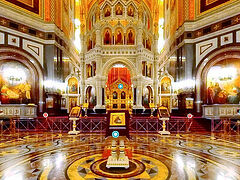
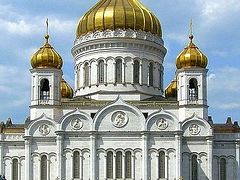
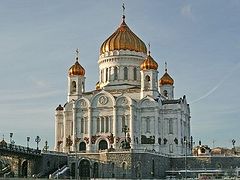
On August 19, the feast of the Transfiguration, the Russian Orthodox Church celebrated the 25th anniversary of the consecration of Christ the Savior Cathedral in Moscow following its reconstruction after Soviet-era destruction. His Holiness Patriarch Kirill of Moscow and All Russia led the Divine Liturgy, marking this significant milestone for Russian Orthodoxy.
The cathedral, originally built in the 19th century to commemorate Russia’s victory over Napoleon, has a dramatic history. Construction began in 1839 under Tsar Nicholas I, with the cathedral finally consecrated in 1883. The original structure stood for less than 50 years before Joseph Stalin ordered its demolition in 1931 to make way for the never-realized Palace of the Soviets. The site later became the world’s largest open-air swimming pool, which operated from 1958 until the early 1990s.
Following the collapse of the Soviet Union, the Russian Orthodox Church received permission to rebuild the cathedral in 1990. After years of fundraising and construction, with about one million Muscovites contributing to the project, the restored cathedral was consecrated on August 19, 2000.

During Tuesday’s anniversary Liturgy, Pat. Kirill was joined by numerous bishops and clergy from across Russia, reports Patriarchia.ru.
The service included special prayers of thanksgiving for the cathedral’s restoration:
With fear and trembling we give thanks, as unprofitable servants to Thy loving-kindness, O Savior and Master our Lord, for Thy benefactions which Thou hast poured out abundantly in the past twenty-five years upon this holy church, recreated in glorious splendor to Thy glory and for the consolation of the Orthodox people of our capital city, and we fall down and offer doxology to Thee as God, and fervently cry out: show to all of us Thy rich mercy, overlooking all our transgressions, we pray Thee, hear us and have mercy.
And:
Lord Jesus Christ our God, God of all mercy and compassion, Whose mercy is immeasurable and Whose love for mankind is an unfathomable abyss! Falling down before Thy Majesty, with fear and trembling, as unworthy servants, we now humbly offer thanksgiving to Thy loving-kindness for Thy benefactions which have come to pass in the past twenty-five years upon this holy church, and as Lord, Master and Benefactor, we glorify, praise, hymn and magnify Thee, and falling down again we give thanks, humbly beseeching Thy immeasurable and ineffable mercy. As Thou hast now deigned to receive and mercifully fulfill the prayers of Thy servants, so also in the future grant us to receive Thy benefactions, prospering in Thy love and in all virtues, delivering the Russian Church, our God-protected country, our capital city and this holy church from every evil circumstance and granting them peace and tranquility, that we may be granted always to offer thanksgiving and speak of good things and sing praises to Thee, glorified as God in One essence with Thy Unoriginate Father and Thy All-Holy, Good, and Consubstantial Spirit: Glory to Thee, O God our Benefactor, unto ages of ages.

At the fraternal meal following the Liturgy, Pat. Kirill reflected on the significance of the cathedral’s restoration:
First of all, I would like to express gratitude to everyone who recreated this church of God—both those who have departed from us and those who are still here. This was truly a feat. Despite the limited material resources of the Church and the state, despite the large percentage of people who, as a result of many years of atheistic education, had fallen away from the Church or ceased to recognize themselves as its active members—at this very time a miracle of God occurred: the Cathedral of Christ the Savior was recreated in the city of Moscow.
The Patriarch emphasized that the reconstruction represented more than just an architectural achievement:
We all understood then that this was not simply the construction of a grandiose building that would certainly attract people’s attention, but a symbol of the rebirth of Orthodoxy in Russia. And so it happened: the rebirth of the Cathedral of Christ the Savior led to the rebirth of the Orthodox faith throughout our country and even beyond its borders.

He noted the unprecedented growth of the Russian Orthodox Church since the cathedral’s restoration, describing it as a response to the sufferings endured during Soviet persecution: “This is a response to the feat of life, to the sufferings, to the sorrows that our people bore as a result of the persecution of the Church. This is a response to the trials that our people endured as a result of many political mistakes of the 20th century.”
Quoting Scripture, the Patriarch reflected on Divine paradox: “God’s strength is made perfect in weakness (cf. 2 Cor. 12:9)—everyone knows these words from Holy Scripture well. It would seem a paradox—how can strength be perfected in weakness? But it is actually so! When human strength is not enough and only the power of faith and prayer remains, God performs miracles for us.”
The cathedral has witnessed numerous historic events since its reconstruction, including the 2000 canonization of the New Martyrs and Confessors, and the 2007 reunification of the Russian Orthodox Church with the Russian Orthodox Church Outside Russia.
As Patriarch Kirill concluded, the cathedral represents a miracle worked through human hands but accomplished by Divine grace, ensuring that “God’s mercy will abide over the capital city, protecting our capital from every enemy and adversary, contributing to the spiritual, moral, cultural and material flourishing of Moscow.”
Follow OrthoChristian on Twitter, Vkontakte, Telegram, WhatsApp, MeWe, and Gab!