Holy Dormition-Kazimirovo Convent, as often happens in Belarusian history, is one of the oldest monasteries on our lands and at the same time still quite young.
The history of Kazimirovo Monastery begins in 1713, when, on the site of an ancient Orthodox church, a nobleman of the Radwan clan, the Under-chamberlain of Rechitsa Kazimir Yuditsky, founded a monastery in honor of a wonderworking icon of the Mother of God inherited from his ancestors. According to tradition, the icon saved Yuditsky during a battle in the Northern War (1700–1721).
The monastery was initially for men and governed by the Uniate Basilian Order. A small town built by Yuditsky and named after him, Kazimirovo, soon grew up around the monastery.
Here is how an abstract from an historical and statistical description of the Minsk Diocese from 1864 testifies to these events:
The former Kazimirovo-Holy Dormition Monastery is located in Bobruisk County, in the village of Kazimirovo, where the Dormition-Kazimirovo Church is now located… It was founded in 1713 by the Rechitsa Under-chamberlain Kazimir Yuditsky, who also built the town itself, naming it Kazimirovo. His motivation for building this monastery was his sense of reverence and gratitude to the wonderworking icon of the All-Holy Virgin Mary that he inherited from his ancestors and which had been with him in war, in which he achieved an unexpected victory.
The monastery church, erected in the early eighteenth century, would be considered a unique architectural monument had it been preserved to our day. The three-domed wooden building was built without a single nail. It’s known that the Kazimirovo church was renowned for its beauty, which was accentuated by the majestic linden trees rising beside it.
In addition to a place for prayer, the church also had a library with about a hundred copies of ancient books and manuscripts and a school for gentry children where they learned reading, writing, arithmetic, and underwent catechism. At various points, there were between two and eight monks laboring at the monastery.
The monastery existed more or less prosperously for nearly a hundred years, but in 1812, during the invasion of Napoleon, the monastery buildings were destroyed by French troops. Soon after, the Uniate church became Latin Rite, and only in 1832 did it become Orthodox. The monastery was abolished.
From that time, the Holy Dormition Church in Kazimirovo functioned as a parish church, and after 1917 shared the fate of our entire Church. In 1933, the church was closed by the God-fighting authorities and dismantled into logs. The parish priest Fr. Simeon Torbikov was arrested on false charges the same year and was shot. Batiushka received his martyric end quite young—he was only thirty-eight.
 Holy Dormition Church in Kazimirovo, 1928
The revival of the Orthodox parish in Kazimirovo became possible only at the end of the twentieth century. In 1996, the former village club building, which had been the rectory in pre-soviet times, was given to the faithful. And then the idea arose to revive the monastery itself. The modern history of the monastery began in 1998, when Nuns Alevtina (Stadnichuk) and Barbara (Potachits) moved from Diveyevo to nearby Zhlobin. They were soon joined by the young Nun Joanna (Yarets) from Minsk, the current abbess of the monastery.
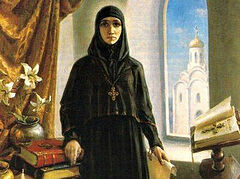
 Abbess Joanna
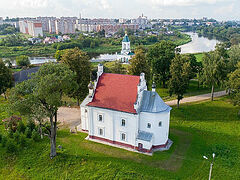
In 2000, the Kazimirovo parish was transformed into a convent and construction on a new wooden church soon began. The current Holy Dormition Church was built in the form of an equal-armed cross. Above the narthex is a tent-roofed bell tower topped with an Orthodox cross. The church was consecrated on August 9, 2002.
Since then, a brick building for the sisters was built on the territory of the monastery and the old priest’s home was renovated and turned into a guest house. Today, there are nine sisters laboring in the monastery, though only two of them are fully tonsured nuns.
Abbess Joanna is only forty-five years old, but already twenty-seven of those years have been spent in monasticism—she was tonsured already in 1990.
The times were different then, as she says, and she didn’t have the opportunity to go through all the stages of spiritual growth: laborer, novice, riassaphore nun… Maybe that’s why she believes you should join a monastery only out of conscious love for God.
The sisters have a large farm to manage. They not only grow vegetables, fruits, grain, and berries, but also take care of the monastery’s cows and goats. The sisters have learned to drive a tractor, which allows them to harvest the crops without outside help.
 Nuns
Nuns
The Kazimirovo Icon of the Mother of God
The monastery’s main sacred treasure is the Kazimirovo Icon of the Mother of God, with which the history of the monastery began in the distant eighteenth century.
The fame of the icon went far beyond the borders of the Grand Duchy of Lithuania, which Kazimirovo belonged to at that time. Starting in 1720, the miracles coming from the holy icon were recorded in a special book kept in the monastery library.
Among the special help provided by the Mother of God through the icon is assistance in childbirth. Women who were afraid of giving birth would come to Kazimirovo. After fervent, sincere prayer, their labor was easy and passed without complications. Today, as in ancient times, pilgrims come to the monastery entreating the Theotokos for easy childbearing or for the gift of children.
During the hard times of the twentieth century, the book listing the miracles was lost, and the icon itself was considered lost in 1933 when the church was destroyed and ravaged and the priest was shot.
However, in 2000, it was revealed that the icon had been wondrously preserved. It turns out that the miraculous image had been kept for nearly seventy years by the family of Anna Vasilievna Veis, a resident of Kazimirovo, who, before her death, bequeathed to her son to return the icon to the church, which he did.
The monastery prays an akathist to the Mother of God before the holy icon every Wednesday morning.
 Kazimirovo Icon of the Mother of God
The monastery celebrates its patronal feast on August 28, the feast of the Dormition of the Most Holy Theotokos. Many guests come to Kazimirovo on that day. The service is always very festive, with a procession after Liturgy.
In the nineteenth century, the patronal feast was accompanied by a market fair that was well known throughout the whole region. There’s no market today, but if you’ve never been to this incredibly beautiful and blessed place, it’s worth visiting on August 28. If you do, you’ll definitely want to return.
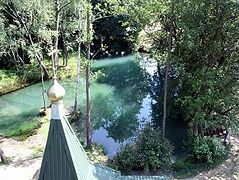
Located in a picturesque area, Kazimirovo Monastery is quite conducive to peace and prayer. And the walls of the monastery, painted by the nuns themselves, are memorable for their beauty.
 Wooden church in Kazimirovo