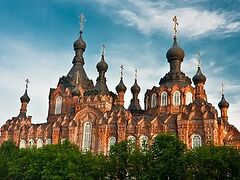
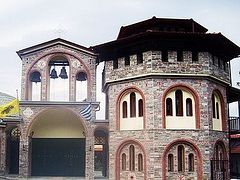
The Kazan-St. Ambrose Hermitage (Shamordino) is a convent less than ten miles from Optina Hermitage, founded with the blessing of St. Ambrose of Optina.
 shamordino-m.ru
The Shamordino estate between Kaluga and Kozelsk was originally acquired by a spiritual daughter of St. Ambrose, Mother Ambrosia (Klyuchareva). According to her will, in 1884, a women’s community was established there with a house church in honor of the Kazan Icon of the Mother of God. The Elder, who long desired to found a women’s monastery, interceded for the appointment of the first abbess there—Sophia Bolotova, his spiritual daughter whom he tonsured in monasticism with the same name. The first inhabitants were widows and orphans, whom the Elder especially cared for. The community was officially opened on October 1/14, 1884, on the day the house church was consecrated.
 Mother Ambrosia (Klyuchareva) Mother Sophia wasn’t in charge of the community very long—just three years. But for the inhabitants and those who knew her personally, she left a significant mark. Bishop Tryphon (Turkestanov), another spiritual child of Elder Ambrose, wrote:
The first abbess, Mother Sophia, inherited a modest estate: a wooden building with a house church and several wooden huts for the sisters to live in. That’s all! There was no money, no property, no supplies of any kind, and yet the population of the community was increasing every day. The Elder sent many healthy and strong girls who were capable of working to the monastery, but no less (if not more) women who were sick, paralyzed, and unable to do any kind of work. The population of Shamordino kept increasing while the means of subsistence kept decreasing. But the abbess of Shamordino, Mother Sophia, wasn’t the kind to be troubled and discouraged by these difficulties. Of imposing appearance, with a firm character, fervent faith in God, and deep submission to the Elder, she could endure everything for the glory of God and for the benefit of the monastery entrusted to her.
Mother Sophia enjoyed the love and trust of the sisters and had didactic conversations with them. In particular, she taught them not to speak ill of anyone: “We have no right to do this because it’s contrary to love, and also because we can’t ever know what’s happening in the soul of another. Perhaps before we’ve even had time to think ill of someone, he’s already offered pure-hearted repentance and has been forgiven by God.”
She also said: “A good monk is no different in his manners from the most well-bred aristocrat. But there is a difference between them, and a significant one: The aristocrat conducts himself with tact out of propriety, while the exemplary monk does so out of conviction and love for his fellow man.” Monasticism for her was first of all a feat of love for God and man. As the Optina Elder Anatoly (Zertsalov) said of her: “It’s difficult to acquire such trust as they have in her. Sometimes I tell one of them to do something, and they tell me: ‘I’ll ask Mother about it, and whatever she blesses’.” Mother used to say about Elder Anatoly: “He’s not a father, but a gentle mother for his children.” This Elder assumed partial spiritual leadership over the nuns dur to Elder Ambrose’s frail condition.
 Schemanun Sophia (Bolotova) Under the first abbess, an almshouse, cells for the sisters, wooden chapels, workshops, and an elementary school where the sisters taught were built in the monastery. A nursery and an orphanage were also set up. Regarding the orphanage and nursery, Elder Ambrose exclaimed: “Oh, how wonderfully you’ve thought this up, Mother. How this pleases me!”
Mother Sophia showed the sisters an example of obedience, humility, non-acquisitiveness, and love. Due to a serious illness, the Elder tonsured her into the great schema. The ascetic spent the last months of her life in solitude and prayer in a separate house. She reposed in 1888 at the age of forty-two. After her death, the Elder told one of the sisters: “Remember, Mother Sophia was a saint!” Mother Sophia (Bolotova) has since been glorified among the locally venerated saints of Tula.
The next abbess was another spiritual daughter of the Elder, Mother Evphrosynia (Rozova), his faithful novice, distinguished by her gentle nature, humility, and asceticism. While Elder Ambrose was still alive, he would visit Shamordino Monastery to the great joy of the sisters. In October 1891, this Optina luminary reposed there, and the spiritual care of the nuns fell to the Optina Elders Joseph (Litovkin) and Anatoly (Zertsalov). The latter said: “I’ll never leave Shamordino and my spiritual children. The Elder gave me an obedience and I can’t refuse.” But Fr. Anatoly died soon after, and difficult times came for the sisters. At that moment, by the grace of God, a patron appeared for the monastery, the spiritual son of Elder Ambrose S. V. Perlov, who supported the sisters in their material needs and built them a hospital. Under his care, a stone cathedral was erected in the monastery in honor of the Kazan Icon of the Mother of God.
In 1901, the Shamordino community received the status of a cenobitic monastery. In 1904, Mother Evphrosynia, “a humble disciple of the Elder, submissive, ready for anything,” as the sisters said of her, reposed. She was buried on the territory of the monastery next to her holy predecessor, Schemanun Sophia.
With the blessing of Elder Joseph, Mother Ekaterina (Sambikina) became the new abbess, under whom there were about 800 nuns. Elder Ambrose’s spiritual son S. V. Perlov continued to help the monastery. He was always very modest, never took a place of honor in the church, and shared with his relatives: “Since I began helping the nuns, my business has flourished like never before. I know that the Lord blessed me for them.” After his death, he was buried in Shamordino. In 1911, Mother Ekaterina departed to the Lord, having accepted the schema before her death. Elder Joseph reposed in the same year, having first appointed the new abbess—Mother Valentina (Rozantseva).
 Schema-Abbess Valentina (Rozantseva) According to the recollections of a priest who knew Mother Valentina, she
came from a merchant family and spoke the purest Kaluga dialect. Even before coming to the monastery, she received a secret tonsure, because she couldn’t openly join a monastery due to family circumstances. She was an example of humility, meekness, and fervent prayer for all. With a comely face and kind, dark eyes, quiet and modest, entirely enveloped in the black covering of monastic garments, she involuntarily won the hearts of all those who got to know her.
Mother Valentina taught the nuns: “Show mercy and you’ll be saved. Be sober, and you’ll receive mercy.” She advised them to always read the Patericon. Her time as abbess coincided with the years of turmoil. By 1917, Shamordino was a large spiritual center with its hospital, almshouse, and several sketes.
In 1918, the “Decree On the Seizure of Church Property” was issued. It was decided to transform the monastery into a labor commune. But the soviet authorities interfered in the work of the commune, preventing the sisters from leading their usual monastic lifestyle and managing the monastery’s operations. In these difficult conditions, Mother Valentina bore the abbatial cross patiently. In 1919, she accepted the schema and died from a serious illness. It was no longer possible to appoint a new abbess at that time. In 1922, the “Decree on the Seizure of Church Valuables” followed. The sisters tried to save the monastery’s sacred items. The government established a commission to liquidate the monastery. In March 1923, the inhabitants were informed of its closure.
Arrests, exiles, and shootings began for the Shamordino sisters. Some of them were taken to Solovki and subsequently tortured. The monastery was ravaged by atheists. The surviving nuns were settled in Kozelsk, closer to the persecuted elders from Optina. Thus, St. Nikon (Belyaev) spiritually guided some of the Shamordino sisters until his death.
During World War II, a military hospital was located on the territory of the ruined monastery. The medics noted the special tranquility of this place. In the post-war years, the soviet authorities opened an agricultural technical school there. The monastery was reduced to ruins over the course of the decades of atheism. In 1988, Elder Ambrose of Optina was numbered among the saints. Two years later, the abbot of the resurgent Optina Monastery began to petition for the restoration of Shamordino Monastery.
In May 1990, the monastery was transferred to the Russian Orthodox Church. Its restoration gradually began under the leadership of Abbess Nikona (Peretyagina). The Kazan Cathedral stood without domes or windows and trees were growing on the rusted roof. Desolation reigned throughout the monastery grounds. The outbuildings were in disrepair. There were families living in the monastic cells, who had to be resettled. The sisters huddled in rooms where there was no water or heating. They slept very little. They prayed a lot and, hoping in the mercy of God, labored tirelessly. The first thing Mother did was to arrange the prayer life of the monastery. At that time, Schemanun Seraphima (Bobkova), a spiritual child of St. Nikon Optina, was living at the monastery. She supported the sisters with prayer, her example of genuine monasticism, spiritual comfort, and stories of old Shamordino. Mother reposed at the age of 105.

Over time, the Kazan Cathedral was cleared, flower beds were planted, workshops were opened, and the convent’s operation were restored. One handmaiden of God brought the cell cross of Elder Ambrose to the monastery, which she had kept in secret for many years. During the clearing of the crypts of former inhabitants, those present sensed an unearthly fragrance. Priestly duties were performed by hieromonks from nearby Optina Hermitage. In 1996, a new church in honor of St. Ambrose of Optina was consecrated in the convent. A year later, Bishop Alexei (Frolov) served the monastic tonsure of several new sisters, giving them names in honor of the Optina Elders, who had been glorified as saints by that time. Under Abbess Nikona, the once magnificent convent rose from the ruins. Today, more than a hundred sisters labor in the restored monastery under the guidance of Abbess Sergia (Scherbakova). Such is the brief history of the glorious Shamordino Monastery.