In the Name of the Father, and of the Son, and of the Holy Spirit.
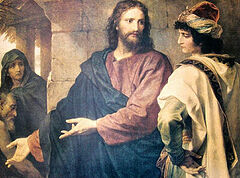
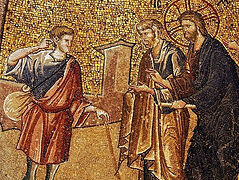
We have just heard the Gospel reading which tells the story of a certain rich young man who comes to Christ. He does not come out of idle curiosity, as some other figures in the Gospels do, nor to witness a miracle. He comes because he is seeking an answer to a very important and painful question that troubles him. The young man is searching for the meaning of life. He is seeking a certain depth, a fullness of existence.
From the brief description of this young man given by the Evangelist Matthew, we can conclude that he was young, successful, and held a certain status in society. But something was missing. And it is for that reason that he comes to Christ.
Moreover, this man was not only wealthy and successful—he was also religious. When Christ tells him, “Keep the commandments in order to be saved,” it turns out that the young man has been keeping all of them. So we see that merely following religious prescriptions is not helping this man. As paradoxical as it may sound, we must conclude that religious life, in and of itself, is not capable of solving the problem that stands before this young man. It cannot provide the answers to those deep questions that arise within the human soul.
At a certain point, a person who begins to live a religious life, regardless of tradition, comes to realize that nothing in his life is truly changing. I keep the commandments, I fulfill my prayer rule, I perform certain religious acts, I even go to church—yet nothing in my life is changing on a deep level. There is no radical, fundamental transformation taking place. In a sense, we might say that religion “does not work.” Religion, in the conventional sense of the word, in the way people are used to perceiving it, is useless.
Today’s Gospel tells us how this problem can be resolved. Christ speaks paradoxical words: “Sell all that you have and follow Me.” When we first hear these words, there is a temptation to understand them in a literal—and ultimately incorrect—way. Indeed, it’s easy to think that Christ is saying, “Sell everything you have, give it all away—and go.”
This creates a very naïve, very simplistic, very flat and unattractive picture: You sold everything? Then you’re saved. You kept something for yourself? Well then, sorry—no salvation for you.
But Christ is speaking of something else; in fact, of something entirely different. A rich man cannot enter the Kingdom of God. Who is rich? The one who feels no need for God. The one who believes that everything he has, all that he possesses, belongs solely to him.
“I achieved everything in life on my own”… We often hear such words, and very often we probably think and say the same ourselves. But as long as a person thinks that all he has achieved—wealth, beauty, even a certain righteousness—belongs to him, then, according to the logic of today’s Gospel, that person is on a completely wrong path.
The Apostle Paul, reflecting on the story of the rich young man, says that all who are called, all Christians, must live as though they possess nothing. That is, everything they have does not truly belong to them—they are merely stewards. We simply make use of what God gives us.
Today’s Gospel is a call to recognize our poverty. A poverty not measured by income or lack thereof, but a deep poverty. To understand that, in essence, we possess nothing, and everything we have is a unique and great gift from God—beginning with our very life, the fact of our existence itself. And only in such poverty, only in such—I will not fear the word—humility, can we find the path to the Kingdom of God. The path to that Kingdom where we will receive true, genuine, and eternal riches—the riches of love, the riches of life in God, the riches of life together with one another.
Amen.