This article can be a companion to our post entitled, “The Dormition of the Most Holy Theotokos. A Gallery of Icons.” Many of the icons described here can be found in large format in that gallery.
 The Dormition of the Mother of God. Icon. Early 13th century, Novgorod. State Tretyakov Gallery, Moscow
The Feast of the Dormition of the Most Holy Theotokos is a bright and joyful celebration for every Christian. On the day of the blessed repose of the Mother of God, all humanity gained an Intercessor and Heavenly Protectress, an Advocate before the Lord. The significance of this great feast is reflected in the Church’s typikon: this Marian feast is granted not the usual four days of afterfeast, but eight—equal in duration to one of the greatest feasts of the Lord, the Theophany.[1] It is preceded by a strict fast, which, in terms of ascetical rigor, ranks immediately after Great Lent. Reliable historical records of the Dormition feast begin only from the end of the sixth century. It is commonly held that the feast was established under the Byzantine Emperor Maurice (r. 592–602). Evidently, before this time, the Dormition in Constantinople was a local, rather than a universally observed, feast.[2] Its firm inclusion in the liturgical calendar was aided by the growing veneration of the Theotokos, a devotion which remained unshaken even amid emerging heresies, including Nestorianism.
The Gospels say nothing about the earthly life of the Mother of God after the Ascension of the Savior. Information about Her final days has been preserved in Church tradition. Therefore, the iconographic sources for the Dormition in Byzantium, the Balkans, and early Rus’ were widely circulated apocryphal writings: The Discourse of John the Theologian on the Dormition of the Theotokos, The Discourse of John, Archbishop of Thessalonica, as well as the earliest festal homily on the Dormition by Modestus, Patriarch of Jerusalem († 632), and three homilies by Saints Andrew of Crete, Germanus of Constantinople, and John of Damascus (all from the eighth century). The accounts of the Dormition that have come down to us vary in length and detail.[3]
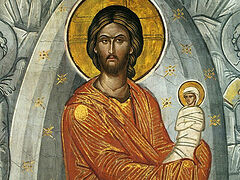
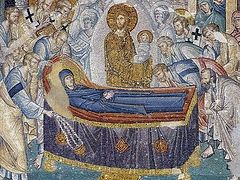
 The Dormition of the Mother of God. Ivory plaque. Late 10th century. Metropolitan Museum of Art, New York The formation of mature Dormition iconography belongs to the post-iconoclastic period. Two ivory plaques from the end of the 10th century—one from the Gospel book of Emperor Otto III (Bavarian State Library, Munich), the other in the Metropolitan Museum of Art, New York—establish the standard composition for the Dormition scene in both Byzantine and Old Russian art (fig. 1). The Theotokos is shown in the center lying upon a bier, the apostles weep on either side, and Christ stands behind the bier holding the soul of His Mother, depicted as a swaddled infant. In some Balkan monuments (e.g., the frescoes of the Ascension Church in the Žiča Monastery, 1309–1316; and the frescoes of the Church of the Theotokos “Hodegetria” in the Peć Patriarchate, c. 1335), the soul of the Theotokos is shown with wings.
 The Dormition of the Mother of God. Icon. First quarter of the 14th century, Pskov. State Tretyakov Gallery, Moscow This composition appears in icon painting from the eleventh century (e.g., an icon from St. Catherine Monastery, Sinai), and from the end of the same century enters the cycle of festal epistylia (festal icons in the templon beam), such as the Deësis, the Twelve Apostles, and Twelve Feasts from the same monastery.
The Dormition of the Theotokos, like the Resurrection of Christ, symbolizes the trampling down of death and the resurrection to the life of the age to come. The images of the Dormition carry rich liturgical interpretation. The bier upon which the Theotokos lies is visibly likened to the altar in a church, while the apostles grouped on either side, led by Peter and Paul, suggest their presence at the Eucharist and reception of the Holy Gifts under both kinds. Christ standing behind the bier is an image of the high priest at the holy table. The depiction of the Apostle Peter with a censer may point to the incensation of the Holy Gifts during the liturgy, while the Apostle John leaning toward the bier resembles the priest reverencing the altar. Often, the scene includes two or four bishops standing with the apostles before the Theotokos. These are saints Dionysius the Areopagite, Hierotheus, Timothy of Ephesus, and James the Brother of the Lord, said by tradition to have been present at the Dormition. They symbolize the bishop communing the priests in the Eucharist. Angels descending in the scene, veiled hands extended toward Christ, resemble deacons in liturgical service.[4] Tradition locates the Dormition in the house of John the Theologian in Jerusalem—in the Upper Room of Zion, where the Descent of the Holy Spirit had also taken place. Architectural settings usually frame the scene.
 The Dormition of the Mother of God. Fresco. Cathedral of the Transfiguration of the Savior of the Mirozhsky Monastery in Pskov. Mid-12th century.
From the eleventh century, a more elaborate iconographic version of the Dormition—known as the “cloud type”—became widespread. In the upper portion of the composition (e.g., the fresco in the Church of St. Sophia in Ohrid, Macedonia), the apostles are shown flying on clouds toward the bier of the Theotokos. According to the Discourse of John the Theologian, the Most Holy Virgin desired to see the apostles before Her repose, and they were miraculously transported by angels from various parts of the world to Jerusalem. The apostles Andrew, Philip, Luke, and Simon the Zealot, it is said, were even raised from the dead for this occasion.
The earliest known example of the “cloud Dormition” in Rus’ is a thirteenth-century icon from the Desyatina Monastery in Novgorod (now in the State Tretyakov Gallery) (fig. 2). In the upper part of the icon, a blue semicircular segment of sky with golden stars shows angels carrying the soul of the Theotokos. A rare and touching iconographic detail is the presence of red slippers at the foot of the bier—a symbol of the Virgin’s departure from earthly life.[5]
Most often, a burning candle or several candles are shown near the bier of the Theotokos, symbolizing prayer to the Lord. On a Pskov icon of the Dormition from the first quarter of the fourteenth century (fig. 3), a jug, or jar (stamna) set in a basin is shown near the bier—a poetic symbol of the Mother of God found in Byzantine and early Russian hymnography.[6] The Theotokos is likened to the golden jar of manna, fashioned at Moses’ command.[7] A closely related iconographic parallel appears in the frescoes of the Transfiguration Cathedral in Pskov (mid-12th century) (fig. 4). In both works, the composition and poses of the apostles are similar, and the scene is flanked by tall buildings in which Jerusalem women are shown weeping. However, in the icon, the apostles lack halos, and the “glory”—the mandorla of Christ—is held aloft by surrounding angels.
In the fifteenth century, icons of the Dormition in Russia commonly featured the miracle of the severing of the hands of the impious Jew Aphonius (or Jephonias) in the foreground near the bier. The popularity of this episode in the 15th–16th centuries may be linked to opposition against heretical movements. The scene first appears in the fresco of the Church of Panagia Mavriotissa in Kastoria (late 12th–early 13th century), and in Old Russian art in the frescoes of the Snetogorsky Monastery and the Church of the Dormition on Volotovo Field.
 The Dormition of the Mother of God. Icon. Circa 1479. Dormition Cathedral of the Moscow Kremlin
Russian icons of the Dormition from the second half of the 15th century—from the Dormition Cathedral of the Moscow Kremlin (c. 1479), from the Kirillo-Belozersky Monastery (1497, now in the Tretyakov Gallery), and from the Dormition Cathedral in Dmitrov (late 15th century, now in the Andrei Rublev Museum)—present a detailed iconographic program. The apostles are depicted journeying on clouds, Jerusalem women weep at the bier, apostles and angels are present, and in the foreground is the scene of Aphonius’ punishment. At the top of the icon, the heavens open, and the Theotokos is raised in “glory” by angels. This detail is interpreted in the Homily on the Dormition by St. Andrew of Crete: “The gates of the heavenly kingdom are lifted up to receive the pre-eternal Door of God.”[8] Analyzing the icon from the Dormition Cathedral (fig. 5), E. Ya. Ostashenko notes the unique design and color of the Theotokos’ mandorla, with no parallels in other monuments.[9] Instead of the traditional blue tones, the outer contours of the “glory” are rendered in two shades of red, and the interior includes a radiant center with short rays. This red coloring and radiant core may be associated with poetic images of the Theotokos, such as the “Woman clothed with the sun” (Rev. 12:1) and the Church arrayed in the “Sun of Righteousness—Christ.”
 The Dormition of the Mother of God. Icon. 15th century, Novgorod. State Russian Museum, Saint Petersburg A notable feature of the 1497 Dormition icon from the Kirillo-Belozersky Monastery is the inclusion of the episode in which the Theotokos entrusts Her cincture to the Apostle Thomas. According to one account, Thomas arrived late, as the Virgin was already ascending to heaven, and She gave him Her cincture as a token. Upon joining the other apostles, he testified to Her heavenly glorification.
Alongside these elaborate iconographic types, a more succinct version of the Dormition image was also widespread. For instance, the Russian Museum holds a fifteenth-century Novgorod icon (fig. 6) with no angels, no flying apostles, and no traditional figures at the bier. The composition is extremely austere; only Christ and two hierarchs are present before the Theotokos. In the upper part are half-figures of St. John the Forerunner and St. Stephen the Archdeacon. This likely reflects either the dedication of the church from which the icon originated or the donor’s wish to include family patron saints in the depiction.
 The Dormition of the Mother of God. Icon. 16th century, Novgorod. State Russian Museum, Saint Petersburg
An interesting iconographic feature is observed in the mid-sixteenth-century icon of the Dormition from the Vladimir-Suzdal Museum-Reserve. Whereas in most of the previously discussed examples Christ is typically depicted frontally, holding the soul of the Theotokos in both hands, in this case, He is shown in profile, blessing the Theotokos who lies on the bier.[10] This detail likely emerged in the “cloud-type” variant of the Dormition in the first half of the sixteenth century and became widespread in the sixteenth–seventeenth centuries. Christ is also shown blessing the Theotokos in a sixteenth-century icon from the Russian Museum (ill. 7). That icon also features the Theotokos being assumed into heaven, seated on a throne, approaching the opened gates of Paradise, beyond which are visible angelic ranks, the Heavenly City (in the form of a cross-shaped tower), and several paradisiacal trees.[11]
 Border scene from the icon The Dormition of the Mother of God, with the Narrative of the Dormition. Late 17th century. Andrei Rublev Central Museum of Ancient Russian Culture and Art, Moscow
In the sixteenth century, the paradise symbolism was also reinforced by placing the Dormition scene within the apse frescoes of churches. For instance, in the decoration of the Archangel Cathedral of the Moscow Kremlin and the Dormition Cathedral in Sviyazhsk, the Dormition was painted above the altar conch,[12] which supports its interpretation as a vision of the heavenly realm, in accordance with the symbolism of the altar as a type of Paradise.
In the seventeenth century, monumental church icons of the Dormition appeared, accompanied by narrative border scenes (kleima) illustrating the full “Account of the Dormition.” For example, in a 1658 icon from the Dormition Cathedral of the Moscow Kremlin, the kleima depict the prayer of the Theotokos before her repose, her farewell to relatives, the journey of the apostles, their dialogue with the Theotokos, and other scenes. The detailed narrative ends with the image of the Theotokos on her bier in the midst of a paradisiacal garden. A similar narrative is found in the kleima of a late seventeenth century icon from the Andrei Rublev Museum (ill. 8). In the final kleima, the Theotokos is depicted lying on a throne, flanked by two burning candles. At her bier stand not only the apostles but also Old Testament righteous ones shown bowing in the lower right corner—among them the prophets David and Daniel. The presence of Old Testament saints, along with the penitent thief holding his cross behind the bier, indicates that the event depicted takes place not on earth but in heaven—in Paradise. Of special note is that this kleima is painted on a white background. Since the earliest days of Christian art, white has symbolized Paradise, as A. N. Ovchinnikov writes: “Any image on a white background should be understood as partaking in Paradise.”[13] Traditionally, white backgrounds are used for scenes such as “The Creation of Adam and Eve,” “The Bosom of Abraham,” “The Meeting of the Penitent Thief with the Prophets Elijah and Enoch in Paradise” (as in icons of the “Descent into Hades”), and “The Sleepless Eye of the Savior.”
The examples discussed here represent only a small fraction of the icons of the Dormition that were venerated and cherished in Rus’. The popularity of the theme was due in part to the fact that many of the main altars of cathedrals in Russian cities (Moscow, Kolomna, Dmitrov, Vladimir), as well as those of ancient monasteries (Kiev Caves Lavra and the Pskov-Caves Monastery), were dedicated to the Dormition of the Most Holy Theotokos.