Archpriest Georgiy Bryeyev Why is it so easy and natural to condemn others, how and why should we fight with condemnation, why doesn’t Christ condemn anyone, and how does all this fit in the context of the Dread Judgment? Foma.ru gathered instructions on this topic from Archpriest Georgiy Bryeyev († 2020). Fr. Georgiy, a well-known Moscow priest and confessor to many other Moscow priests, raised from ruins to thriving parishes two churches in the capital city: the Churches of the Life-Giving Spring in Tsaritsyno district, and of the Nativity of the Theotokos in the Krylatskoye district. He is remembered as a man of great spiritual integrity, and as a beloved father-confessor.
***
If we look inside ourselves and try to see our tendencies, we will easily notice that we already have a developed habit of condemning others.
Clergy, confessing people, very rarely meet a person who could say: “I never condemn anyone”. This is nice to hear, but such a state is likely the exception…
Condemning is an expression of our pride, through which we claim for ourselves the possibility to judge another person. Self-exaltation is a quality of every person and is deeply rooted in each of us. Feelings of smugness and self-worth always warm us from the inside. We think: “He’s so handsome and good, but I’m even better!” and immediately our souls feel warm. Everything pleasant that we hear said about us gladdens us, but if someone says anything against our own opinion of ourselves… he’s in for it! Some even become furious, saying: “What did you say to me?!”A feeling of self-worth can be a strong stimulus for reaching great heights, it is a strong engine! But we know that in fact it works on fleshly, earthly energy. And we know that the Scriptures say, God resisteth the proud… (Jas. 4:6; 1 Pet. 5:5).
We cannot fully overcome feelings of self-love; they are very strong. And if a person does not struggle with them, doesn’t reject them, then, naturally, a demand arises to judge others from the heights of their self-opinion, saying: “I am so high and perfect, but I do not see perfection around me. Therefore, I have the right to make judgments and label others.” And now people are wont to get together, talk, discuss how this one or that one lives. And they themselves don’t notice when they start to condemn others, justifying themselves, saying, “I’m not condemning, I’m just discussing”. But in such discussion there is always a tendency to portray people in gloomy, dark colors.
In this way, we begin to take upon ourselves that which doesn’t belong to us: judgment. And we usually do this not openly, at that. For instance, we look at someone and think to ourselves: “Ah, that person is of such-and-such a kind, built in such a way”. This is a slippery slope and a mistaken opinion!
***
In the holy scriptures there is a very deep expression: For what man knoweth the things of a man, save the spirit of man which is in him? And also: even so the things of God knoweth no man, but the Spirit of God. (1 Cor. 2:11). With this the Lord immediately describes the depth which is characteristic of personality. You cannot know a person completely! Even if you thoroughly study his biography, there will still be mqny hidden things that only he is capable of experiencing and feeling.
If this depth is lacking in our approach to a person, then all of our deliberations are quite superficial. This is why the Lord says directly: And why beholdest thou the mote that is in thy brother’s eye, but perceivest not the beam that is in thine own eye? Either how canst thou say to thy brother, Brother, let me pull out the mote that is in thine eye, when thou thyself beholdest not the beam that is in thine own eye? Thou hypocrite, cast out first the beam out of thine own eye, and then shalt thou see clearly to pull out the mote that is in thy brother’s eye. (Lk. 6:41–42).
From the outside, we can put a person in any light, but only he himself can know himself authentically and deeply—if, of course, he tests himself, if he wants to know himself not only as one of millions, but as God sees him. Because, when we value ourselves in any other way—as other people see us or based on our personal opinion, it seems to us that yes, we are really some kind of special, worthy, and certainly not criminals. Like the pharisee said, “I am not as other men are. I fulfill the Law of God, fast, give tithes.” This naturally “flies out” from us. And bears witness of the fact that we don’t have deep self-knowledge.
***
It seems to me that a person’s knowledge of himself and of God is the key to freedom from condemning others. This freedom is given either by grace or as the result of struggle, internal work. And condemnation happens because we on the one hand do not tend towards deep self-knowledge, and on the other haven’t gotten to the level of repentance.
 foto.ru Looking into oneself is the beginning of a spiritual process. The conscience gives a person knowledge about himself, and when he sees himself, he sometimes even gets to the point of hating, thinking: “I hate myself like this!”. Yes, you have approached self-knowledge. It’s bitter, but this knowledge may be the most important and significant thing in life, because it is the point of departure for repentance, for the possibility of the rebirth of your nous, for a qualitative change of your relationship to yourself and the whole world, and first of all, to your Creator.
Why is it said that there is more rejoicing in heaven over one repentant sinner than over one hundred righteous ones, not needing repentance? Because it is difficult, but necessary to come to this repentance, saying: “It turns out that I am essentially no different from others; my nature is from Adam of old; I am by nature the same as my brother.”
But we don’t want to know ourselves, study ourselves with an inquisitive eye, because this requires the next step, which is the search for the answer to the question: “But from what is this so in me?” The carnal opposes the spiritual; this is the law of inner warfare. This is why people choose a more natural and simple path, as it would seem: looking around, judging others and not yourself. They don’t recognize that they are causing great damage to themselves…
***
When a person sees clearly, he begins to understand that God does not condemn anyone. The Gospel of John says directly: For God so loved the world, that he gave his only begotten Son, that whosoever believeth in him should not perish, but have everlasting life. For God sent not his Son into the world to condemn the world; but that the world through him might be saved. (Jn. 3:16–17) There is an idea connected with the Messiah, that He will be vested with kingly authority and come to judge the peoples, as one having authentic Divine judgment. But here it turns out that God came not to judge us, but to save! This mystery is really amazing, it surprises us! And if God doesn’t judge, then who can judge?
Therefore, condemning is an erroneous attitude of our consciousness, an erroneous idea that we have authority. And if God Himself refuses this authority? The Scriptures say that the Father gives the power of judgment to the Son, and the Son says, “I have not come to judge you.”
But at the same time, the Lord does not hide that there will be a righteous judgment, which, like Lermontov wrote, “is not bought with the ringing of gold.” God will reveal Himself, and in this revelation, all of creation will see itself as it is. Now the Lord hides Himself because of our weakness and our imperfection, but when the full revelation of God comes, then there will be nothing left to hide. The books of conscience will be opened, all secrets will be revealed, and people will answer for every word. And this is what the Lord says: He that rejecteth me, and receiveth not my words, hath one that judgeth him: the word that I have spoken, the same shall judge him in the last day (Jn. 12:48). He shows that our idea of judgment as of some kind of extraordinary, super-personal, authoritative proceeding—as in our earthly courts, when an entire panel of judges gathers, examines huge volumes of the case and makes a decision—is not entirely correct. God does not make the decision. He gives freedom, He always gives a person the opportunity to improve: step away from the unhealthy norms that bring joy neither to you, nor to those around you. In this way, a person is free to choose until the end.
They say that being judged by human judgment is a hard fate, because people can be very cruel in their judgments, fundamentally cruel. They pass judgment on you, and that’s it, just try to change yourself in the eyes of society! But God’s judgment is merciful, because the Lord wants to justify a person: I have no pleasure in the death of the wicked; but that the wicked turn from his way and live (Ezekiel 33:11).
***
There’s a fine line between judging actions and judging a person, and it’s hard not to cross it! For it is said: don’t condemn the person himself, as the image and likeness of God. The Holy Spirit does not accept it when we take for ourselves the authority to make a harsh assessment of another. Yes, maybe his foolish, disgraceful action is worthy of condemnation, but don’t condemn the person himself! Tomorrow, he may correct himself, walk the path of repentance, change; that potential is not taken from a person until his last breath. We don’t know the fullness of God’s Providence for him, nor how dear he is to God—for Christ poured out His blood for all of us, redeemed all and judged no-one. Therefore, we ourselves simply have no right to judge!
Yes, Christ drove the sellers out of the temple with a whip, but that was not judgment, but a willful action directed against lawlessness. In the scripture it is said: The zeal of thine house hath eaten me up (Jn. 2:17). We meet similar examples in the course of our lives. When we see that someone’s actions depart from spirituality and morality, that someone’s actions do much evil to people, then of course you can react, call them to order, pull them back, saying: “What are you doing? Come to your senses! Look at the meaning of your actions.”
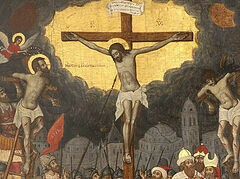
But our fallen nature is such that negative emotions immediately surface in any situation, without any provocation; you just look at a person and you are already measuring and valuing his external worthiness — but you must stop yourself. Judge not, that ye be not judged. For with what judgment ye judge, ye shall be judged: and with what measure ye mete, it shall be measured to you again (Matthew 7:1–2). These words of the Lord should be in our memory at all times and in every place. A great deal of sobriety is necessary here, and also a principled attitude, saying: “No, Lord. You are the only Judge, You are the only Lover of Mankind, You do not wish death unto anyone and did not pronounce judgment on even the most terrible sinners. Even being crucified, You prayed: ‘Father, forgive them, for they know not what they do.’”
***
 Giuseppe Milo
I remember that I had a parishioner, an simple person, who said, “Father, God has mercy on everyone and forgives everyone; I believe that everyone will be saved!” Out of the goodness of her heart she didn’t want to judge anyone and believed that in every person there is something good, which can be learned from. This sort of attitude is achieved through sobriety of spirit, when the soul is filled by true examples, with the Gospel. And everyone who prays every day and reads the Scriptures has a special perception of the world, a certain mood! Those who feel Divine Grace feel the love of God for everyone, and that’s why they don’t want to have any malicious outbursts or wicked feelings towards others.
In this regard, we Christians have a powerful example in highly spiritual people. They loved everybody, pitied them, condemned no-one, and even to the contrary—the weaker a person was, there more visible deficiencies he had, the more attention and love the saints showed to such a person. They valued him highly, because they saw that the truth will get through to them, for they are prepared for it through the difficulty of their lives. But pride, on the contrary, always finds terrible condemnations, which are ready to dehumanize any person.
“Everyone is bad and everything is bad!” This is the spirit of pride, a demonic spirit. This is a narrowing of our heart. It activates a mechanism from which people themselves suffer. All condemnation is the introduction of some kind of darkness into oneself. In the Gospel of John there are these words: He that believeth on him is not condemned: but he that believeth not is condemned already, because he hath not believed in the name of the only begotten Son of God. And this is the condemnation, that light is come into the world, and men loved darkness rather than light, because their deeds were evil. (John 3:18–19). In condemning, a person breaks the spiritual law of life in God and immediately receives a notice that he has sinned gravely. How many times this has happened—someone prays, asks God for mercy, forgiveness, the Lord gives it to him, and the person leaves the service renewed! But then he meets someone on the way back from Church, and condemnation begins: “This person’s this or that way, and he over there is off his rocker!” That’s all it takes. He loses everything that he gained! And many Holy Fathers say that the moment you look at someone wrongly, accept a foolish thought about them, grace leaves you instantly. Grace does not bear condemnation, which is utterly opposed to the gospel spirit.
***
How must we struggle with condemnation? Firstly, John Chrysostom gives this advice: if you sin in thought, repent on the spot, also in thought. Having caught yourself thinking something foolish of your relative or your friend, reply in thought thus: “What is this thought? Why am I thinking this way? Lord, forgive me for this momentary lapse! I don’t want this thought.”
Secondly: When internal feelings provoke you to give a negative evaluation of someone, immediately turn to yourself with the question: Are you free from this deficiency? Or do you know nothing about yourself that you could be rebuked for? And you will feel that you are the same as the one you were ready to condemn!
In ancient times there was also a “golden” rule, that when you struggle with a feeling of resentment and you can’t figure out why some person did some action, put yourself in his position and him in yours, and immediately a great deal will become clear to you! This has a greatly sobering effect. Here I placed myself stood in the position of another, and I say: “O my God! How many troubles he has in his life! He has difficulties with his family, problems with his wife, with the children… Really, how hard it is for the poor guy!”
The Holy Fathers have another rule. Want to condemn someone? Well, put Christ in your place. Would the Lord condemn him? When they crucified Him, Christ condemned no-one, but on the contrary, suffered for everyone. So why am I suddenly counting myself above God, placing myself as a judge?
***
It is possible to avoid condemnation in all situations. Because Man is so constructed that he can always protect the personhood of another, not label him, but immediately take the path of discernment: “I know how wonderful he is, how many hardships he has had, and he got through them all.”
Condemnation is the result of a heart that is “out of tune.” For instance, I meet a person, and instead of joy, I think: “There he is again with a cigarette,” or “He’s drunk again,” or this or that. There are no good motivations for this. On our path, there is the temptation to condemn. You can’t get away from that! But before I let loose a stream of condemning thoughts, I should first put myself in my place and make room for discernment.
I like the words of the modern Greek ascetic, St. Paisios of the Holy Mountain: “Modern Man should be a ‘factory of good thoughts’.” You need to be ready to accept the personality of a person and understand that yes, it’s hard for him, he’s gotten into complicated circumstances, life has broken him; but in any case there is something good and whole in him that grants the possibility of numbering him with orderly, good people. The internal production of such good thoughts—the acceptance of any person in any capacity, no matter how he looks or behaves—is like a protective environment that will not allow you to accept the evil, destructive part of a person into your heart. For, when you characterize your neighbor in a bad light, you destroy him in your soul. A person is a wonderful thing, in and of himself! As one ascetic said, if we only knew how beautiful the human soul is, we would be amazed and would condemn no-one. Because the human soul is truly magnificent. But it reveals itself—as it always happens in our fairy tales—at the last moment…