Hieromonk Silouan (Yaroslavtsev) has been living and serving in Milan for a long time. He has answered some questions on his ministry on Italian soil.

—Father Silouan, please tell us a little about yourself. How did you come to the faith? Were there open churches in your childhood?
—I grew up in the town of Vyshny Volochyok (in the Tver region). In the Soviet era we had a church right in the center of the town. But I don’t remember its doors ever being open or anyone attending services there. And I had no religious relatives. I was interested in the faith, and I bought a Gospel in the early 1990s when it appeared on sale. I was baptized in 1995, after graduating from the institute. As an adult, of course, I wondered how I had come to the faith.
And one day, a pastoral theology teacher at the Moscow Theological Academy told us students a very wise thing: “Don’t think that you are so pious and good and came to the faith on your own. Most likely, you had righteous ancestors in the previous five generations in your families, and they pray for you.” At that time, I immediately remembered that my paternal great-grandfather was a confessor of the faith. He was dispossessed as a “kulak”, went through labor camps, but in the 1950s he still prayed on his knees for half an hour every morning and evening. And quite recently, it emerged that my maternal grandmother was an archpriest’s daughter, and her brother and her sister’s husband were also priests, but she concealed this in order to protect her three children and prevent them from being deprived of their ration cards during the period of famine. She died prematurely at the age of thirty, and we have only now been able to find out and trace it back. That is, it has turned out that I have as many as three relatives in the next older generations who were priests and pray for me.
—How did you end up in Milan? How long have you been living and serving there?
—After the institute, I learned English, won a contest for young professionals, and went to study and work in the UK. Then, after working for some time in an international company, I went to Italy for a long-term project. By that time I already believed in God, but was still not active in the Church. I seriously integrated into Church life in Italy and have been living here for a quarter of a century now. I have been serving as a priest for almost twelve years. Before that, I sang and read in the choir, was a novice, became a monk, and served as a hierodeacon.
—How did you take up the monastic path?
—The Lord calls you to monastic life, but you make the decision yourself. Especially when you realize that you will have to live and serve in the world, because there are no monasteries here and no one will support you. I had before my eyes the example of the rector of our church, Archimandrite Dimitri (Fantini), a native Italian. He used to be a good orthopedic surgeon; he converted to Orthodoxy half a century ago and was ordained forty-five years ago. Father Dimitri became a hieromonk at the age of about forty, and continued to work and serve at the same time for several more years. I realized that with God’s help, all this was possible.
And I have had a similar path. Becoming a monk and a priest is a responsible step. In my case, it was not without the help of Archimandrite Naum (Baiborodin; 1927–2017), a famous elder of the Holy Trinity-St. Sergius Lavra. I understood that God’s will was needed for all this, and I came to him for his blessing for the monastic life. I confessed, and Fr. Naum and I talked at length and in detail about Italy. He blessed me and gave me a breviary (book of needs) and thirty kilograms of books (his cell was filled with stacks of them). That was Fr. Naum’s blessing, which, of course, helped me a lot and still helps me. I am very, very grateful to him. Subsequently, all those books came in handy in my studies.
—In Milan, you serve at the Church of Sts. Sergius of Radonezh, Seraphim of Sarov and Vincent of Saragossa. How did it happen that your church has three Heavenly patrons at once? And why these particular saints?
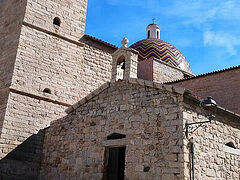
—Father Dimitri (Fantini) has been the rector of our parish since 1985. He has always loved the Russian Church and the Russian saints very much, and even before his conversion to Orthodoxy, in the 1970s, he had been on pilgrimages to Russia a number of times. The first church of our community was in rented premises. He dedicated it to Sts. Sergius and Seraphim as the most important Russian saints. Then we moved to the church where our community now worships. This is a remnant of the Convent of St. Vincent of Saragossa in the center of Milan, which was located on this site from the ninth century. Historically, in Milan, this church has been known as “San Vincenzo”. He is an early Christian martyr of the fourth century. During the previous centuries, it was always the place of St. Vincent, and we did not want to exclude him, so he became one of the patrons of our church. We commemorate him in our parish and we have his icon in the iconostasis. Of course, we also greatly venerate St. Ambrose of Milan. He is the closest Orthodox saint to us; his basilica, where the saint’s relics rest, is very close to our church—about 500 yards away.
 The Church of Sts. Sergius of Radonezh, Seraphim of Sarov and Vincent of Saragossa —Where does your parish serve on St. Ambrose of Milan’s feast?
—It depends. There is a second parish of the Russian Orthodox Church in Milan, dedicated to St. Ambrose. They try to organize the Liturgy at his Basilica of Sant’Ambrogio. But it isn’t always possible. It can be done on weekdays, but it isn’t allowed at weekends. We have an icon and a particle of the saint’s relics, and we serve either there or in our parish.
—Is the skull relic of St. Thecla of Iconium Equal-to-the-Apostles also in Milan?
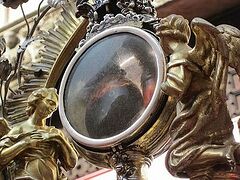
—Yes, at the Milan Cathedral. Sometimes you can read akathists there or just come to pray. Now the cathedral charges an entrance fee. Although you can still enter the chapel with St. Thecla’s skull for free, it is becoming increasingly difficult to arrange a service.
—According to your observations, do the Italians still keep their faith, or are they being increasingly carried away by the material world?
—The old generation is dying out before our eyes. I’ve been observing this for over twenty years now. I arrived in a city where all the stores were closed on Sundays, even including grocery stores. It seems to me that if we call ourselves an Orthodox nation, we could learn from them. So, at that time, everything was closed on Sundays, because for the people it was God’s day, and they were supposed to be in church. And any kind of work was simply forbidden. I remember it perfectly well. But gradually, from the early 2000s onwards, all this began to disappear. And now that generation is dying out, even though many Italians are long-livers. There are fewer and fewer young people in their churches now, and you mostly see these remaining old women who try to go to church for Mass daily. When I start telling them about Orthodoxy, for example, that we have strict obligatory rules of fasting and Confession before Communion, they respond that they remember all this perfectly well from their childhood. Now we are not talking about the differences between our dogmas and the way they understand the sacrament, but the fact is that they, too, prepared for the sacrament strictly and perceived it with reverence until the mid-1960s, prior to the “reforms” of Vatican II. All this is now gone, pushed to the sidelines and forgotten.
—What relations do you have with local Catholics? Do you cross paths somehow?
—Surely, we cross paths. There are, for example, well-established traditions to greet each other on holidays. On St. Ambrose’s Day in Milan, the traditional “speech to the city” by the Archbishop of Milan takes place. Representatives of all the churches are present there. Or a blessing for the coming year on January 1. We are also supposed to come and congratulate them. And we meet on other occasions as well.
—So, everything is going peacefully, and you as Russian Orthodox are not being oppressed?
—Thank God, not yet. But you never know how the situation may develop. There aren’t many Russians in Milan, and I’m the only Russian priest.
—Please tell us about the life of your parish. Who are your parishioners? In what languages do you serve?
—We have very different parishioners. There are many Russians, Ukrainians, Moldovans, Belarusians—and more women than men. Since I am the only Russian priest in the area, some Russians come with their families from other cities and even from Switzerland.
According to statistics, over eighty percent of our compatriots who emigrated to Italy are women. They are mostly married to Italians. Their children are growing up, and their first and last names are often Italian. At the same time, these women pass on their language and faith to their children, have them baptized in Orthodoxy, and bring them to Sunday school. These children usually help us at the altar and read the Epistle. Most of them are bilingual, but Italian is already the main language for them at school and outside the family circle.
As priests, we must know Italian well and preach in Italian to be able to convey our faith. There are quite a few Orthodox native Italians who sought the truth and found it in our Church. These are generally highly educated people, so we need to explain everything to them, communicate with them, and hear their confessions. As a rule, it is also easier for parishioners from Serbia, Romania, Georgia, and Greece to talk and confess in Italian. We even have Orthodox Latin Americans with children.
We serve chiefly in Church Slavonic, but we have litanies in both Italian and Moldovan. We also read the Gospel and Epistle in three languages. These are the major languages in our parish, and everybody understands them. If a person hears his mother tongue in church during services, it is very important for him. By the way, we differ in this, for example, from the Romanian Orthodox Church in Italy. They usually read only in Romanian for their Diaspora and are disinclined to translate anything into Italian—even the Gospel—and many of our compatriots note this. We do not encourage it.
There are not many Orthodox churches in Italy. If the only parish within a radius of sixty miles serves only in Romanian, then the Russians, Ukrainians, and Belarusians simply have nowhere to go, or they feel unwanted at services, so we try to accept everyone from a “linguistic perspective”. I also preach sermons in Russian and Italian. Everybody understands that for sure. These are the specifics of our services.
—Do many people come to your parish on Sundays?
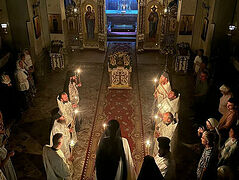
—Yes. For the past few years, we have had to celebrate two Liturgies on Sundays—an early and a late one on an additional altar. This is because previously all who wanted to could not physically fit in our small church, with some people standing on the sidewalk and listening to the Liturgy through the open doors. Around fifty people normally attend each of two Liturgies. We have a Sunday school and lots of children. Of course, there is not enough space, and we celebrate two Liturgies so that those who have prepared and want to receive Communion can always do so.

—You said that there are native Italians among your parishioners. Do you translate any spiritual books into Italian for them?
—Glory be to God, there has been a wave of interest in Orthodoxy among Roman Catholics in recent years. So, quite a lot has been published in Italian about Russian Orthodox saints; many spiritual books have been translated, including, for instance, Everyday Saints and Other Stories by Metropolitan Tikhon (Shevkunov). You can also find subject matter on the internet. In addition, our Italian priests have done a great deal over the past thirty to forty years. There are translated texts of services, and all the services of need, etc. If only it is in demand. And there is no big problem with it right now.
—What is the situation with monastics in your area?
—Our Archimandrite Dimitri has always dreamed of setting up a monastic community where he could serve. We don’t have a full-fledged monastery, but we have managed to found a small community, a skete in a picturesque place, on a lake amid the mountains, closer to Switzerland. The place is very beautiful; we bought the premises and made a small skete with a church. Father Dimitri now serves and lives there permanently, together with a novice and a nun. Due to his age, it is already rather hard for him to pastor a vibrant parish. The second priest and I are trying to take on the main stream of people in Milan and the surroundings. The second nun of our parish helps us in church.
An Orthodox monastery—like in Russia, with a daily liturgical life according to the rule—is unlikely to be found anywhere in Italy today. There is no such thing yet, but we hope, with God’s help, that someday there will be a sufficient number of monks here, the opportunity to pastor them and organize a full-fledged monastery.
—Father Silouan, do you manage to visit Schema-Archimandrite Gabriel (Bunge) in Switzerland? Please tell us about him.
—Yes, of course. We try not to visit him with the whole parish all together—he asks for it himself. After all, he lives in seclusion. But sometimes he invites me, and I always come with great joy. Father Gabriel longed to withdraw from the world by living in a remote place. And you have to make an appointment with him—he has every day scheduled by the hour. This situation has been going on for years, because so many people come to him from all over Europe: pilgrims, those who want to speak and ask for his spiritual advice and blessing, and the simply curious. Sometimes I humanly feel sorry for him because he is an ascetic. Father Gabriel also needs privacy and prayer, so we try not to intrude upon him.
 With Schema-Archimandrite Gabriel (Bunge; far right)
He suffered much in order to build his monastery and church. Fr. Gabriel used to be a Catholic monk at a Belgian monastery. And adopting Orthodoxy was a huge problem for him. For many years he could not openly tell his superiors about this, and he revealed it at the very last moment, having prepared everything fifteen years ago, when he was past his prime. He acquired Orthodoxy through much suffering. Orthodox monasteries in Europe are few and far between. Thus, Orthodox Europeans are attracted to him and gather around him. He lived alone for a long time, but now there are five monks in his skete: French, Germans, and Swiss. He’s German himself. Father Gabriel speaks many languages fluently and gives spiritual guidance to people from different countries. People are drawn to him and see the truth of Orthodoxy. Many become Orthodox only thanks to his example. He is certainly a very spiritual and kind person who helps many people. For Western Europeans, it is often easier to discuss some things with him because of his mentality than with us, Russian clergy. And this is his great role for the whole of Orthodoxy in Western Europe.
—In conclusion, what would you wish our readers?
—It is necessary to preserve Orthodoxy, to be heedful to spiritual instructions of the elders and confessors of the faith. I would strongly advise all parishioners to appreciate all this. Because we often look for something new and interesting “on the side”, but “we don’t cherish what we have and cry after losing it”, as a Russian saying goes. It often happens that way. And in addition to cherishing it, we must be able to transmit this spirit to others in our earthly lives, as stated in the Gospel: Ye are the light of the world. A city that is set on an hill cannot be hid. Neither do men light a candle, and put it under a bushel, but on a candlestick; and it giveth light unto all that are in the house (Mt. 5:14–15).
—Thank you, Father Silouan!