Why is this great mystery from God and this cruel death given to us? It is the only path of death for all—without any crossroads—from which we cannot turn either to the right or to the left; the common bitter cup of death, which none can refuse, and the judgment of God, which comes upon all. For it is the impartial sword of God: death does not fear kings, does not spare the elderly, does not avoid the warrior, does not pity refinement, does not grieve for beauty, is not moved by tears, guards not the young, and has no compassion for infants—but strikes all alike.
We walk a single path from which no wealth can ransom us. Today I am alive—and tomorrow it will be as though I never existed; today I am honored among friends—tomorrow, I lie in a dishonored grave; today we anoint ourselves with fragrant oils—tomorrow, we stink; today we live in luxury—and tomorrow, we are led to the grave in tears.
All is vanity in human life—like a withered flower, like a fleeting and deceitful dream, it passes. What earthly glory remains unchanging? In a single moment, death takes it all away. Alas—it is said—how great is the sorrow the soul experiences when it is separated from the body! It stretches out its hands to the angel of God and pleads to be delivered from the dark adversary; it reaches out in supplication to its companions—it has now understood its end.
And in that hour, neither father helps son, nor mother helps daughter, nor brother helps brother. The soul looks tenderly and lovingly at all, knowing now that it is about to return to the earth. For human life is smoke, a vapor, ash, and dust. Man appears for a short time, and soon perishes.
Where now is passing glory? Where is the gold and silver that cannot help us? Where are the weapons and adorned horses? Truly, there is nothing beautiful or good in this life; for on the day of death, all is neglected, all is despised, all is corruptible, all vanishes; for none of it can be exchanged for one’s soul.
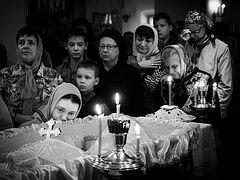
And so, when the soul is separated from the body, it is a dreadful mystery, a terrifying sight to all who witness it. The soul departs in weeping, while the body is covered and given to the earth. The dead lie in the grave, blackened, decayed, falling apart, and stinking.
Let us be convinced, then, brethren, that there is no benefit in bodily beauty or facial charm, for all of it changes and becomes vile. The glory of all earthly things quickly fades, hope vanishes like smoke, the beauty of the face is destroyed, the eyes grow dim, hearing fails, the mouth closes, hands and feet wither—and we are given over to the grave.
Truly, all is vanity! Therefore, seeing this, brethren, let us endure with thanksgiving, for all things come from God. Death is rest for the righteous man (cf. Job 3:23).
Let us not consider those who depart to God as perished. The righteous God, seeing that they do righteousness, gives them rest in righteousness.
Rather, let us count as truly perishing those who were never illumined by holy Baptism, and those who, in self-deception, committed unrighteousness, gathering sins to themselves, who perished while still on the earth.
From: Venerable Job, Abbot of Pochaev: Life, Teachings, Akathist. 3rd edition, revised. (Pochaev Press, 2001).