“Who would have thought that the Kurdissa Icon of the Mother of God would be painted by a Russian, the prayer service composed by a Greek and an American, and that its first veneration would take place among Orthodox Christians in the United States?” wonders Hieromonk Madai (Maamdi), an ethnic Kurd. It was through his efforts that the “Kurdissa” icon of the Mother of God, with inscriptions in the Kurdish language—came into being.
Fr. Madai spoke in an interview about the creation of the image, the national identity of baptized Kurds, and the future of Orthodoxy among his people.
 Kurdissa icon
“I myself grew up in a Yezidi family where the Mother of God was venerated”
—Father Madai, how did the idea of creating the Kurdissa Icon of the Mother of God come about?
—The choice was obvious: through the veneration of the Mother of God, we draw closer to Her Son, the Savior of humanity.
—How did it happen that the first icon with national Kurdish elements is that of the Mother of God and not of Christ?
—It happened naturally that the “Kurdissa” icon was created first; it was not a deliberate decision. However, we must understand that everything in Christianity and Christian art leads us to Christ God. The Mother of God is the primary guide to Christ.
The Church has venerated Her since the earliest centuries of Christianity. Her icons were already present in the catacombs of the first Christians, and Her apparitions and miracles are known everywhere—not only among Christians but also among Muslims, Yezidis, and adherents of other faiths.
I myself grew up in a Yezidi family where, despite the traditional rejection of Christianity, the veneration of the Virgin Mary was always present. Even in the homes of sheikhs and pirs, one can find Her Icon.
Among the Yezidis, the Mother of God is often identified with Hatun Farhan—a holy daughter of a Yezidi sheikh. However, the Blessed Virgin Mary has overshadowed her with Her own greatness (Hatun Farhan’s figure has practically been forgotten among the Yezidis). The Mother of our Lord Jesus Christ has become the symbol of motherhood for all times and peoples, embodying supreme humility, love, and devotion.
 Kurdissia icon, the scroll in Kurdish —Why was the decision made to depict Mary alone on this icon, without the Christ Child?
—I chose the Annunciation as the theme for the icon—the moment when the young Virgin was told of the birth of the Son of God. At that moment, She spoke the prophetic words: For behold, from now on all generations will call me blessed (Luke 1:48). And these words have come to pass.
Even in the Quran, She is honored in the 19th surah, where Her righteousness and divine choseness are described (She is the only woman mentioned by name in the Quran). However, only in the Gospel is the true depth of Her mission revealed: to become the Mother of God.
—And this phrase from the Gospel of Luke is written on the icon, correct?
—Yes. In creating this icon, we sought to ensure that Her image and the inscriptions in the Kurdish language would speak to the heart of every Kurd and Yezidi. That She would become a bridge between our culture and the truth of Christ.
—There is an opinion that, on the contrary, by embracing Christianity, Kurds will lose their national identity. What do you think about this?
—This is a myth connected with the tragic experiences of the past: Previously, baptized Kurds often became members of nationalist churches where there was no place for their language and culture—such as the Armenian, Nestorian, and Syrian churches. But in Eastern Orthodoxy, everything is different. The Orthodox Church provides space for every nation and every language.
“Our people have never known such a Mother”
—Is the very person of the Mother of God foreign to Kurdish history and culture?
—Unfortunately, in the past, Christianity was known to our ancestors through Nestorianism, a heretical movement that diminished the person of the Mother of God, calling Her merely the Christ-bearer rather than the Theotokos. Therefore, Her veneration did not take deep root in our historical homeland. Our conversion to the fullness of Orthodox Christianity opens the possibility for the Mother of God to act in our people and our history. But it is important to understand that the Mother of God is not limited to helping only Christians. Even among the Muslims and Yezidis, there are hundreds of examples of the Virgin Mary’s intercession.
—Can you give an example from modern times?
—In 1985, in Damascus, a Kurdish Muslim family had a son born with a face covered with hair. The mother hesitated for a long time, but after an apparition of a mysterious nun who instructed her to bring oil to the Orthodox Saidnaya Monastery, the child’s face was miraculously cleansed. At the place where the oil was spilled on the monastery steps, a radiant imprint of the Mother of God appeared, which became a sacred relic. In this monastery is the miraculous icon of the Theotokos of Saidnaya. Thus, the image of the Virgin Mary was already close to our people in Syria.
—You once said about the writing of the icon of “Kurdissa”: “This is the beginning of the Christian path for the Kurdish people.” What makes you speak of this event in such high terms?
—The Kurdish people today are more divided than ever: political, religious, and national issues have become a chasm that makes it difficult for us to reach out to one another. No political force, no religion, no historical figure has been able to unite us. The image of the Virgin Mary inspires reverence and peace, softening hearts. Like a loving Mother, She has the power to unite Her children, even if they are at odds.
Our people have never known such a Mother who could gather us all under Her protection.
“I Would Have Been Willing to Wait Another Seven Years”
 Iconographer Anna —It is said that the icon took about seven years to complete. Were there any doubts or difficulties along the way?
—The iconographer Anna, who worked on the image of Kurdissa, knows more about these difficulties than anyone else. These years became a time of spiritual and artistic growth for her. And I understand that the wait was worth it. Even if it had taken another seven years, I would have been willing to wait.
—What did you feel when you saw the finished icon for the first time?
—Seeing the first sketches, I felt we were on the right path, but witnessing the completed image was something entirely different.
I was in awe of the greatness of what had been accomplished.
Each time I pray before it or seek blessings for the translation of liturgical texts into Kurdish, I feel its unseen protection. Through Her prayers, the Lord will make the impossible possible for my people.
—Have you heard of any miracles associated with Kurdissa?
—When I lived in a Monastery house in Tulsa, Oklahoma, a Greek-American pilgrim, a church cantor, translator of liturgical texts, and aspiring hymnographer, visited us. He was deeply interested in the Orthodox mission among Kurds and Yezidis and listened attentively to my accounts of our work.
That night, we had a long conversation. He was profoundly moved by our mission and the tragic history of our people. The next morning, he came to me with eyes full of light. He said that during the night, an inspiration had ignited within him to compose a supplicatory canon to Kurdissa. It felt like something more than mere inspiration. What touched me especially was that this canon began to take shape during the Dormition Fast, as if the Mother of God Herself had inspired him. In two weeks, he completed the full text of the supplicatory canon and even wrote several stanzas for Vespers and Matins. His work was continued by Sister Sidonia. She is a unique person! She is a blind American nun who found Orthodoxy after a long spiritual search. She learned the Georgian language, translated the supplicatory canon to St. Nina into English, and is a true expert in church hymnography.
We sent her the supplicatory canon and draft hymns. Despite her blindness, Sister Sidonia made textual corrections that elevated the work to an entirely new level, astonishing even my friend.
I recall a profoundly moving moment when she asked us to describe the icon in detail so she could better understand its essence… How could we describe something to someone who had never seen anything from birth? Yet, our efforts exceeded all expectations; her work on the texts astounded us with its depth. We felt the direct intervention of God in this process. Who would have thought that a Russian would paint the Kurdish Icon of the Mother of God, that a Greek and an American would compose its supplicatory canon, and that its first veneration would take place among Orthodox Christians in the United States!
The Gathering of Orthodox Kurds in Tbilisi
—And when you presented the icon to Orthodox Kurds and Yezidis, what was their reaction? What moment stood out to you the most?
—From the very beginning, when the idea of creating Kurdissa and the Pantocrator Christ icon was born in my heart, I envisioned that these images would become the first icons for our future church, where we would serve in the Kurdish language.
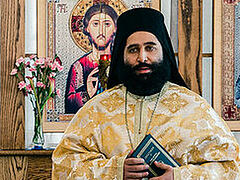
I also believed that they would be blessed by the first ordained ethnic Kurd speaking Kurmanji. This dream seemed distant, but by God’s grace, after fifteen years, it became reality.
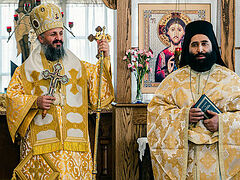
In August 2024, at the Patriarchal Cathedral in Tbilisi, with the participation of more than sixty Orthodox Kurds and Yezidis, I, as a Kurd ordained to the priesthood, translated the supplicatory canon and performed the blessing of this icon and other icons and liturgical items. Many stood before the icon in tears, realizing that this sacred image was connected to their culture, language, and longing for God—something previously unimaginable.
What comes next?
 Kurdissa icon —What other icons are planned?
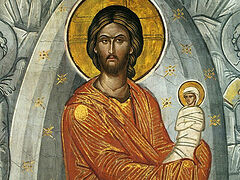
—Our iconographer Anna is completing the image of Christ Pantocrator, who is enthroned upon angels, cherubim, and seraphim. This image symbolizes that Christ is the Lord of the angels, who are but servants of His glory.
Anna and I have a large project in mind, which I can only partially disclose for now—it involves the creation of a grand icon for Orthodox Kurds of the Sorani, Gorani, and other communities in Iraqi Kurdistan. This image will be significant not only spiritually but also culturally.
Furthermore, Georgian artisans are actively participating in this process. They have already created several icons with inscriptions in two Kurdish dialects: Kurmanji and Sorani. Among them are the Icon of Christ the Merciful (Rehîm) and an image of St. John Chrysostom, which will be placed on the first page of his Divine Liturgy, the translation of which into Kurdish I recently completed.
Together with an iconographer, we have also designed a unique “Araratissa” Icon of the Mother of God, the story of which deserves a separate telling.
Romanian artisans are creating for us an icon of St. George, painted on glass, a technique particularly characteristic of Romanian tradition. Greek iconographers, inspired by the story of “Kurdissa,” have expressed a desire to paint several icons for us in their own style.
My friend, an African-American monastic, Brother Seraphim, is completing for us an icon of St. Moses the Ethiopian, where a Kurdish Orthodox cross will be depicted, with inscriptions in both Kurdish dialects.
Georgian artisans have already created nearly twenty enamel icons, which are used for liturgical items. In Moscow, a pious Christian woman is engaged in hand-embroidering the Nativity Icon—a large-scale project that took her over two years just to prepare the pattern. Serbian artists have crafted for us two magnificent mosaics: one depicting Jesus Christ and the other the Mother of God. They are executed in the Orthodox tradition yet bear a unique character that emphasizes the distinctiveness of the work. Each of these projects is part of our effort to establish Orthodox Christianity in the hearts of our people, blending the spiritual heritage of various Orthodox nations.
—How do you see the future of Kurdish Orthodox Christians? What challenges and trials exist today? And what, on the contrary, gives you hope and joy?
—I look to our future with inspiration. We have found God, who does not merely observe us from afar, but cares for His people, dwells among them, and shares in their joys and sufferings. This is a profound connection with the living and loving God.
Every conversion to Christianity is a miracle of its own, each story of baptism is unique and imbued with the divine plan.
We are merely sowing the seeds, but it is God who causes them to grow. This fills us with great hope.
The challenges we face are centered around the question: What comes next? Yes, thousands of Kurds and Yezidis have received Baptism—historically, they are one people, although today they refer to themselves differently—but now we must discern how to build our future life in faith.
—What would you like to say to those who support your mission among the Kurds?
—I express my deepest gratitude to all our fellow laborers and urge them not to stop at what has been accomplished. Your work, your support will never be in vain. You are participating in the work of God, and this is something that no one can take away from you. Every earthly endeavor will eventually come to an end. But the work of God is eternal, it will go before us even when the Lord calls us to Himself.
We are only at the beginning of this journey, merely preparing the soil for future accomplishments. But I am certain that a great future awaits our people. The Lord said: He who is faithful in a very little is faithful also in much (Luke 16:10).
—What guidance would you give to Kurds who will pray before this Icon?
—Every Kurd and Yezidi who stands before the Icon of Kurdissa must remember two things. First, our history—one filled with suffering and loss, in which our people were given neither rest nor help from those whom our ancestors worshipped. They cried out to angels, spirits, and saints, but their pleas remained unanswered. Is it worth clinging to the faith of the forefathers, which left us abandoned and alone?
On the other hand, before us stands the image of the Mother of God, the Mother of the Living God. She is not an abstraction, not a mere idea, but a real Intercessor who has saved those who have turned to Her in faith. Look at the nations that accepted Christ. They have known war, suffering, and genocide, but they have always risen again because they possessed the power of God, they had the Mother of God who interceded for them.
When we pray before this Icon, we must remember: from this moment on, our history is no longer the story of victims who merely endure suffering. It is the story of a people who have found Christ and, through Him, have attained victory.
Our prayer is that before this Icon, future generations will not only receive Baptism but will live in an enlightened and deep faith, knowing that the Mother of God is always with us, and Her Son awaits all who seek the Truth. It is crucial not to lose sight of this path, which leads us to the Triune God, whose Name is Love.