St. John of Kronstadt
In the Gospel reading we heard today, the Lord Jesus Christ compares the Kingdom of Heaven to a certain king who made a wedding feast for his son, and sent forth his servants to call those who were invited to the wedding—and they would not come.
What inattention, what pride, ingratitude, and arrogance! Yet how much condescension and longsuffering the king showed! Again, he sent forth other servants, saying, “Tell those who are invited, behold, I have prepared my dinner, my oxen and my fatlings are killed, and all things are ready: come unto the marriage feast.”
And how did those invited respond to the renewed invitation of their gracious king? But they made light of it, and went their ways, one to his farm, another to his merchandise; and the remnant took his servants, and entreated them spitefully, and slew them.
Now listen to what the king did with these arrogant and ungrateful people. Upon hearing of such brazen insolence from those invited to the wedding, the king was wroth: and he sent forth his armies, and destroyed those murderers, and burned up their city. Then saith he to his servants, “The wedding is ready, but they which were bidden were not worthy. Go ye therefore into the highways, and as many as ye shall find, bid to the marriage.” So those servants went out into the highways, and gathered together all as many as they found, both bad and good: and the wedding was furnished with guests.
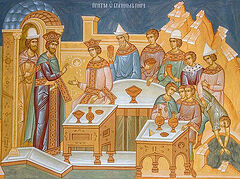
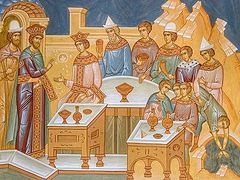
Then the king entered to see the guests, and he saw there a man which had not on a wedding garment. And he saith unto him, “Friend, how camest thou in hither not having a wedding garment?” And he was speechless. Then said the king to the servants, “Bind him hand and foot, and take him away, and cast him into outer darkness; there shall be weeping and gnashing of teeth. For many are called, but few are chosen.” (Matt. 22:2–14)
Here ends today’s Gospel reading.
This story is called a parable, that is, a likeness or a kind of riddle. It must be interpreted. Who is the king who made a wedding feast for his son? It is God the Father, the Creator of heaven and earth, and King of all creation. Who is the king’s son? It is the Only-Begotten Son of God, our Lord Jesus Christ. And His bride is the Church—first of all, the Jewish people, chosen by God, and secondly, the soul of every believing Christian.
It is written: Christ loved the Church and gave Himself for it (Eph. 5:25); and the Apostle Paul says: I have espoused you to one husband, that I may present you as a chaste virgin to Christ (2 Cor. 11:2). The wedding feast symbolizes the Kingdom of Heaven, in which the truly faithful shall be united forever with the Lord Jesus.
To this wedding—or into the Kingdom of Heaven—the Jews were first invited, through the prophets and apostles. But they refused the invitation—and more than that, they insulted the messengers of God and killed many of them. For this, in time, God destroyed the Jewish nation by the sword of the Romans and demolished their city and temple.
In place of the Jews, God invited the Gentile nations—including us, the Russian people—to the wedding feast; that is, into His Church, through the apostles and equal-to-the-apostles.
But not all Gentile Christians, nor the generations of Christians who followed them, will enter Christ’s Kingdom. Those among them who do not keep pure the bright wedding garment of innocence and holiness received at Baptism, or who, having stained it with sins, do not cleanse it with the tears of repentance, shall at the Dread Judgment be cast into outer darkness, where there shall be eternal weeping and gnashing of teeth.
This is the interpretation of the parable we heard! But there may also be another interpretation that is just as true, and one that applies even more directly to us, brothers and sisters.
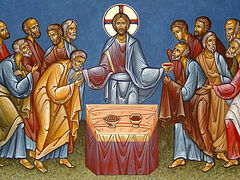
The wedding feast spoken of in today’s Gospel is the Divine Liturgy, at which is offered to the faithful not a fattened calf, but the very Lamb of God, Who was slain as a sacrifice for the salvation of us sinners, that we might be nourished by His most pure Body and Blood, united with Him in the closest of unions, becoming flesh of His flesh and bone of His bones. This is the marriage of the King’s Son: the union of Christian souls with Christ in the Mystery of Holy Communion. This is the feast: the partaking of His Body and Blood—divine, most holy, incorruptible, heavenly, and deifying!
But how many today hasten to this divine feast? Does not the greater part even now neglect this heavenly supper out of carelessness, laziness, or various worldly excuses? For example, on account of business, or because of unbelief and pride, or simply from sleeping too long, and so on? Who does not see this, who does not notice or know it? Such is our unbelief, such is our spiritual dullness, such is our attachment to the world, such is our inattention to the greatest mystery of the faith—the mystery of immortality and deification! Such is the vanity and ingratitude of Christians toward the Lord, Who offers Himself as food and drink for our cleansing, sanctification, and eternal life! And what are such people worthy of? Surely, to be rejected by God, since they themselves have rejected Him throughout almost their entire life.
But even those who do come to this wedding of the Lamb, to the Divine Liturgy—whether to commemorate His life, His preaching, miracles, benefactions, suffering, death, burial, Resurrection, and Ascension into heaven, or to partake of His most pure Body and Blood—do they come in wedding garments? With a pure soul? With a clean heart? Do they come with thoughts fixed on heaven, with a holy disposition?
Or do many come to church, to this bridal chamber of Jesus Christ, with worldly thoughts and passions? And we ourselves, the celebrants of the dread, heavenly, and bloodless Sacrifice—do we always appear in the wedding garment of purity and inner dispassion when we come into the temple and serve in it? Alas! Often we ourselves lack the wedding garment, and lack reverent thoughts and inner attention of the heart. Often we enter clothed in the filthy rags of the passions.
Let us all hasten to repentance, to whiten the garments of our souls with tears of repentance and deeds of righteousness, especially almsgiving, which cleanses sins. I behold Thy bridal chamber, adorned, O my Savior, and I have no wedding garment that I may enter there. Make the robe of my soul to shine, O Giver of Light, and save me.
Amen.